How One 429 Took Down an Agent Chain: Retry, Backoff, and Failover Postmortem
Replay a synthetic 429 retry storm with immediate retries, synchronized exponential backoff, and jitter plus a total budget, then build a safe gateway and agent state machine.
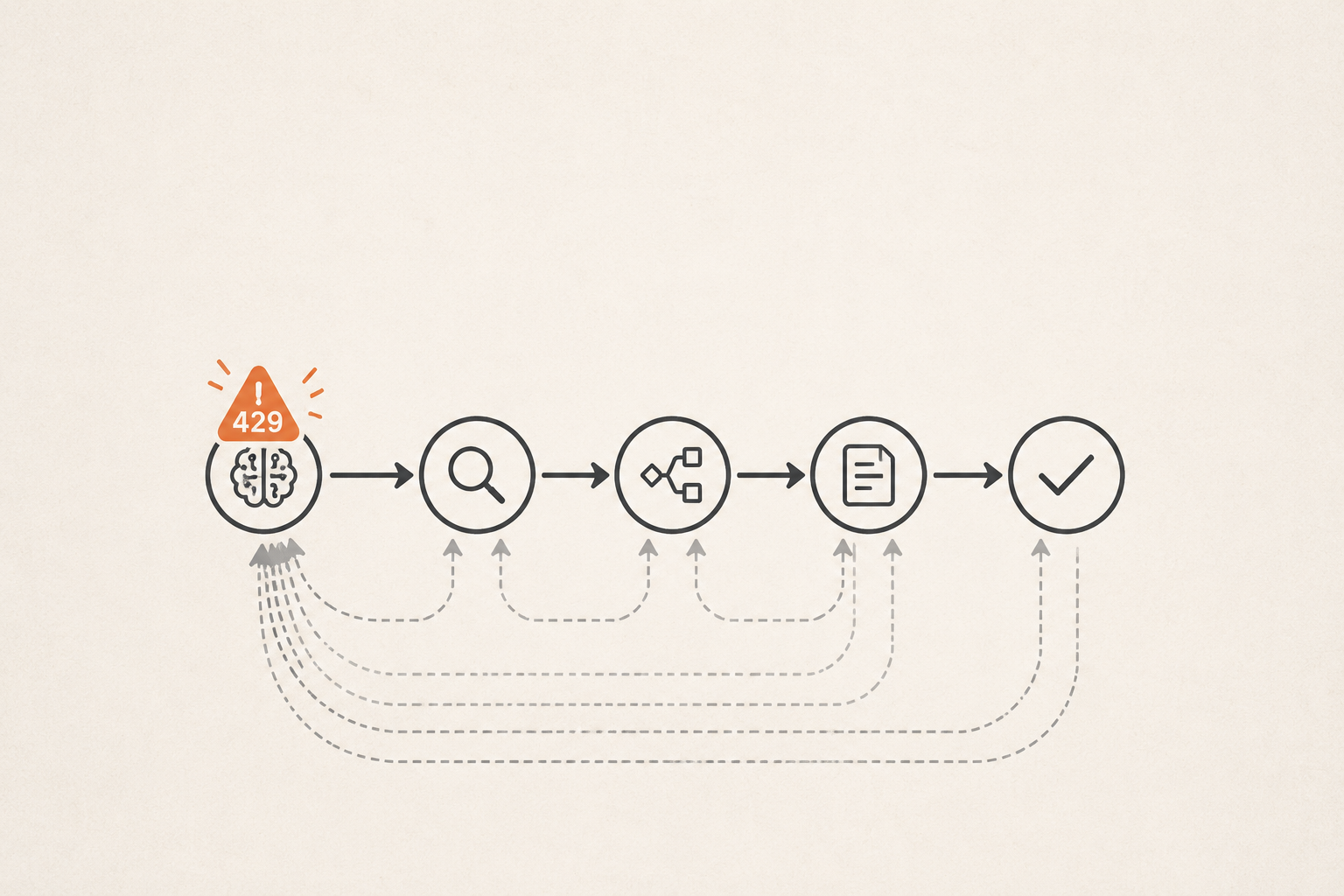
A 429 looks like a single-request problem. In an agent system, it can become a multiplier.
An agent may call a model to plan, invoke a tool, and call the model again to assemble the result. If every layer responds to 429 with “try again immediately,” one user request becomes dozens of upstream attempts. Those attempts keep the rate-limit window saturated while new agent steps add more traffic. The outcome is a retry storm.
This post does more than repeat “use exponential backoff.” It provides:
- a synthetic multi-step agent incident timeline;
- a Python standard-library replay of three retry strategies;
- an auditable state machine for classifying 429, waiting, switching channels, and enforcing a total budget.
Every request count, recovery time, and result comes from a fixed synthetic fixture. No live model API was called. The results do not represent any provider's actual limits, availability, or performance.
How the failure multiplies
Assume one request runs this chain:
user request
  → planning model
  → search tool
  → synthesis model
  → final answer
If each stage allows up to three attempts, the worst case is not three attempts:
3 × 3 × 3 = 27 model or tool calls
That excludes retries by:
- the client SDK;
- the LLM gateway;
- the job queue;
- the user's Retry button;
- parallel agent branches.
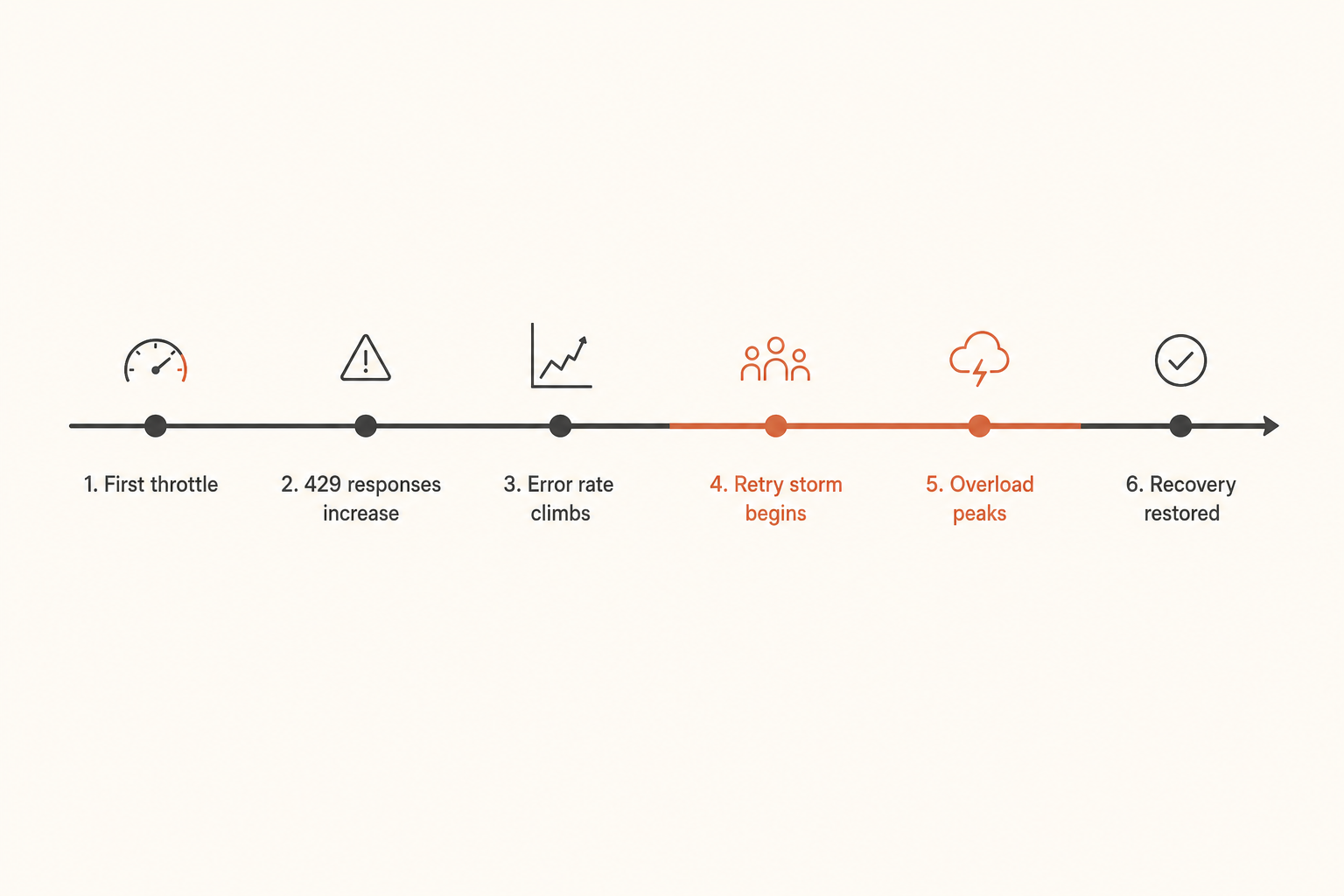
Synthetic incident timeline
This timeline demonstrates the mechanism. It is not a production incident record.
| Time | Event | Bad action | Immediate effect |
|---|---|---|---|
00:00 | 120 agent subrequests arrive | all target one channel | upstream begins returning 429 |
00:00–00:10 | first 429 wave | clients retry immediately | traffic doubles inside one window |
00:10–00:500 | second and third waves | SDK and gateway both retry | the rate bucket stays saturated |
00:500–00:1750 | synchronized exponential backoff | every client uses the same delay | each wake-up creates another spike |
00:2000 | upstream recovers | jittered attempts begin succeeding | part of the agent fleet completes |
00:2500 | total budget expires | remaining retries stop | tail latency becomes bounded |
The important question is not simply whether 429 should be handled. It is which layer owns retries, how many attempts it may make, what deadline it shares, and whether another layer is retrying the same operation.
429 is not one error
OpenAI's current error guide distinguishes at least two common 429 meanings:
- requests are arriving too quickly;
- credits, quota, or monthly spend are exhausted.
The first may recover after waiting. The second is usually not fixed by sleeping for a few hundred milliseconds. Anthropic documents separate request, input-token, and output-token limits and exposes limit, remaining, and reset data in response headers. Google's 429 guidance also distinguishes pay-as-you-go capacity pressure from Provisioned Throughput behavior.
Do not reduce the policy to:
if status == 429:
    retry()
Classify first:
| Result | Retry by default? | Reason |
|---|---|---|
| transient RPM/TPM/concurrency pressure | yes, after a bounded wait | a window may recover |
explicit Retry-After | wait as instructed | do not override server pacing |
| account quota or budget exhausted | no | waiting does not add quota |
| body or context limit exceeded | no, not unchanged | input or model must change |
| invalid request, authentication, permission | no | retries cannot repair configuration |
| safety refusal or unsupported capability | no blind cross-model retry | it may change semantics or expand risk |
The HTTP status is only one signal. A decision also needs error type, response headers, account budget, idempotency, and the remaining deadline.
Offline replay of three strategies
The fixture is fixed:
- 120 clients start at
t=0; - the upstream recovers at
2,000ms; - each client gets at most four attempts;
- collisions use 100ms buckets;
- the total retry budget is
2,500ms; - random seed
107makes the result reproducible.
Only requests at t >= 2,000ms succeed. This does not emulate a provider's internal algorithm. It compares the timing shape of three schedulers.
Strategy A: immediate retry
delay = 0
Result:
- requests:
480 - completed:
0 - completion rate:
0% - peak inside the throttled window:
480 - final attempt:
0ms
The 120 first attempts and all three retries happen at the same instant. The policy converts one 429 wave into a larger 429 wave.
Strategy B: exponential backoff without jitter
delay = 250 × 2^(attempt - 1)
Result:
- requests:
480 - completed:
0 - completion rate:
0% - peak inside the throttled window:
120 - final attempt:
1,750ms
The instantaneous peak is lower, but every client wakes at 250ms, 750ms, and 1,750ms. Synchronized backoff turns one spike into several orderly spikes.
Strategy C: exponential backoff, jitter, and total budget
base = 250 × 2^(attempt - 1)
delay = min(base + random(0, 250), 1500)
A retry is discarded when its scheduled time would exceed the total budget.
Result:
- requests:
480 - completed:
94 - completion rate:
78.3% - peak inside the throttled window:
120 - final attempt:
2,438ms
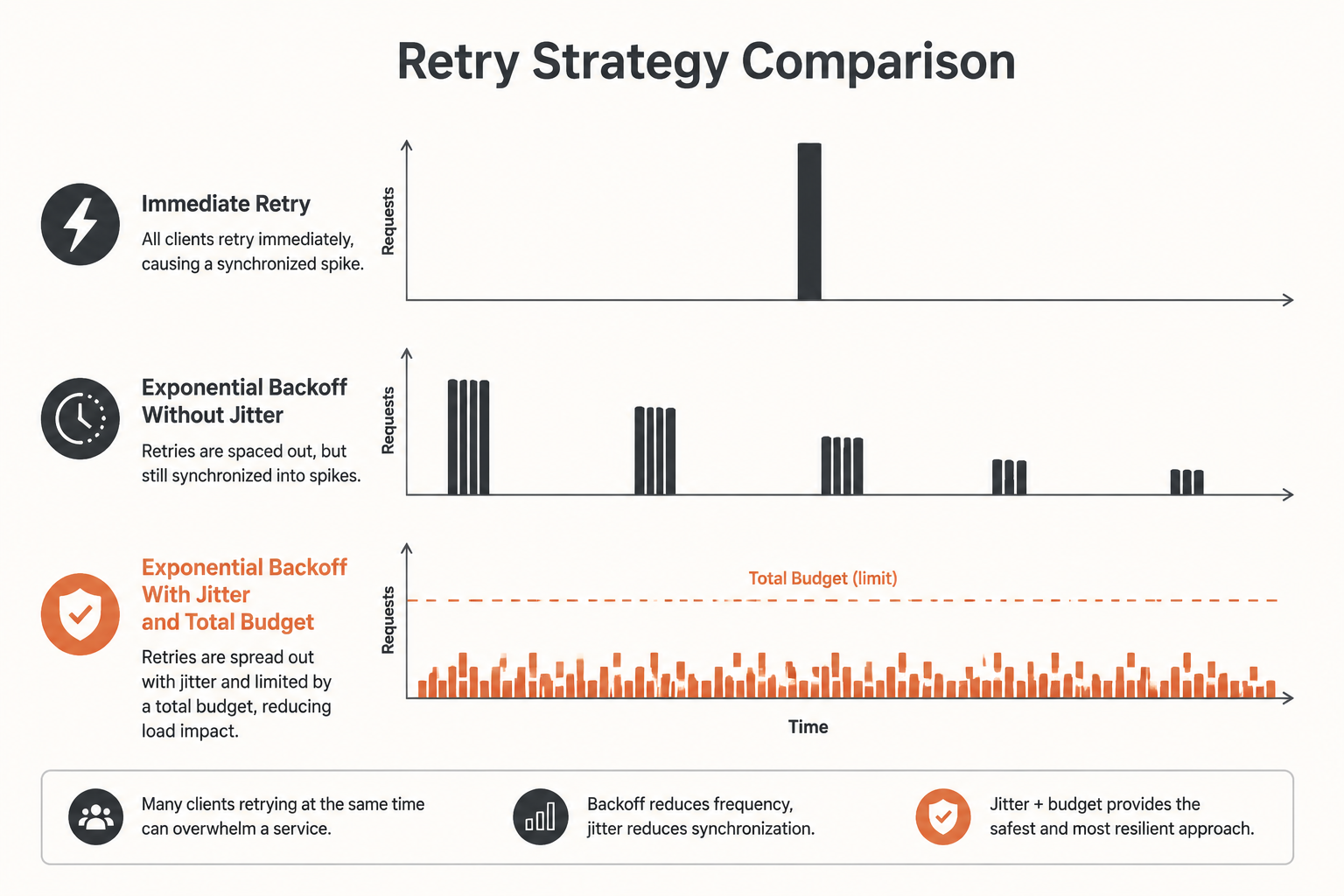
This result does not prove that these delay constants are optimal in production. It demonstrates three reproducible properties:
- immediate retry pins every request to one instant;
- exponential backoff without jitter preserves client synchronization;
- jitter plus a total time budget lets some requests reach the recovery window without unbounded tail latency.
The initial collision is still 120 because all 120 first attempts arrive together. A production system also needs admission control, queues, token buckets, or concurrency limits. Retry policy cannot repair an already overloaded ingress by itself.
Core of the replay
def next_delay(attempt, rng):
    base = 250 * (2 ** (attempt - 1))
    return min(base + rng.randrange(0, 251), 1500)

next_at = current_at + next_delay(attempt, rng)
if next_at <= total_budget_ms:
    schedule(next_at)
The script uses only the Python standard library and makes no network request. The table above is real local execution output, not mental arithmetic.
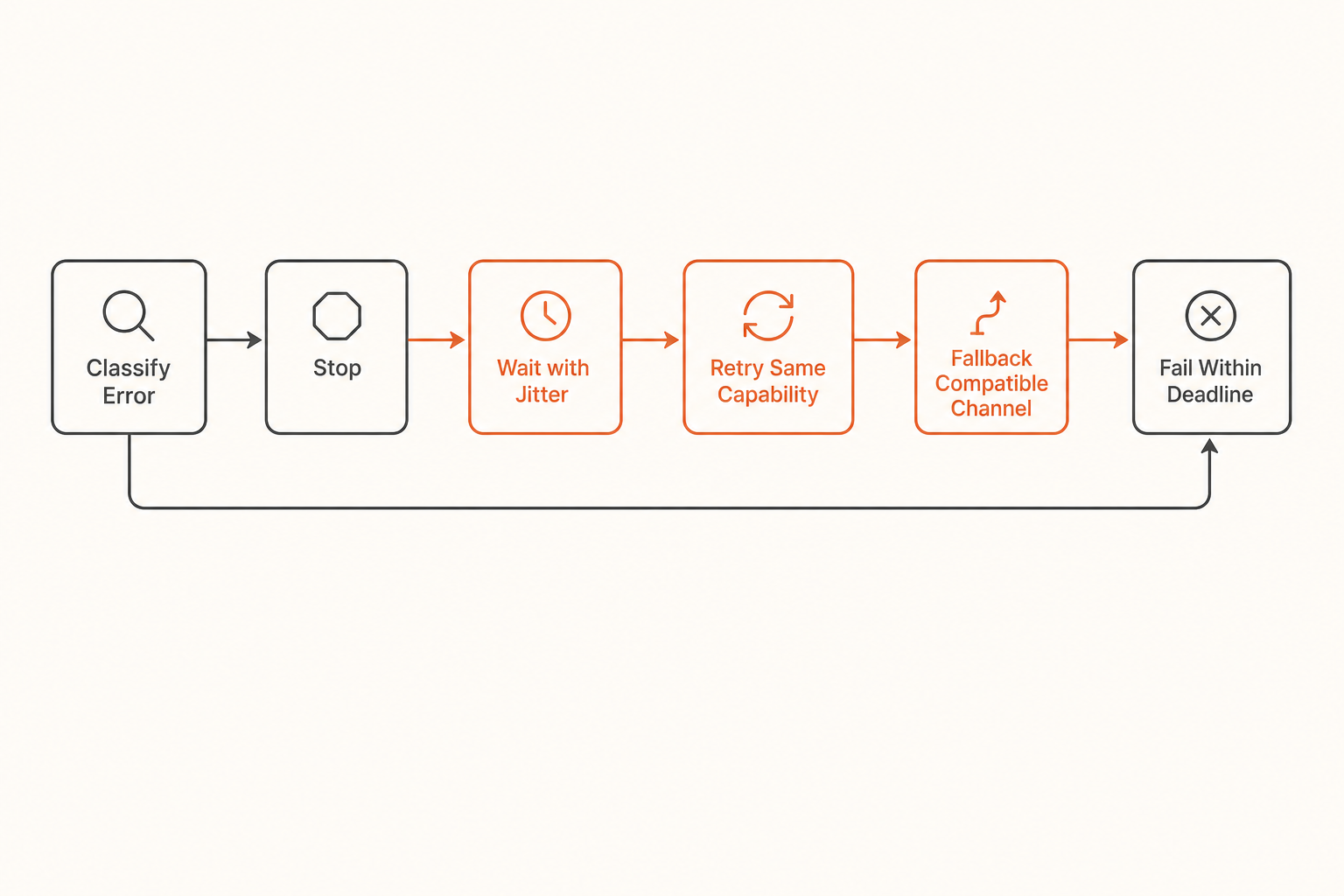
A safe state machine: classify, wait, then switch
A gateway or agent client needs at least these states:
START
  → SEND
  → SUCCESS
  → CLASSIFY_ERROR
       ├─ invalid/auth/permission/safety → FAIL
       ├─ quota/budget exhausted         → FAIL + alert
       ├─ transient 429/5xx/timeout      → WAIT
       └─ stream already started         → STOP transparent replay
  → WAIT_WITH_JITTER
  → CHECK_DEADLINE_AND_BUDGET
       ├─ expired → FAIL
       └─ available → RETRY_SAME_CAPABILITY
  → if deployment unhealthy → FALLBACK_COMPATIBLE_CHANNEL
  → if no safe candidate → FAIL
Why the first fallback should preserve model capability
When the primary channel is temporarily throttled, the lowest-risk alternative is usually:
- the same model;
- equivalent tool support;
- the same context and output guarantees;
- the same region and retention policy;
- another healthy deployment or API key.
Cross-model fallback should happen only when the candidate passes the same hard constraints and the product permits a semantic downgrade. “The cheap model is available” does not mean it is compatible.
LiteLLM's first-party documentation separates fallback after num_retries from balancing deployments under the same model group. That boundary is useful: retry count, cooldown, and cross-model fallback should be recorded separately.
Streaming adds one red line
After the first visible token reaches the client, a gateway cannot safely replay the whole request from the beginning:
- the client may already display partial text;
- tool arguments may be only half assembled;
- repeating a tool can duplicate side effects;
- two generations create duplicate content and ambiguous billing.
A baseline policy is:
- failure before first token: retry or switch a compatible channel within the deadline;
- disconnect after first token: record a partial stream and return a protocol-defined recoverable state;
- tool already executed: require an idempotency key, transaction, or human confirmation; never transparently replay side effects.
What Nbility currently does
In the synchronized /opt/data/nbility code, the main relay loop currently:
- caps attempts with
common.RetryTimes; - selects a channel by group, model, request path, and usage state on each attempt;
- uses priority tiers and weight within a tier;
- evaluates continuation through
shouldRetryandshouldRetryTaskRelay; - supports configurable HTTP status-code retry ranges;
- explicitly excludes special cases such as
504,524, and bad response bodies; - records
use_channeland error details and may disable channels according to policy; - keeps an asynchronous task pending when polling receives 429 instead of immediately marking it failed.
The default HTTP retry range is not “429 only.” Current code includes multiple 1xx, 3xx, selected 4xx, and selected 5xx statuses while excluding 504 and 524. Production operators should tune those rules to upstream semantics and business idempotency instead of assuming that the presence of retry implies complete exponential backoff and jitter.
Boundary: the current main relay loop demonstrates attempt counts, channel selection, status filtering, and error records. The exponential backoff, jitter, total deadline, and admission control used in this article's simulation must not be presented as existing Nbility features.
Plausible-looking mistakes
Mistake 1: every layer retries
The client retries once, the SDK twice, the gateway three times, and the agent step three times. Attempts may combine multiplicatively, not as 1 + 2 + 3 + 3.
Define one retry owner. Other layers should propagate the error and remaining deadline. Traces should record retry attempt, owner, and parent request ID.
Mistake 2: every 429 means temporary congestion
Exhausted credit, account budget, unsupported models, and request-policy limits do not become healthy after a short sleep.
Mistake 3: cross-model fallback ignores capability
A vision request cannot silently fall back to a text-only model. A strict-schema tool call is not compatible merely because the backup returns HTTP 200.
Mistake 4: attempts are capped but time is not
“Three retries” is not a deadline. Long backoffs can hold user and agent concurrency for tens of seconds. Before every attempt, check:
remaining_deadline > estimated_backoff + minimum_attempt_time
Mistake 5: replaying a stream that already started
This creates duplicate text, repeated tool calls, and bills that are difficult to reconcile. Track whether any visible token has been emitted.
Production checklist
- assign one retry owner
- distinguish RPM, TPM, concurrency, credit, and budget failures
- prefer provider
Retry-Afterand rate-limit headers - use exponential backoff with jitter
- enforce both maximum attempts and a total deadline
- limit ingress concurrency before overload reaches the provider
- retry only recoverable failures
- never retry authentication, permission, invalid input, or safety refusal unchanged
- never transparently replay the full stream after visible output
- validate model capability, region, tools, and schema before fallback
- protect tool side effects with idempotency or transactions
- record retry owner, attempt, deadline, channel, and final state
- use cooldown or a circuit breaker to avoid unhealthy channels
- replay fixed fixtures before shadow traffic and a small canary
Conclusion
A 429 incident usually exposes missing retry ownership and failure boundaries, not simply insufficient upstream capacity.
The reliable sequence is:
- classify the exact 429 meaning;
- control admission so new traffic does not deepen overload;
- assign one retry owner;
- respect
Retry-Afterand add jittered backoff; - check total budget and idempotency;
- prefer a healthy channel with the same model, capability, and compliance boundary;
- degrade across models only when explicitly allowed;
- fail clearly when a stream has started or no safe candidate remains.
Nbility already provides a unified endpoint, channel priorities and weights, configurable status retry rules, channel records, and billing boundaries. A complete retry budget, jitter, circuit breaker, and agent-level trace still require implementation and validation in the gateway or caller. Visit Nbility for unified model access, or request a small test credit through the ticket center.