Multi-Model Routing Is Not Random Switching: Balancing Quality, Cost, and Latency
Use three tasks and a runnable offline replay to design constraint-first LLM routing across quality thresholds, cost, TTFT, health, cache affinity, and fallback.
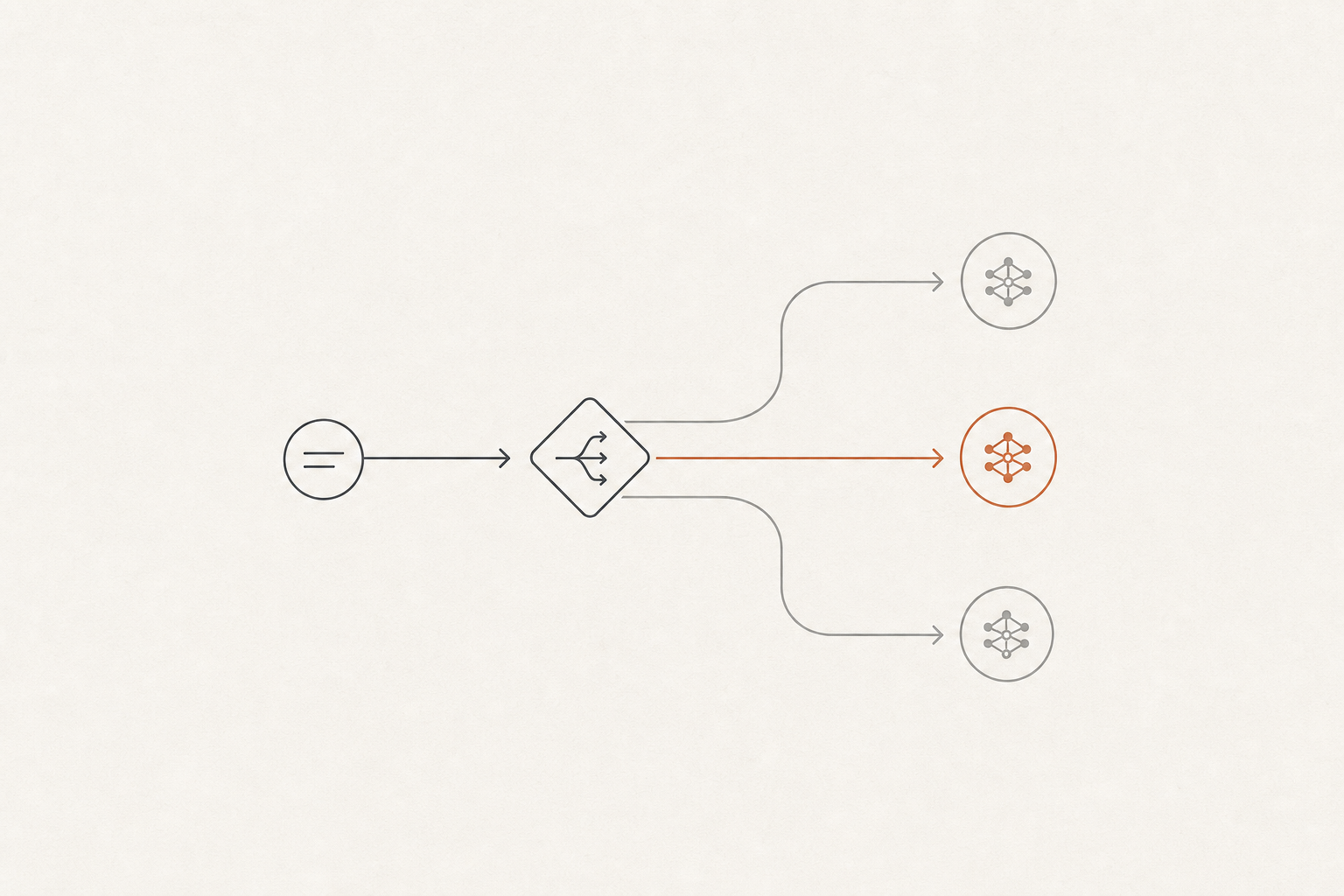
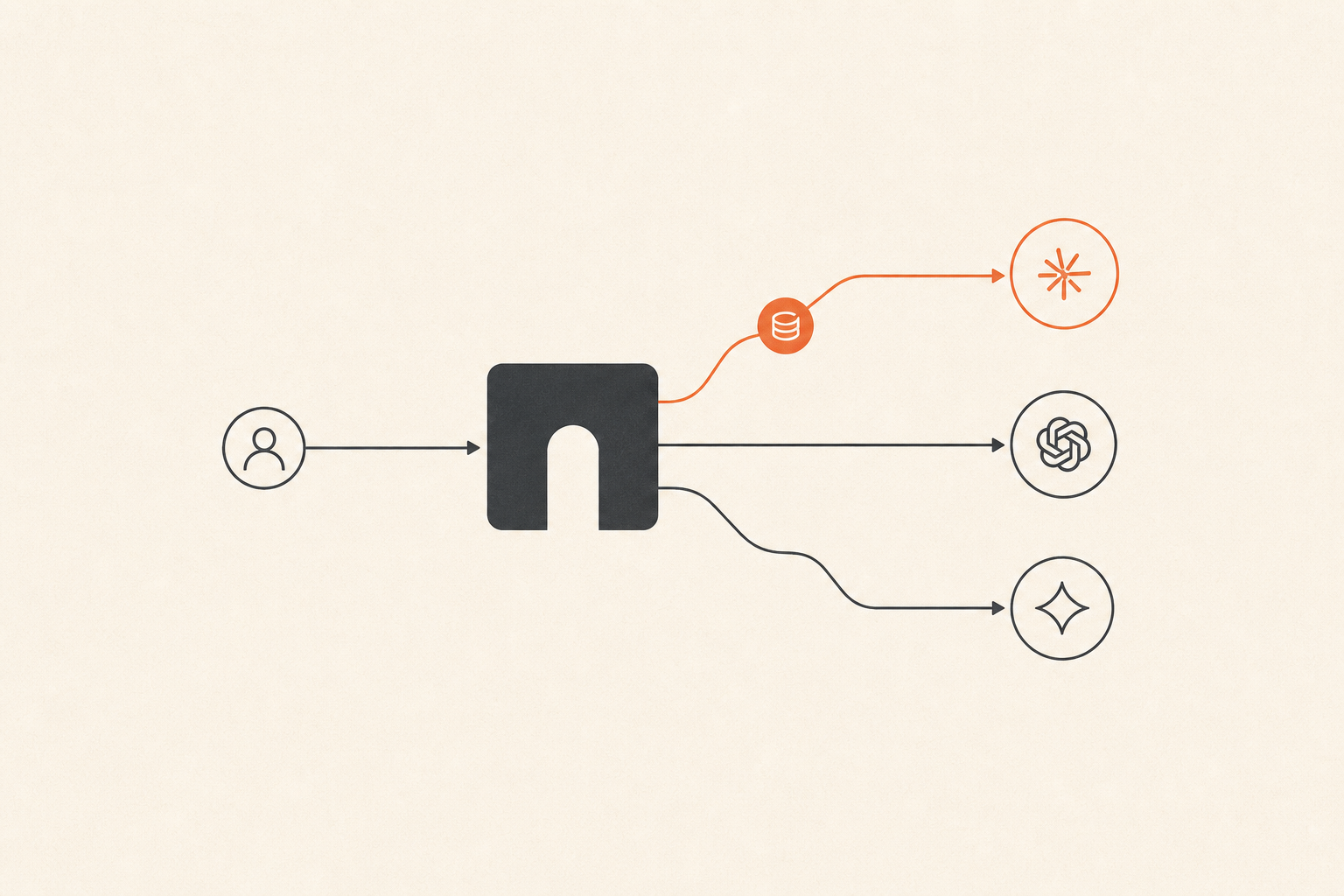
Connecting three models and picking one at random is traffic distribution, not a multi-model decision policy.
A production router needs to answer at least four questions:
- Which models are allowed to handle this request?
- Which candidates satisfy the task's minimum quality requirement?
- Among qualified candidates, how should cost, time to first token, and health trade off?
- If the primary path fails, is another model a safe fallback?
The order matters:
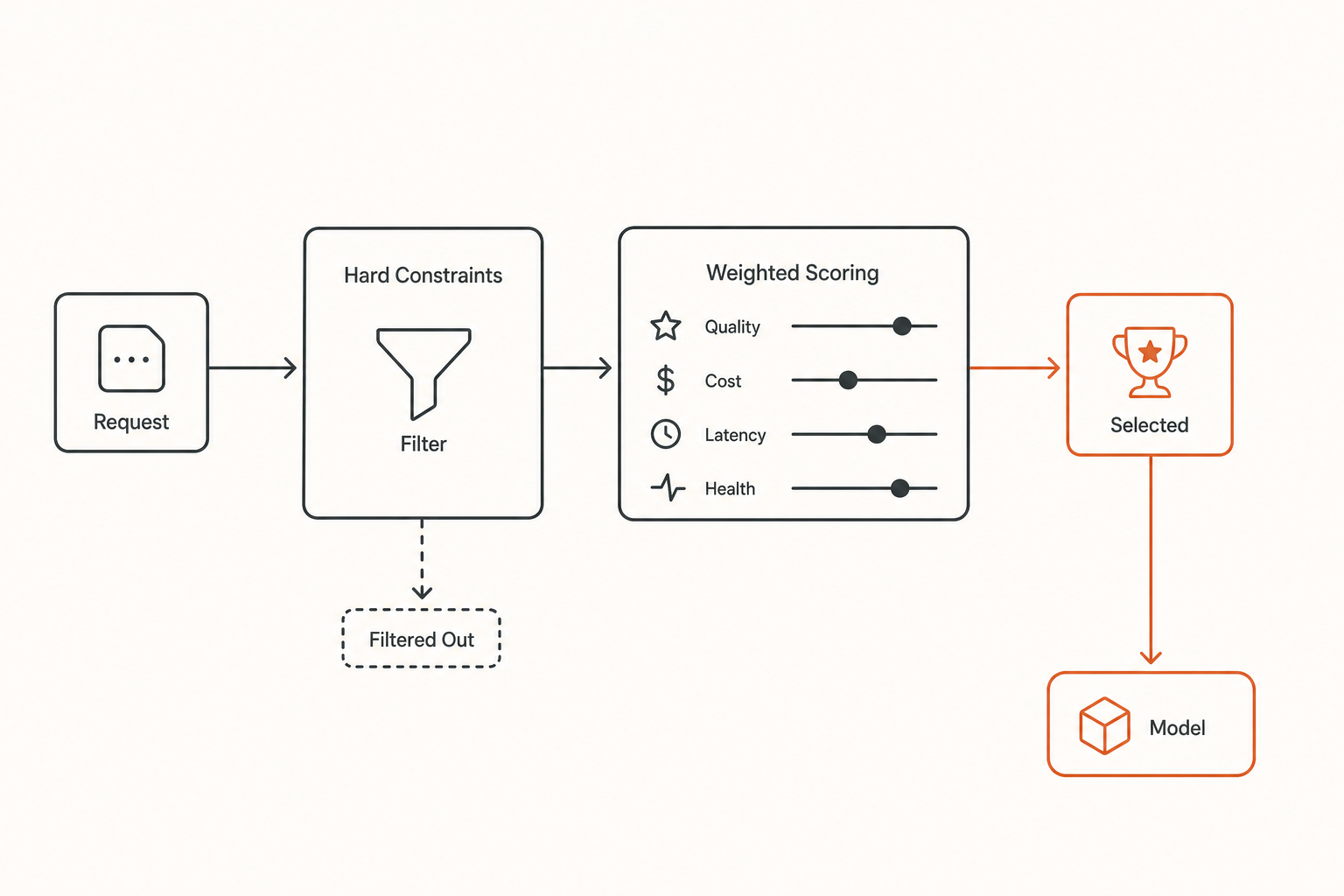
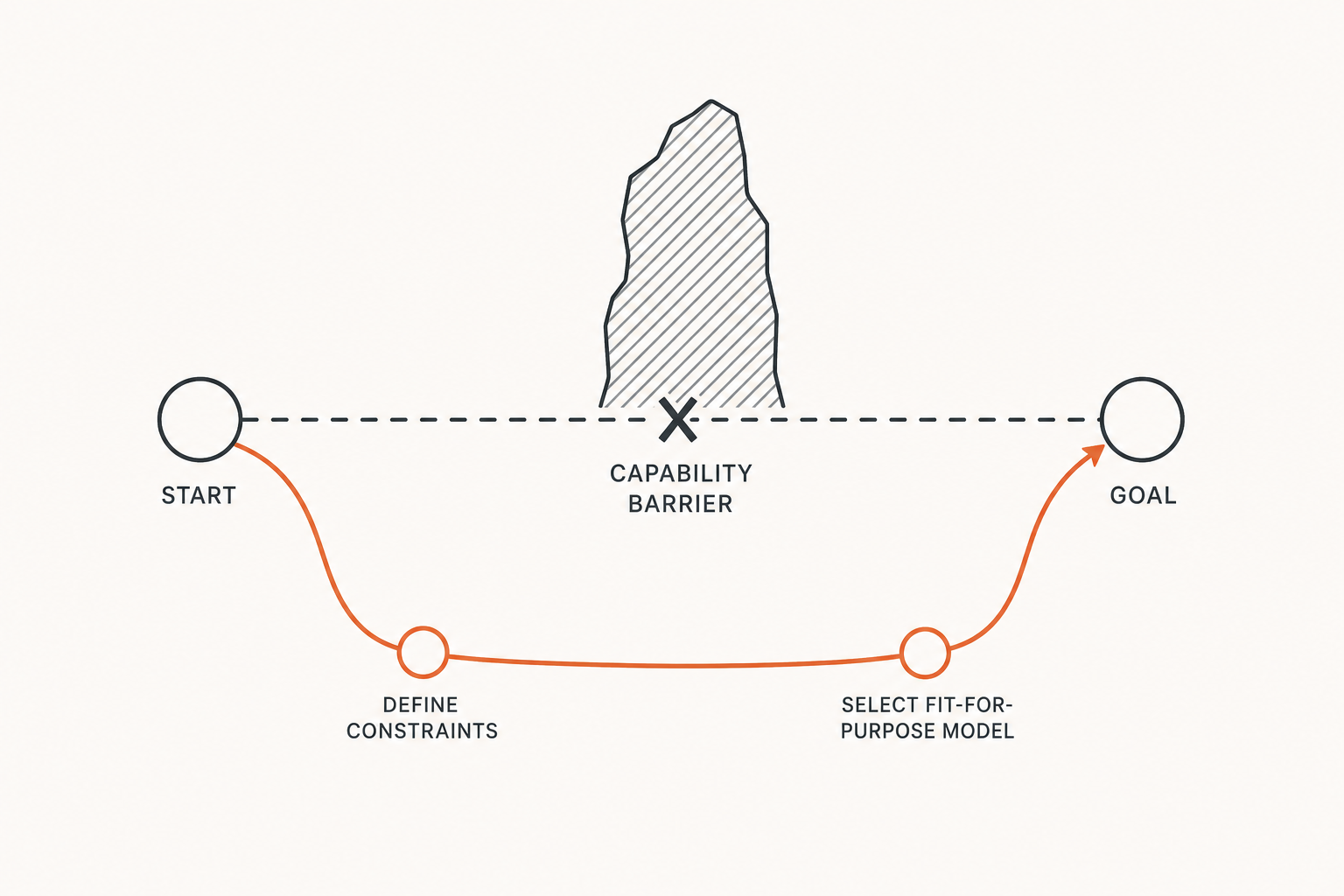
Eliminate models that violate hard constraints first. Optimize quality, cost, and latency only among the survivors.
If every signal goes directly into one weighted score, a cheap model that lacks vision, has an insufficient context window, or violates residency requirements can still win on price. That is not cost-efficient routing. It is treating a non-negotiable constraint as a preference.
This article includes a runnable offline decision replay, rules for three tasks, and one deliberately wrong strategy. Model names and measurements are synthetic fixtures for testing the algorithm. They are not live provider benchmarks, and no latency or quality results are fabricated.
First separate three kinds of routing
Systems often call several different layers “model routing.” Keeping them separate prevents policy confusion.
| Layer | What is selected | Typical signals | Example |
|---|---|---|---|
| Deployment load balancing | endpoints serving the same model | weight, concurrency, RPM/TPM, latency | two regional deployments of one model |
| Model selection | different models or tiers | capability, quality, cost, TTFT | small / balanced / deep |
| Failure fallback | an alternate path after failure | error type, idempotency, compatibility | switch before the first token |
LiteLLM's documentation separates deployment balancing under the same model_name from fallback across model_name groups. Its deployment strategies include simple shuffle, least busy, usage-, latency-, and cost-based routing. Amazon Bedrock Intelligent Prompt Routing stays within a model family and predicts which model is likely to deliver the better response for a prompt.
Both are valid, but neither is a universal “smart router.”
A constraint-first decision pipeline
A practical router can be organized into five layers:
classify request
→ filter hard constraints
→ enforce quality floor
→ apply scoring or ordered rules
→ choose deployment for selected model
→ record decision and fallback chain
Layer 1: hard constraints
Hard constraints should filter, not contribute a few points:
- tools, vision, audio, or JSON Schema support;
- sufficient context window;
- region and data residency;
- tenant access;
- permission to process the data classification;
- enabled channel with available usage capacity;
- lossless-enough protocol support;
- fixed provider or model-version requirements.
Formally:
eligible(model, request) =
  capability_match
  AND context_fits
  AND tenant_allowed
  AND region_allowed
  AND channel_healthy
If any term is false, the model does not reach scoring.
Layer 2: a task-specific quality floor
Quality is not one global leaderboard number. Summarization, code migration, invoice extraction, and tool use need different evaluation sets.
Maintain separate gates such as:
support_triage.accuracy >= 0.85
invoice_extraction.schema_pass >= 0.98
code_migration.tests_pass >= 0.90
Those thresholds must come from your offline evaluations, canary traffic, or human acceptance—not a vendor's aggregate benchmark. Without evaluation data, explicit static rules are more honest than pretending an automatic quality score is accurate.
Layer 3: multi-objective scoring
Score only candidates that passed constraints and quality. After normalizing signals to 0..1:
score =
  wq × quality
+ wc × (1 - normalized_cost)
+ wl × (1 - normalized_ttft)
+ wh × health
+ wa × cache_affinity
In production, split “latency” and “capacity” further:
- TTFT controls the first visible wait in chat and voice experiences;
- total completion time includes full generation, tool loops, validation, and retries, and matters more for reports and code migration;
- rate-limit headroom should use the account's actual RPM, TPM, concurrency, and response headers—not public example limits;
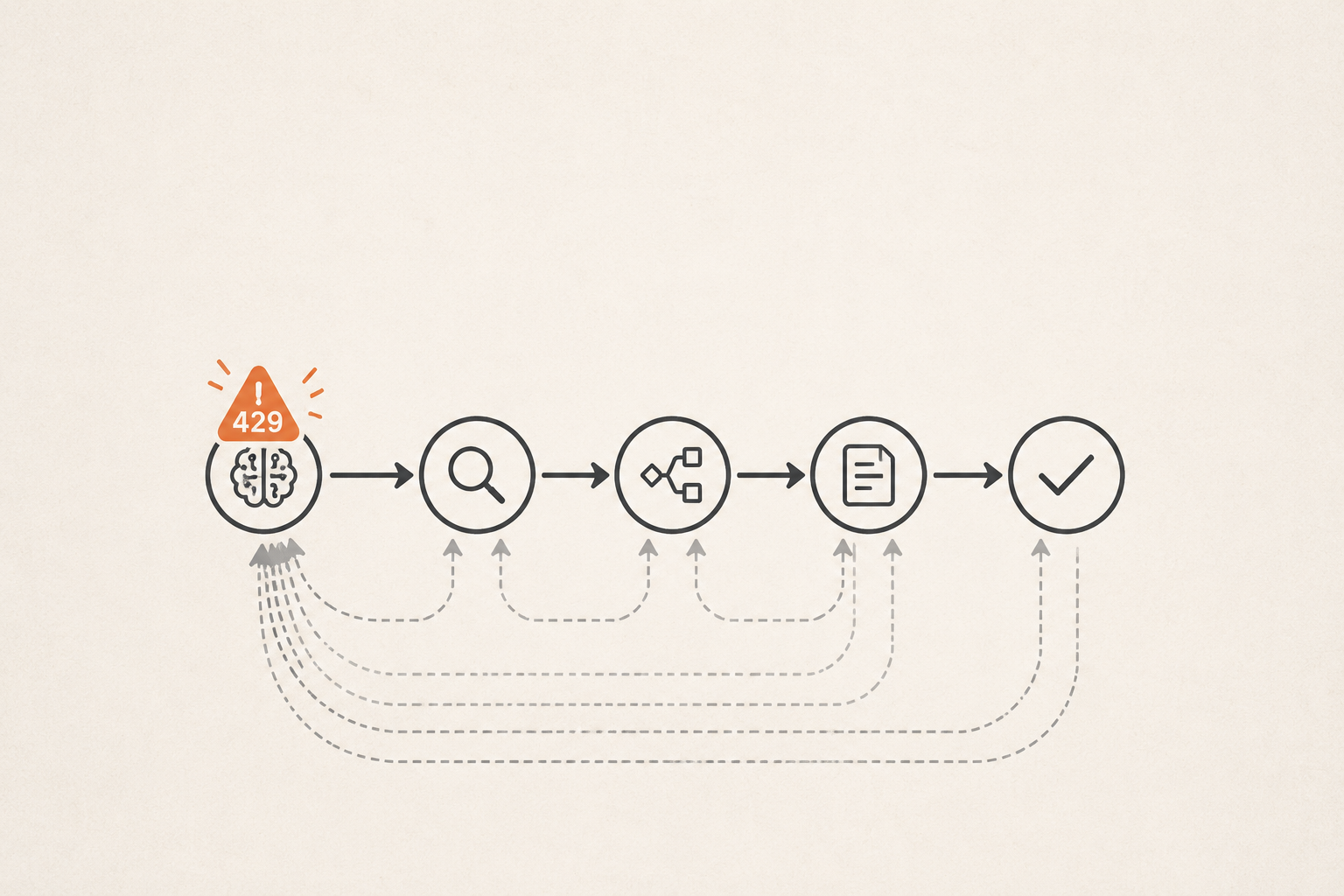
- 429 may describe transient capacity pressure, not degraded model quality or a permanent outage.
For readability, this fixture includes only TTFT and health in its score. A production policy should add total completion time and rate-limit headroom by task and version the input snapshot.
Weights vary by task:
| Task | Quality | Cost | TTFT | Health |
|---|---|---|---|---|
| Support triage | 0.25 | 0.35 | 0.30 | 0.10 |
| EU invoice vision | 0.45 | 0.15 | 0.20 | 0.20 |
| Large code migration | 0.60 | 0.10 | 0.10 | 0.20 |
These weights are inputs to this article's fixture, not industry defaults.
Layer 4: deployment selection
Select a model tier first, then choose among deployments serving that model. Useful deployment signals include:
- priority;
- weight;
- least busy;
- remaining RPM/TPM;
- rolling latency;
- region;
- prompt-cache affinity;
- health and cooldown state.
This stage must not reintroduce a semantically incompatible model.
Routing three tasks
The replay defines three anonymous tiers:
| Tier | Tools | Vision | Context | Region | Intended role |
|---|---|---|---|---|---|
fast-small | yes | no | 32K | global | low cost and low latency |
balanced | yes | yes | 128K | EU | capability/cost balance |
deep-reasoning | yes | yes | 256K | global | high quality, cost, and latency |
Quality, cost, TTFT, and health values are synthetic. Their purpose is deterministic replay, not market comparison.
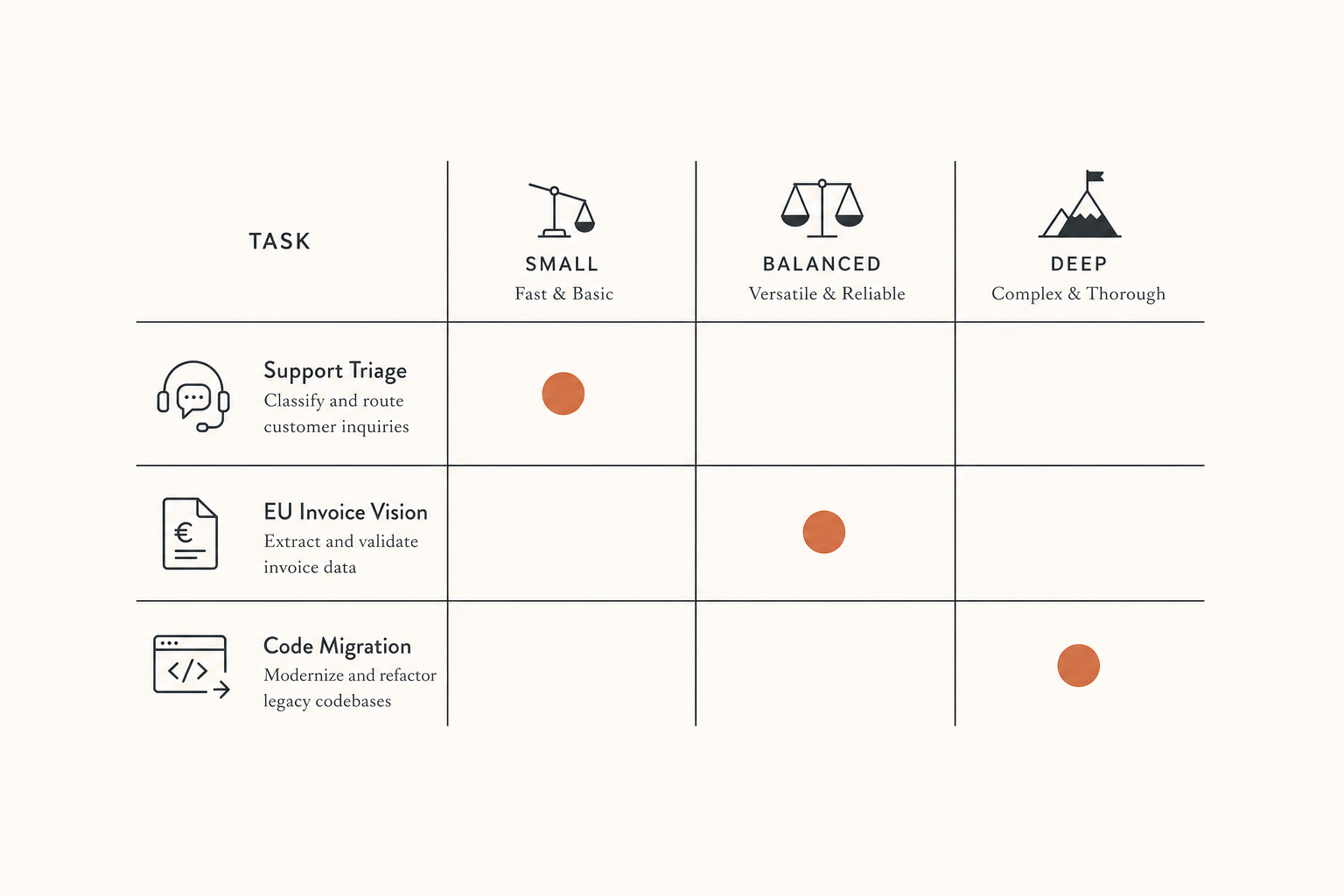
Task 1: support-ticket triage
Requirements:
- 8K context;
- ticket tool use;
- no vision;
- interactive result;
- high volume and low value per call.
Policy:
tools required
quality must clear the classification floor
cost and TTFT matter more than maximum quality
Offline result:
| Candidate | Score |
|---|---|
fast-small | 0.8410 |
balanced | 0.6845 |
deep-reasoning | 0.4265 |
The router selects fast-small. That does not mean small models always work for support. Its cost and latency only become relevant after it has passed this task's quality gate.
Task 2: EU invoice image extraction
Requirements:
- vision;
- 20K context;
- EU data residency;
- output enters a finance workflow.
Hard filters produce:
fast-small: no vision and wrong region;deep-reasoning: wrong region;balanced: the only eligible model.
The router selects balanced with 0.7835. Another model's lower price or higher general benchmark score cannot override the hard constraints.
Task 3: large code migration
Requirements:
- 100K context;
- tools;
- quality carries the largest weight;
- higher latency is acceptable, but cost still matters.
fast-small is rejected because 32K cannot hold the request. The remaining scores are:
| Candidate | Score |
|---|---|
balanced | 0.8250 |
deep-reasoning | 0.7900 |
“Quality has the largest weight” does not mean “always choose the most expensive model.” In this fixture, balanced has slightly lower synthetic quality, but enough cost and TTFT advantage to win overall.
If real migration evaluations show that balanced fails the quality floor, Layer 2 removes it and deep-reasoning becomes the choice.
Wrong strategy: choose the globally cheapest model
A broken implementation looks like:
selected = min(models, key=lambda model: model.cost)
It always chooses fast-small in this fixture:
- support triage: potentially appropriate;
- EU invoice: no vision and wrong region;
- code migration: a 32K context cannot accept 100K.
Related mistakes include:
- selecting by average latency before checking tool support;
- using one set of weights for every task;
- replacing a rate-limited model with a cheaper but incompatible one;
- treating a public model benchmark as your task success rate;
- randomly distributing stable long prefixes and destroying cache affinity;
- hiding a cross-model downgrade inside ordinary load balancing.
Runnable offline replay
The companion script uses only the Python standard library. Its central logic is:
def eligible(model, task):
    reasons = []
    if task["tools"] and not model.tools:
        reasons.append("tools")
    if task["vision"] and not model.vision:
        reasons.append("vision")
    if model.context_k < task["context_k"]:
        reasons.append("context")
    if task["region"] and model.region != task["region"]:
        reasons.append("region")
    return reasons


def score(model, weights):
    return (
        weights["quality"] * model.quality
        + weights["cost"] * (1 - model.cost)
        + weights["latency"] * (1 - model.ttft)
        + weights["health"] * model.health
    )
A production system should replace synthetic fields with:
- versioned per-task offline evaluations;
- cost derived from actual usage and current pricing;
- p50/p95 TTFT and total generation time;
- health statistics for 429, 5xx, timeout, and disconnect;
- a capability catalog for context, tools, modality, and region;
- prompt-cache hit and affinity data.
Log every decision with enough evidence to reconstruct it:
{
  "policy_version": "router-2026-07-20",
  "task_class": "invoice-vision-eu",
  "eligible_models": ["balanced"],
  "rejected": {
    "fast-small": ["vision", "region"],
    "deep-reasoning": ["region"]
  },
  "selected_model": "balanced",
  "selected_channel": 17,
  "fallback_chain": ["balanced-backup"],
  "decision_reason": "only candidate satisfying vision+EU"
}
That is how an operator answers, “Why did this request not use the cheaper model?”
Static rules, weighted scoring, and cascades
Static rules
Use them when:
- task classes are clear;
- compliance is strict;
- quality data is weak;
- the candidate set is small;
- decisions must be easy to audit.
For example:
EU invoice + vision → eu-vision-balanced
code migration > 64K → long-context-code pool
support classification → fast-tool pool
Static rules are not primitive. A dishonest “intelligent score” is worse than an explicit rule table.
Weighted scoring
Use it when:
- every candidate already satisfies hard constraints;
- quality and performance data share stable definitions;
- cost/latency trade-offs need continuous tuning;
- shadow evaluation and replay are available.
Risks include normalization drift, compensation between unrelated signals, and stale metrics. Version both weights and input snapshots.
Cascade routing
A cascade is not a failure retry:
call a low-cost model
→ run a deterministic validator
→ escalate only when validation fails
It works best with strong validators: JSON Schema, unit tests, business rules, or field completeness. If the validator is another fuzzy LLM judge, its escalation decisions need evaluation too.
Expected cascade cost is:
cheap_cost + escalation_rate × expensive_cost
Do not report only the first model's price.
Fallback policy cannot look only at “failure”
At least three fallback classes matter:
| Type | Example | Baseline policy |
|---|---|---|
| Same model and protocol, another deployment | regional connection failure | switch before first token; relatively low risk |
| Equivalent-capability model | primary 429; backup supports the same tools/schema | validate compatibility and quality floor; record downgrade |
| Cross-capability degradation | vision model to text-only model | deny by default unless the product explicitly allows it |
LiteLLM's separation of deployment retries, cooldown, and cross-model fallback is a useful boundary. The previous LLM gateway vs API gateway analysis also explains why replaying a stream after output starts can duplicate text, break tool arguments, and double-charge usage.
Article #107 will build a failure timeline for 429, backoff, and failover. This article deliberately does not turn “routing” into every reliability concern.
Prompt caching changes the optimal route
If two channels expose the same model, the currently fastest endpoint is not always the lowest total-cost endpoint. If a stable prefix is warm on Channel A, randomly moving the next request to B can lose both the cache-read discount and TTFT benefit.
Cache affinity can be modeled as:
- a soft preference while A is healthy;
- a bounded hard constraint during a short-TTL conversation window;
- a break condition when A errors or hits usage limits.
Nbility currently implements channel affinity. It tries the cached preferred channel, verifies that the channel, path, model, and group remain eligible, and records affinity after a successful request. Configuration controls whether an invalid preference is retained, cleared, or prevents retry.
This does not mean Nbility currently performs the article's automatic quality/cost/TTFT scoring across different models. Claims supported by the present code are:
- token-level model and group access;
ModelMapping;- enabled and usage-limit filtering;
- priority tiers;
- weighted random selection within a tier;
- moving to the next priority on retry;
- channel affinity;
- requested model, upstream model, channel, and billing records.
A quality scorer and real-time cross-model optimizer should remain an explicit policy service or configuration layer, not be presented as an existing feature.
What Nbility priority and weight actually mean
The current GetRandomSatisfiedChannel path does this:
- find channels by group, model, and request path;
- skip channels that reached usage limits;
- collect and sort available priorities descending;
- choose the highest tier for the first attempt;
- make a weighted random choice within that tier;
- move to the next priority as retry index increases.
Use the fields accordingly:
- priority for primary and backup channel tiers;
- weight for traffic share within a tier;
- Model Mapping to map application aliases to provider model IDs;
- group for price, access, or service-level boundaries;
- affinity for conversation or cache stability.
Do not read weight=80 as “quality is 80%.” It is a traffic weight among same-priority channels, not a multi-objective scoring weight.
Production checklist
- classify the task before selecting a model
- treat capability, context, access, and region as hard constraints
- maintain a per-task evaluation and quality floor
- estimate cost from actual input/output/cache structure
- measure both TTFT and total generation time
- distinguish 429, quota exhaustion, 5xx, and timeout in health state
- separate same-model balancing from cross-model selection
- validate tools, schema, modality, and context before fallback
- do not transparently replay a full stream after visible output
- define affinity eviction and failure bypass
- store policy version and rejection reasons for every decision
- run offline replay, shadow traffic, and small canaries first
- make degraded business success an immediate rollback signal
Conclusion
Multi-model routing is neither random provider switching nor one impressive-looking formula that mixes quality, cost, and latency.
The correct order is:
- hard-filter by capability, context, access, and compliance;
- enforce a task-specific quality floor;
- optimize cost, TTFT, health, and cache affinity only among qualified models;
- load-balance deployments after selecting the model;
- separate retries from cross-model degradation;
- log decisions and update policy from real outcomes.
Without quality data, start with explainable static policy built from Nbility model aliases, groups, priorities, weights, and channel affinity. Do not invent an “intelligent routing score.” As real logs and task evaluations accumulate, place a scored policy layer in front of the stable gateway endpoint. Visit Nbility for unified model access, or request a small test credit through the ticket center.