What It Takes to Self-Host Le Chonk
Mistral Large 4's open weights create deployment choices. Read the actual license, understand MoE memory requirements, and plan a meaningful serving trial.

Mistral Large 4, also called Le Chonk, now has downloadable weights. A team that needs control over model location and adaptation can hold the model and choose how to operate it.
That choice comes with inference infrastructure, service maintenance, and license questions. One especially useful distinction: a mixture-of-experts model activating only part of its parameters does not mean a deployment only needs to accommodate those active weights.
We checked the announcement, model card, and full license on November 11, 2026. The announcement records publication on October 29 and an update on November 5; the current model documentation labels November 5 as GA. Those are distinct source dates. We did not download the large checkpoint, deploy it, or run an independent performance comparison.
Open weights create several operating choices
The model card describes an approximately one-trillion-parameter, natively multimodal MoE model. It accepts text and images and returns text, with function calling, structured output, and request-level reasoning effort. Multimodal input does not imply image or video generation.
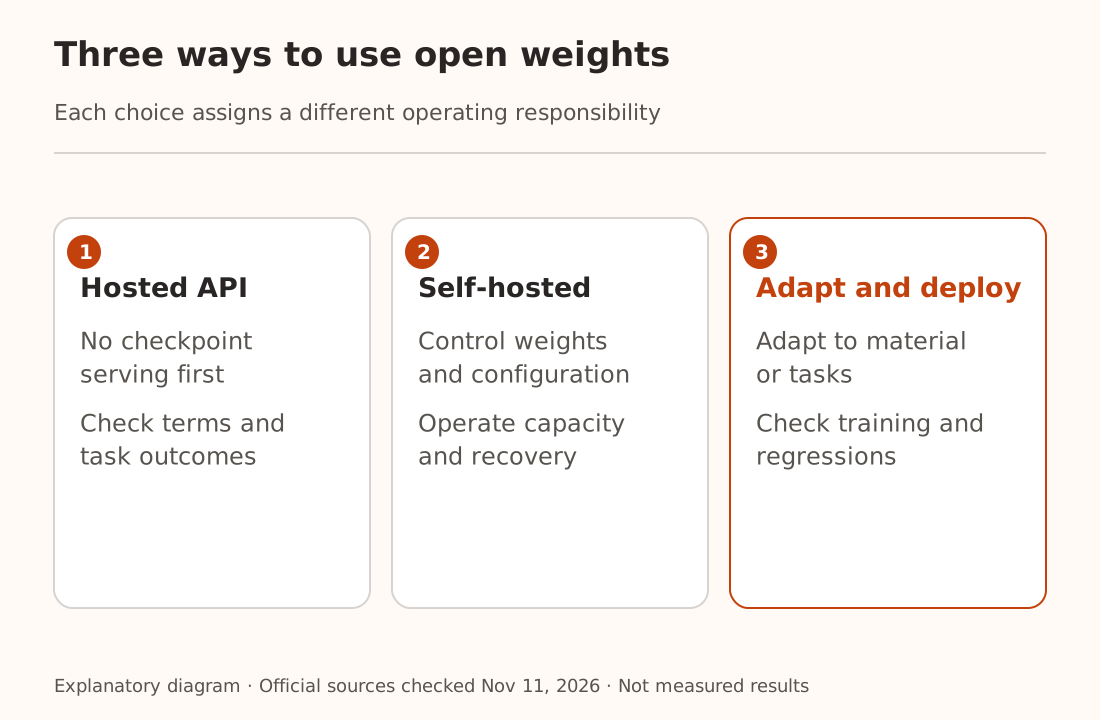
| Approach | What you gain | What you operate or verify |
|---|---|---|
| Hosted API | A way to evaluate tasks without serving the weights | Access, terms, data requirements, and task outcomes |
| Your own infrastructure | Control over weights, location, and serving configuration | Compute, capacity, updates, monitoring, and recovery |
| Adapted or fine-tuned deployment | A model tailored to particular material or work | Training data, adaptation, quality, and regressions |
If the requirement is merely one API address for several models, a gateway may be the relevant layer. The LLM gateway explanation covers routing and protocol handling. A gateway does not itself make a large checkpoint into a running inference service.
Read the MaaS condition in the full license
The Mistral Ecosystem Open-Weight License is a modified MIT license. Shortening that description to “MIT” loses a material condition.
Section 2 says that if the licensee or any affiliate operates a Model-as-a-Service business, a separate commercial license is required before using the model or derivatives for any commercial purpose. Section 3 exempts internal use and access through Mistral's official products from Section 2.
The license defines MaaS as giving a third party access for inference or post-training, through an API, hosted endpoint, or another means, with meaningful control over inputs, parameters, or training data. It excludes end-user products with model capabilities embedded solely in specific features or harnesses, and mere relaying to models hosted by others.
| Intended use | Relevant boundary in the text |
|---|---|
| Internal use without making the model available to third parties | Section 3 exempts it from Section 2 |
| Model capability embedded in a specific product feature | The MaaS definition has an exclusion; the actual implementation must fit |
| An external model service with input or parameter control | Review the MaaS definition and separate-license requirement |
| Mere relaying to someone else's hosted model | Explicitly excluded from the definition; mixed business activities need separate examination |
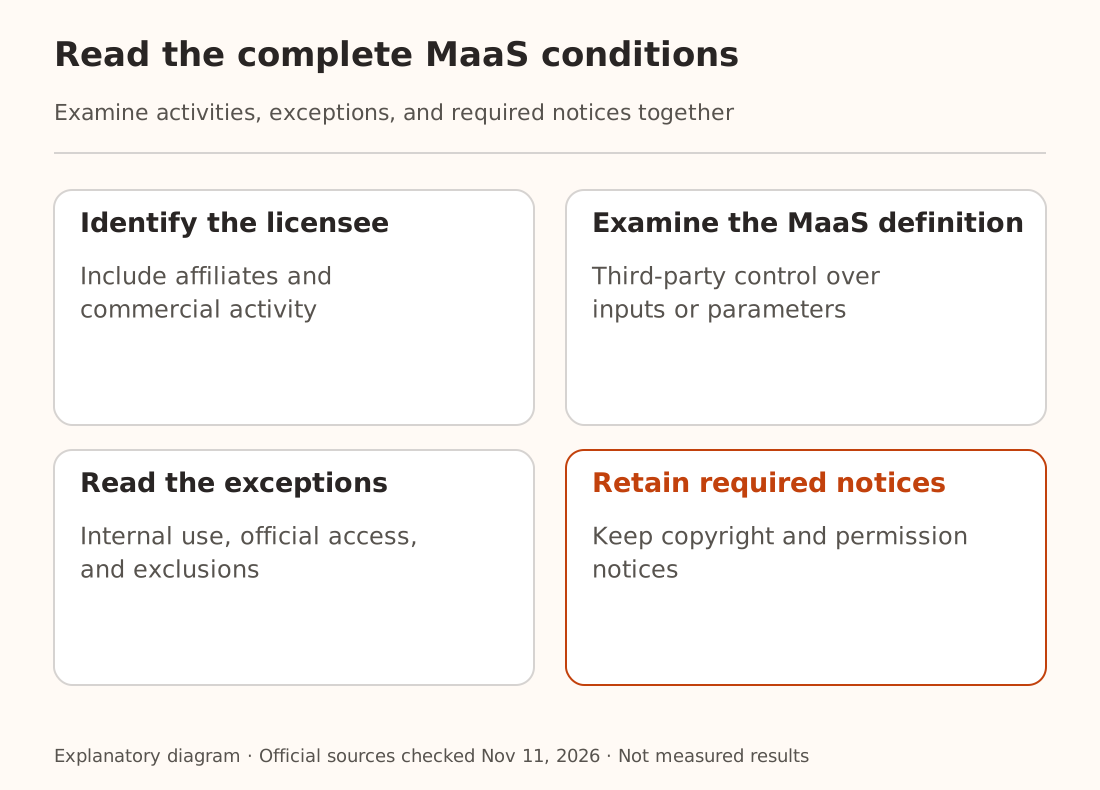
“We sell a chat feature,” “an affiliate runs a model service,” or “we changed the weights” is not enough information on its own. Read the licensee, affiliate, activity, and exception provisions together. Copies and distributions must also retain the required copyright and permission notice. For an unclear business arrangement, ask Mistral about the full arrangement rather than relying on a general free-commercial-use label.
Active parameters are not a memory specification
The card reports about 49 billion active parameters per token, or about 52 billion including embeddings and output layers, within an approximately one-trillion-parameter model. The active count describes computation; it does not replace the full weight-storage requirement.
Long-context KV caches, concurrent requests, and runtime overhead need additional room. A supported 1M context window is not a promise that every hardware configuration can serve that length at any concurrency.
The official vLLM example uses --tensor-parallel-size 8 with Mistral tool-call and reasoning parsers. That is an example configuration, not evidence that any eight GPUs suffice. The card also links an NVFP4 checkpoint targeting Blackwell hardware. Check its engine and hardware requirements separately from those of the original checkpoint.
Capacity planning needs precision, context length, concurrency, and an engine version. A weight-file size alone cannot establish throughput or a dependable minimum-memory figure.
Validate useful behavior before moving traffic
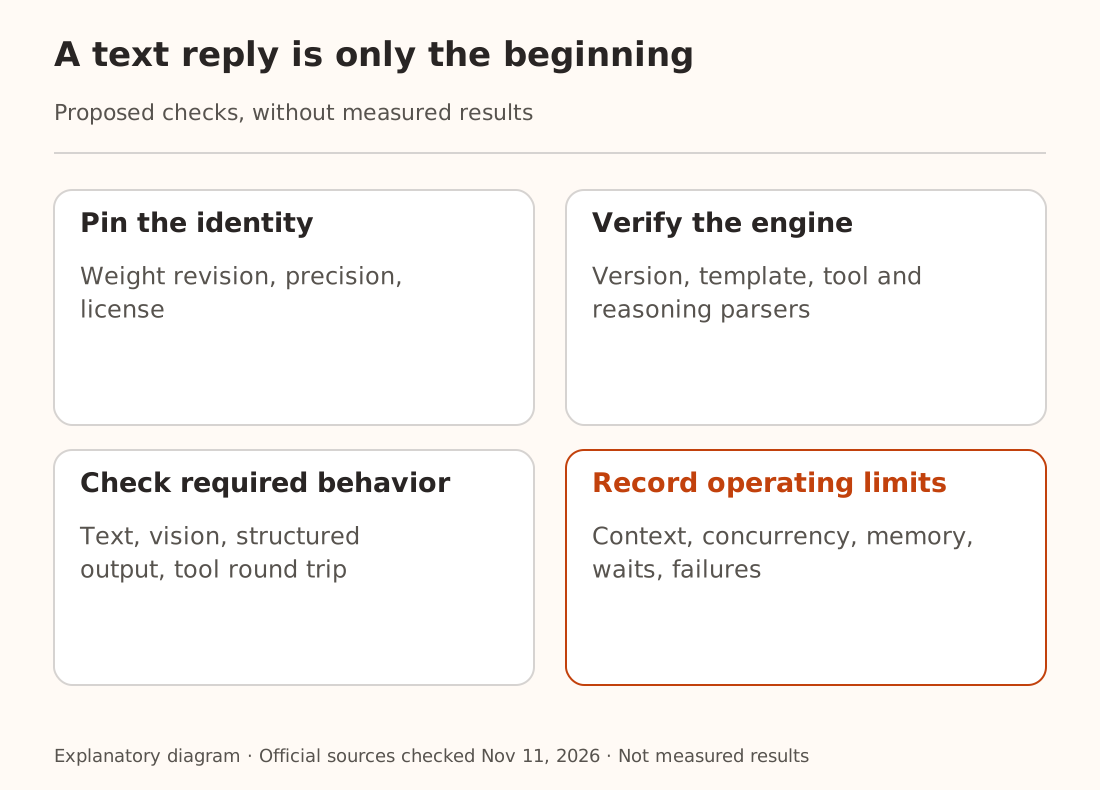
A useful deployment record includes:
- Identity: repository, pinned revision, precision, and license copy. Record the API service name separately from the weight repository.
- Implementation: engine version, chat template, and reasoning and tool parsers. Working text output does not verify tool handling.
- Behavior: a public text task, an inspectable public image, a harmless tool round trip, and any required structured output.
- Operating conditions: memory, waiting time, and failures at representative input lengths and concurrency. These are proposed measurements, not results from this article.
A tool check must reach application execution, result return, and the model's follow-up answer. Merely seeing a tool name in text is insufficient. Use the catalog and capability checks when connecting clients, and preserve task failures with the controlled-input method.
A team without ongoing inference operations capacity can first establish value through a hosted service, then decide which workloads justify self-hosting. When connecting through Nbility or another gateway, verify the endpoint and protocol with the connection guide. Connectivity is one part of that operating decision.