Rerank Only Helps When the Evidence Reaches Your Candidate Set
A practical RAG example separates candidate coverage, reranking, context selection, and citation mapping without inventing accuracy scores.
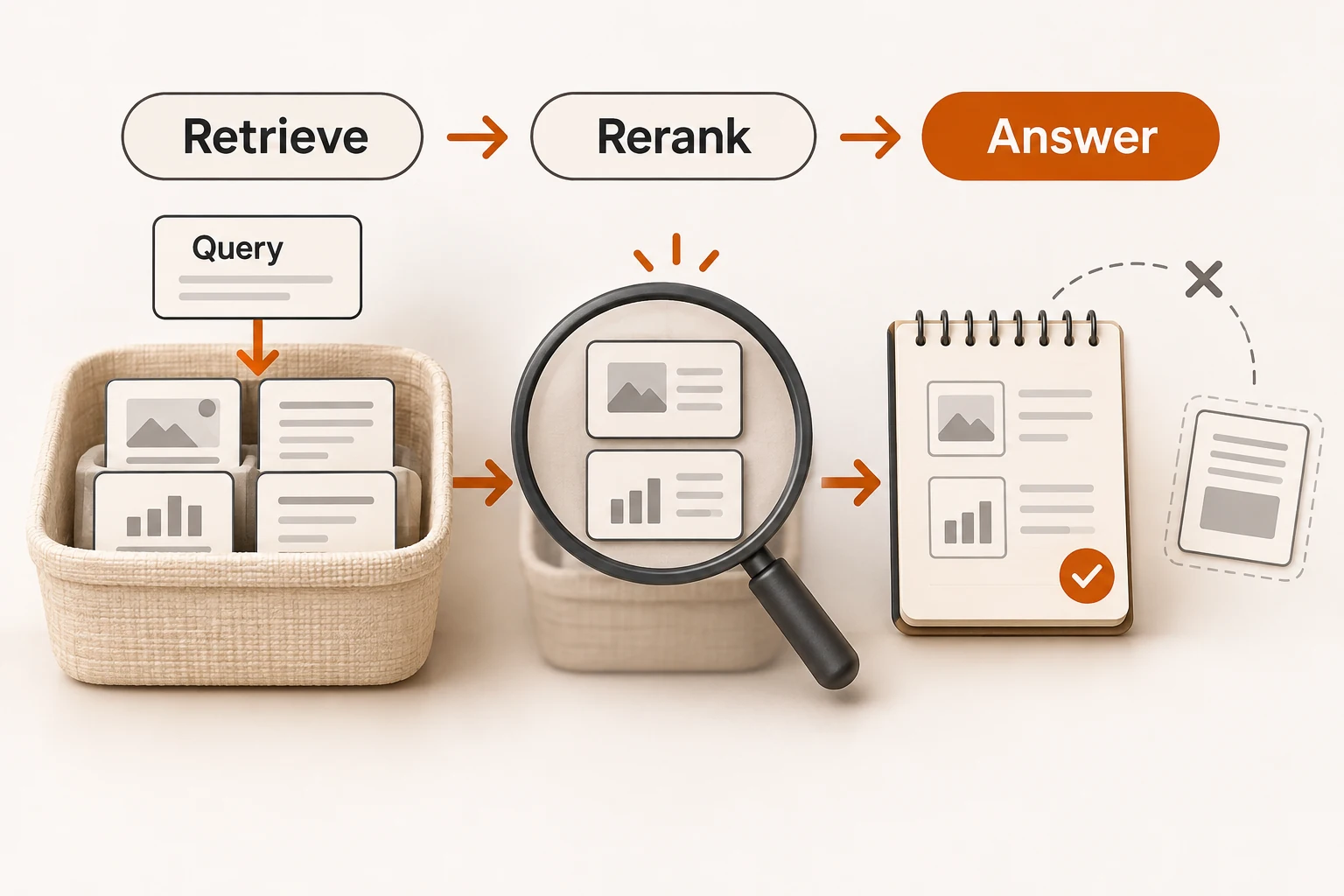
Adding reranking to a knowledge base can improve which passages reach the answer. It helps only when the supporting passage is present in the candidate list. A reranker cannot recover an exception clause that retrieval never supplied.
The sources for this guide were checked on November 13, 2026: Cohere's current guidance and the Nbility Rerank API. The example below is synthetic. No live reranking request or retrieval accuracy study was performed. For extraction and citation problems earlier in the process, see the PDF citation guide.
Make the exception part of the acceptance criteria
Use three public teaching passages with stable IDs. They are sample text, not a merchant's actual policy:
[
  {"id":"policy-general","text":"Unopened standard products may be returned within seven days of delivery."},
  {"id":"policy-custom","text":"Custom products are excluded from the standard seven-day rule and require manual review."},
  {"id":"policy-delivery","text":"After dispatch, tracking is available on the order page."}
]
Ask whether an unopened custom product qualifies for an immediate seven-day return. A useful answer must apply the custom-product exception. Quoting the general rule accurately while ignoring that exception still fails the task.
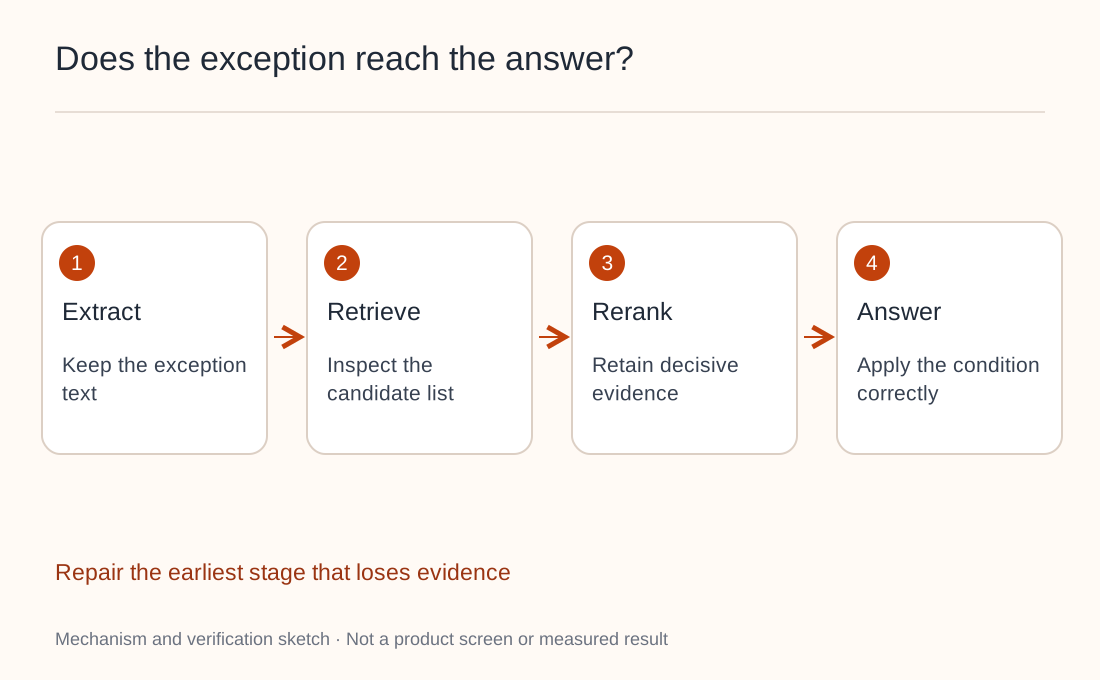
Inspect the input to reranking first. If it contains only the general policy and shipping information, the failure is upstream: extraction, chunking, filters, or retrieval. A more capable reranker has not been shown to fix missing evidence.
Separate retrieval breadth from context size
You can retrieve a broader set of authorized, current passages and send a smaller selection to the answering model. The appropriate counts depend on the documents and task; there is no universal value offered here.
Cohere's reranking guide distinguishes the query, candidate documents, and top_n. Increasing top_n changes how many results are returned from the supplied candidates. It does not expand the preceding search.
The following is an unexecuted Nbility request example. Select a reranking model available to your account. Do not assume Cohere's native endpoint, model IDs, and limits apply to every Nbility channel:
curl --fail-with-body https://api.nbility.ai/v1/rerank   -H "Authorization: Bearer $NBILITY_API_KEY"   -H "Content-Type: application/json"   -d '{
    "model": "YOUR_RERANK_MODEL",
    "query": "Can an unopened custom product be returned immediately under the seven-day rule?",
    "documents": [
      "Unopened standard products may be returned within seven days of delivery.",
      "Custom products are excluded from the standard seven-day rule and require manual review.",
      "After dispatch, tracking is available on the order page."
    ],
    "top_n": 2,
    "return_documents": true
  }'
If retrieval deteriorated after an embedding change, investigate model identity, dimensions, and existing indexes separately. An incompatible representation and an unhelpful ranking require different fixes.
A relevance score does not certify an answer
Cohere's best practices explain that scores depend on the query and passages. Nbility also cautions against comparing scores across models or treating them as probabilities.
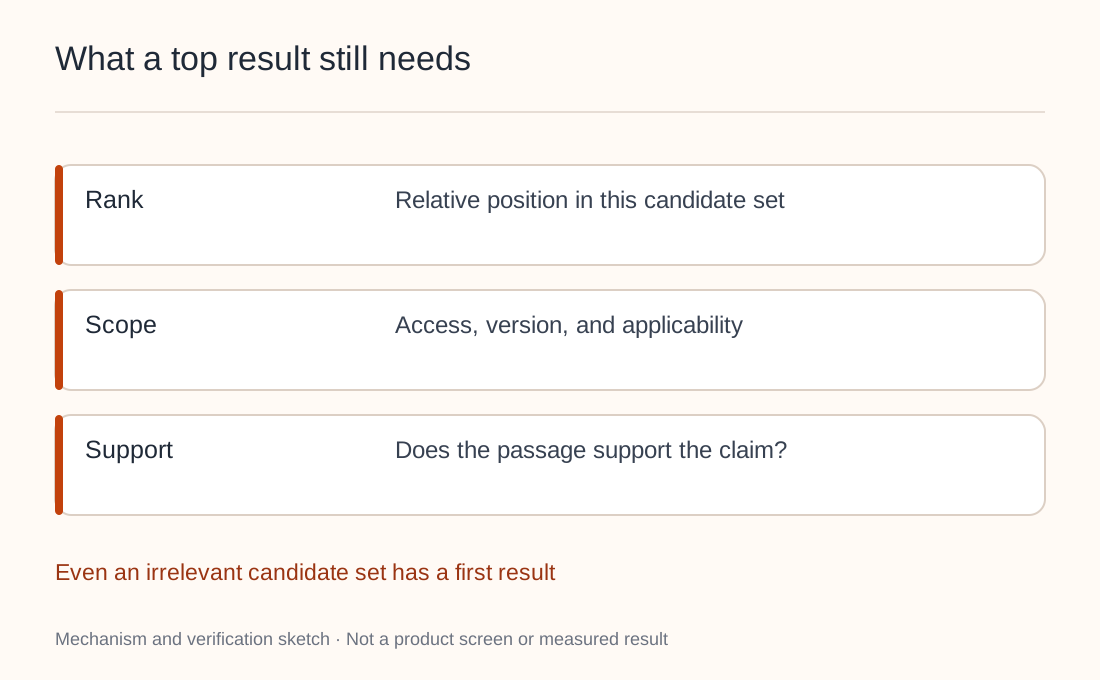
A first-place passage can still be outdated, incomplete, or irrelevant to the decisive exception. Even a poor candidate set can produce a first-place result. Choose thresholds using representative questions, including paraphrases, exceptions, and questions the collection cannot answer. Watch both unwanted inclusions and missed evidence.
Check the selected model's length, truncation, and chunking behavior as well. A limitation documented for one model is not a promise about all reranking services.
Preserve identity when the order changes
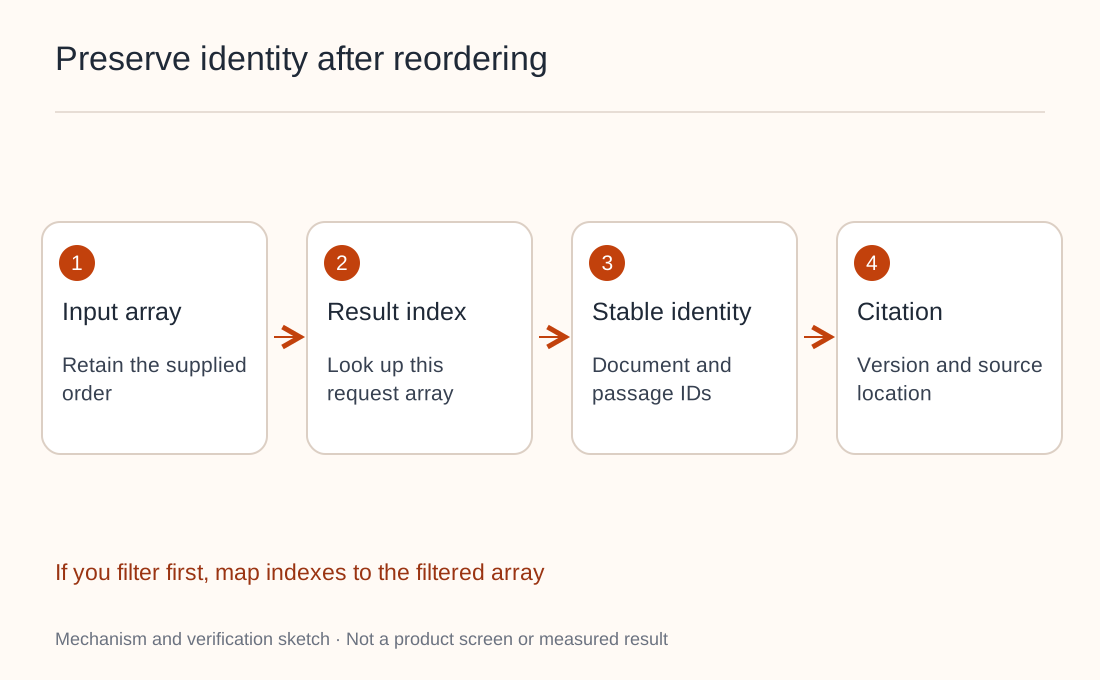
In the Nbility response, index refers to a position in the documents array supplied to that request. Map it back to the stable document ID, passage ID, version, and access scope. If candidates were filtered first, use that filtered array for the lookup.
Otherwise a reordered passage can receive the old passage's citation: the link opens, but the source does not support the sentence. In a temporary fixture, swap the input order and confirm that the displayed source follows the stable ID.
Record three outcomes independently: did evidence reach the candidates, survive context selection, and support the final answer? For a question such as “How long does manual review take?”, the supplied material gives no duration. A useful system should say so.
Use the connection basics for endpoint configuration. Once candidate coverage and source mapping are clear, comparing rerankers becomes a focused decision about a specific stage.