Should Fable 5.2 Become Your Everyday Coding Model?
Understand Fable 5.2 and Mythos 5.2 access, Anthropic's recommendation to start most work with Opus 5.5, and a practical way to evaluate an upgrade.
Anthropic released Claude Fable 5.2 and Mythos 5.2 on November 9, emphasizing demanding, open-ended technical work. One detail matters for everyday development: the company still recommends starting most coding and knowledge tasks with Opus 5.5, then moving to another model when the work calls for it.
The useful question is which unfinished tasks this release might unlock. A release announcement alone is a weak reason to replace every default.
Checked on November 11, 2026, this article draws on the release announcement, current model overview, and system card. We did not run a comparison of either model. The trial below is a suggested method; the vendor's projects remain vendor reports.
Fable and Mythos have different access boundaries
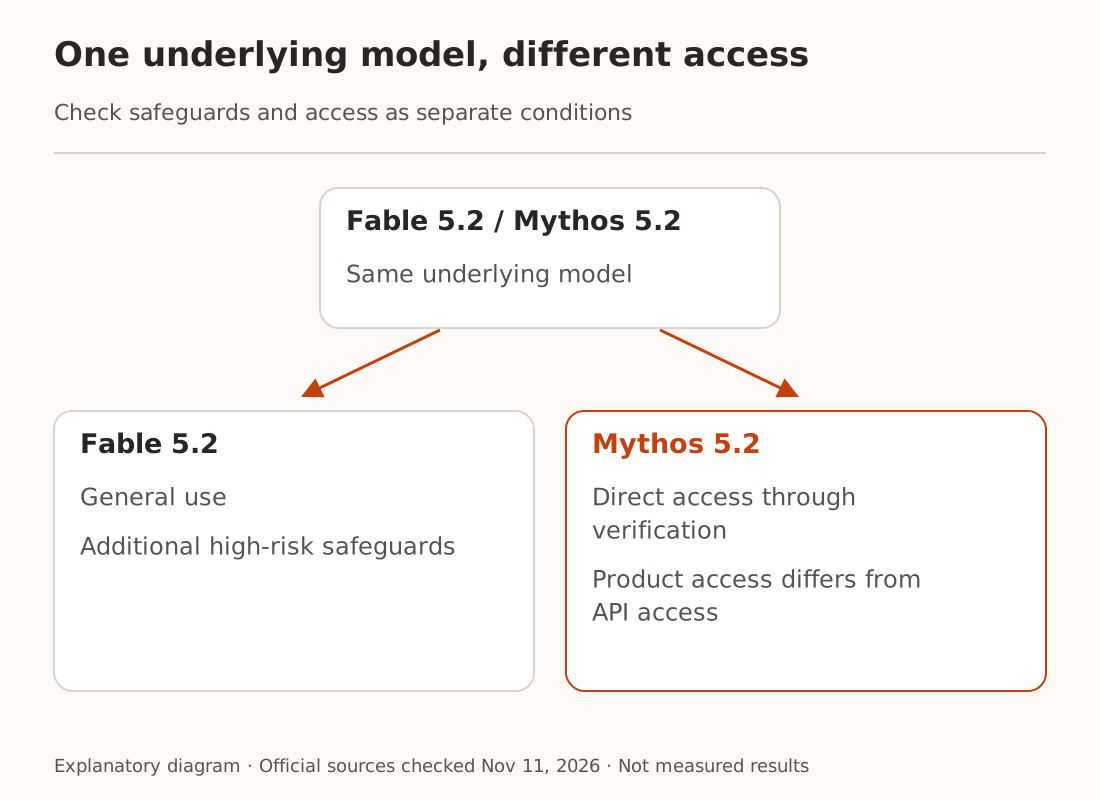
Anthropic describes Fable and Mythos as configurations of the same underlying model, with different safeguards in high-risk dual-use areas such as cybersecurity and biology. Fable is available for general use. Direct Mythos access requires participation in the relevant verification programs.
| Model | Official role and access | What to establish first |
|---|---|---|
| Fable 5.2 | General use with additional safeguards in high-risk domains | Availability on your platform, plan, and account |
| Mythos 5.2 | Direct access for verified work, including security and life sciences | Approval and authorization for the intended use |
| Opus 5.5 | Anthropic's starting recommendation for most coding and knowledge tasks | Whether it already meets your completion criteria |
The system card also says Mythos 5.2 powers Claude Security, available to Claude Enterprise customers. Access to a product powered by a model is a separate entitlement from direct API access to that model. A product listing does not establish unrestricted Mythos access.
The Claude API identifier is claude-fable-5-2. A third-party service has its own catalog and token restrictions. An upstream launch does not establish that an aggregator serves it. The model ID guide explains how to check that additional layer.
Choose tasks that expose a meaningful limitation
The release highlights coding, reasoning, vision, and sustained technical work. Its software migrations, hardware projects, and mathematical formalization examples involve particular tools, work arrangements, and human participation. They do not establish what will happen in your repository.
Useful candidates for a trial include:
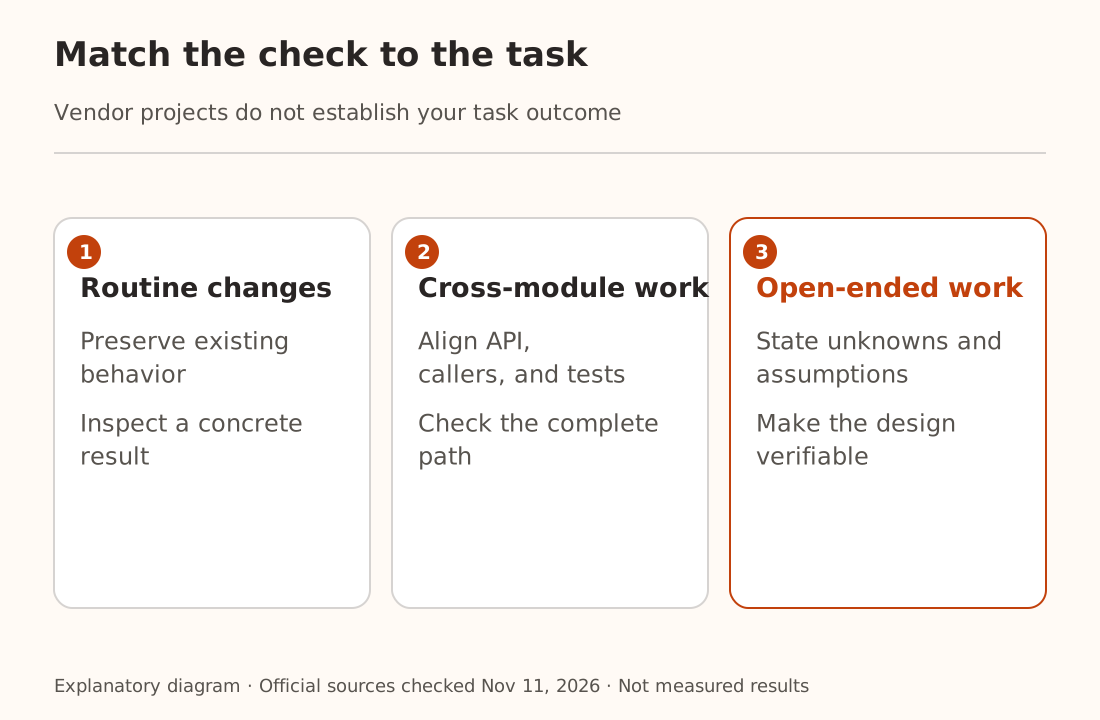
- Changes spanning modules. An API field change may require caller updates, compatibility behavior, and tests. Completion means the whole path works.
- Technical design with incomplete requirements. Check whether the model identifies missing information, states assumptions, and proposes ways to verify its design.
- Engineering material combining diagrams and text. Use public documents and check relationships, units, and participants against the originals.
If your current model reliably handles small edits, short summaries, or fixed-field extraction, judge a switch using your own waiting time, request records, and corrections. The announcement's ambitious projects cannot settle those everyday choices.
Changing the model, expanding tool access, and enabling more parallel work in one attempt makes attribution difficult. Keep the execution environment stable first. For deliberate model combinations, see the constraints behind model routing.
Keep a small, inspectable trial
Use the same public material, starting revision, and acceptance criteria. The following brief can be adapted to a public sample repository; we have not executed it as a model test:
Add empty-date handling to the existing CSV importer.

Requirements:
1. Preserve the output format for valid dates.
2. Keep an empty date empty; do not infer today's date or another default.
3. Report a nonempty invalid date with its original source row.
4. Preserve the existing calling interface and avoid unrelated changes.
5. Add tests for these behaviors and report their actual results.

List changed files, completed checks, and anything still unverified.
First record where the current model fails. Then try Fable from the same starting state. Inspect preserved behavior, actual check execution, and whether the tests cover the requested change. A longer explanation is not a completed task, and one successful attempt is not a general performance result.
If history or missing tool results already affect the task, use the quality-regression investigation method to stabilize the input first. Otherwise, a fresh conversation may receive credit that belongs to neither model.
Verify the whole usage path before changing defaults
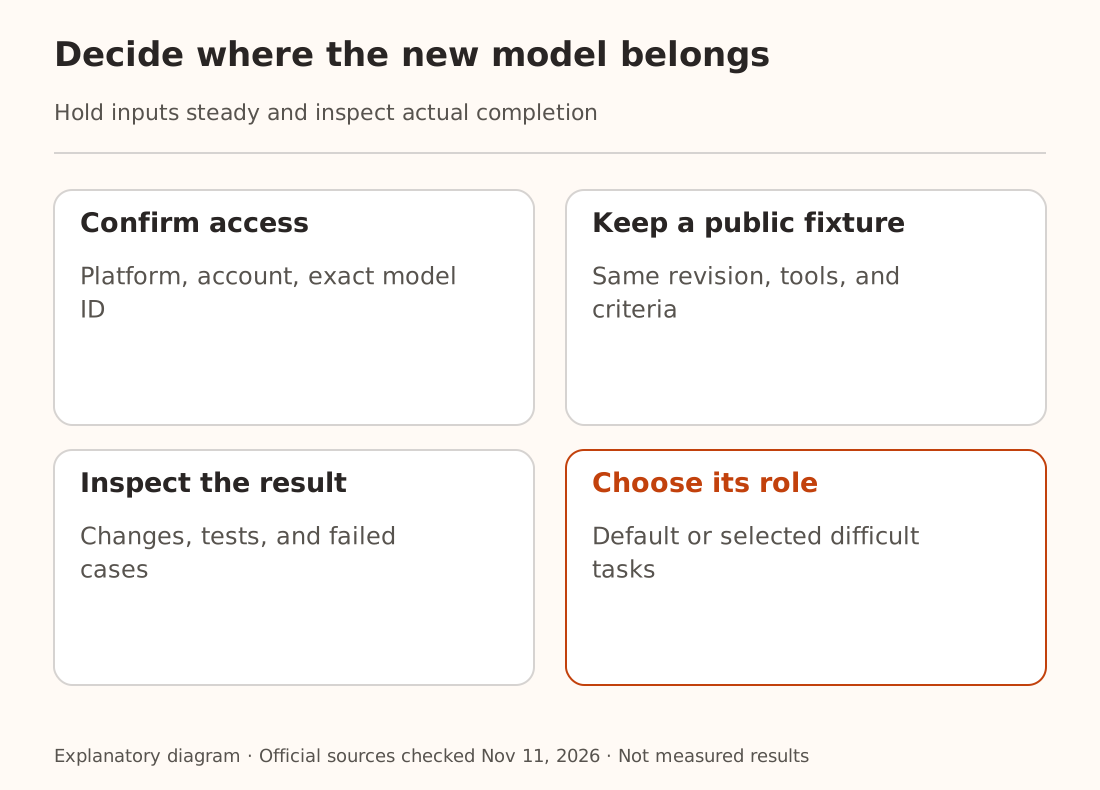
Proceed in this order:
- Confirm access, exact model ID, and supported settings on the platform you use.
- Hold the client, public inputs, tools, and completion rules steady.
- Check the complete result: changes, tool outcomes, tests, and final explanation.
- Retain failures and manual corrections before deciding whether to make it the default or reserve it for difficult work.
A refusal calls for checking the task and authorized access; Mythos should not be treated as a switch for bypassing Fable safeguards. A missing model or broken tool path calls for account and compatibility checks before a capability judgment.
For Claude Code, use the connection documentation to verify the configured service. On Nbility, consult your account's actual model catalog and request records. One previously unsuccessful public task provides a clearer starting point than a wholesale configuration change.