MCP progress does not remove the task deadline
Separate MCP progressToken notifications, final results and cancellation. A progressing tool can still hit a maximum request timeout.
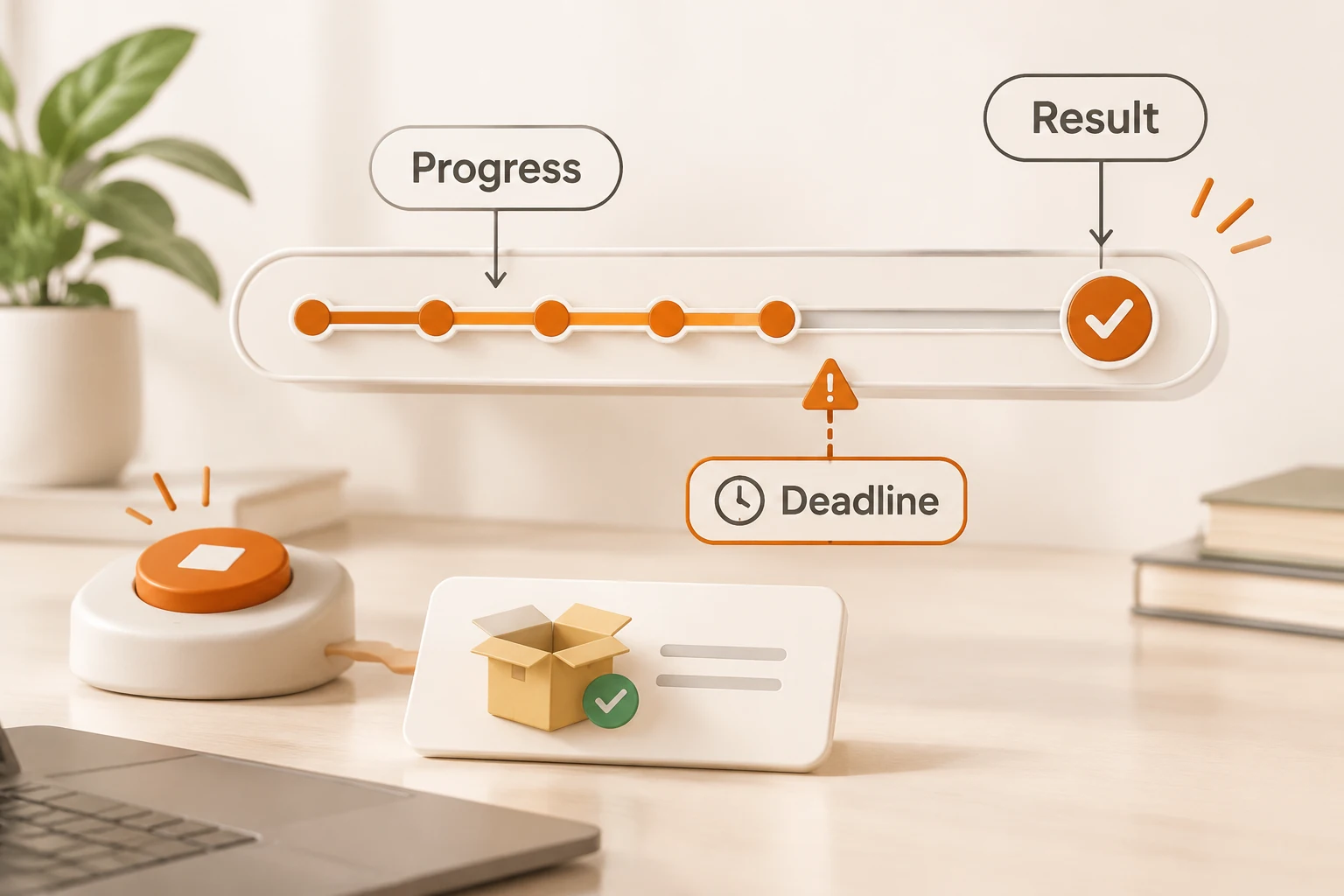
An MCP tool can report progress continuously and still reach a maximum request timeout. Progress indicates ongoing work; it does not replace the final result. Cancellation asks work to stop; it does not undo a completed write.
This article checks MCP 2026-07-28 Progress and Cancellation on November 25, 2026. The public-document export is a mechanism example, not an executed service or cancellation test.
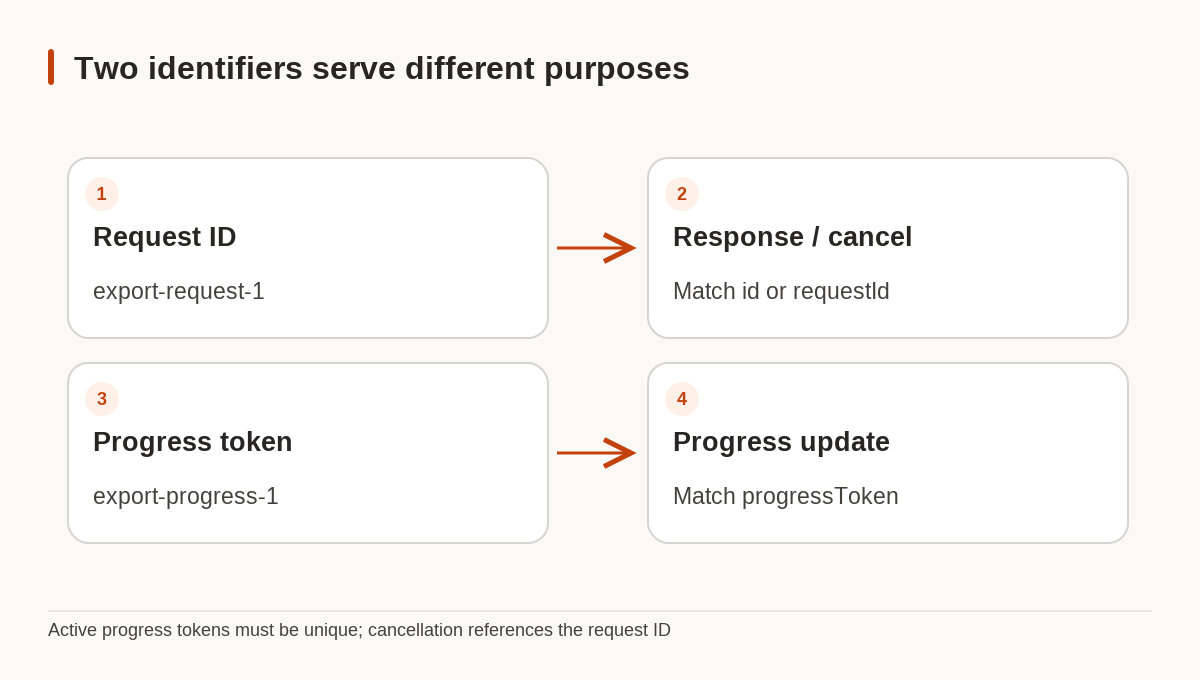
What connects a progress notification to its request?
The JSON-RPC request ID associates requests with responses; progressToken associates progress notifications with ongoing work.
To request progress, a client includes a string or integer progressToken in _meta, unique across active requests. This is an illustrative current-protocol request:
{
  "jsonrpc": "2.0",
  "id": "export-request-1",
  "method": "tools/call",
  "params": {
    "_meta": {
      "io.modelcontextprotocol/protocolVersion": "2026-07-28",
      "io.modelcontextprotocol/clientInfo": {
        "name": "article-exporter",
        "version": "1.0.0"
      },
      "io.modelcontextprotocol/clientCapabilities": {},
      "progressToken": "export-progress-1"
    },
    "name": "export_public_demo",
    "arguments": {}
  }
}
An illustrative progress notification uses that token:
{
  "jsonrpc": "2.0",
  "method": "notifications/progress",
  "params": {
    "progressToken": "export-progress-1",
    "progress": 4,
    "total": 10,
    "message": "Prepared 4 of 10 public sections"
  }
}
A server may choose not to emit progress, and controls its frequency. Missing notifications alone do not prove a stalled operation. Ordinary SSE keepalives do not establish business progress either; see SSE events and network chunks.
Is 100 percent progress a completed result?
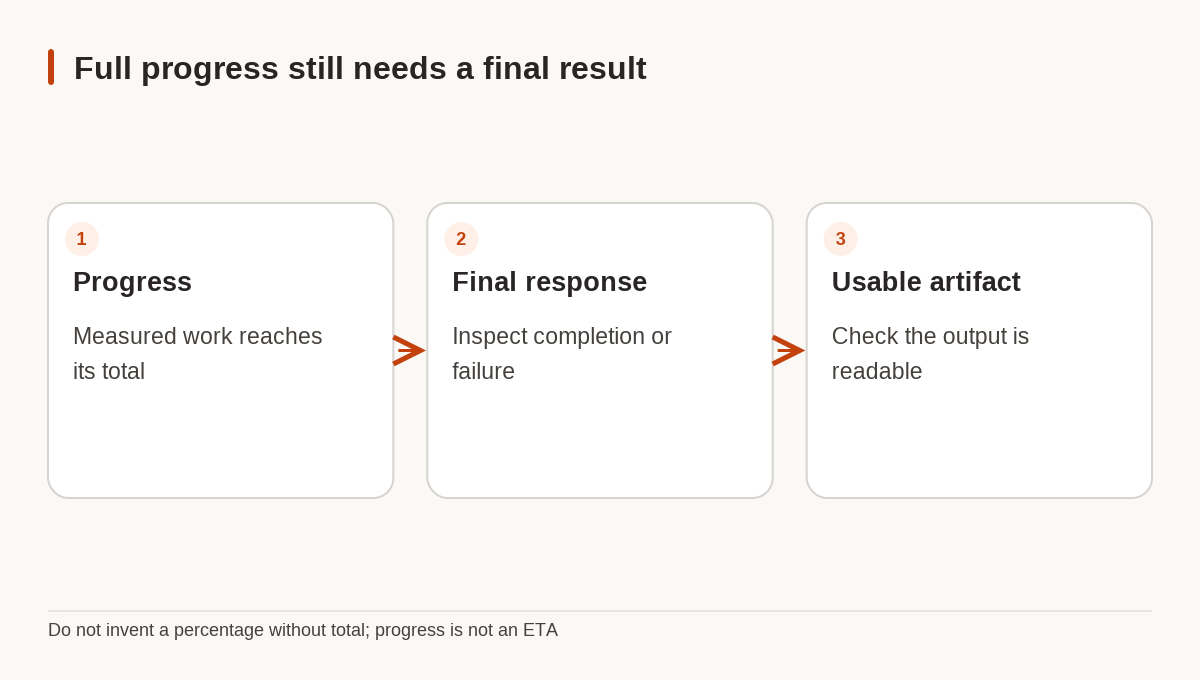
Even when progress reaches its total, the client still needs the final method response and a valid business outcome.
Progress values must increase between notifications. The total is optional, and both values can be floating point. Without a total, show processed work or a stage rather than inventing a percentage. A meaningful 4/10 can describe 40 percent of that measured work; it does not predict remaining time.
An export might finish preparing every section and then fail to write the final file. A full progress bar, a final resultType: "complete" response and a readable artifact are separate evidence. A result can also request further input; consult tool-result validation.
Why does a progressing task time out?
Implementations may reset a timeout on corresponding progress, but the specification still recommends an enforced maximum timeout.
Inspect the per-request timeout, the SDK's progress-reset behavior and the overall request deadline separately. Hosts, HTTP intermediaries and downstream services may impose independent limits.
For example, an application might wait up to 30 seconds without progress but at most five minutes overall. Notifications every ten seconds could avoid the idle threshold while still reaching the total deadline. These are illustrative settings, not MCP defaults or measured client behavior.
In 2026-07-28, request-scoped progress flows on that request's response stream, not on the subscriptions/listen stream used for opted-in change notifications. Listening for catalog changes is not a replacement for handling request progress.
Does cancellation prove the operation never happened?
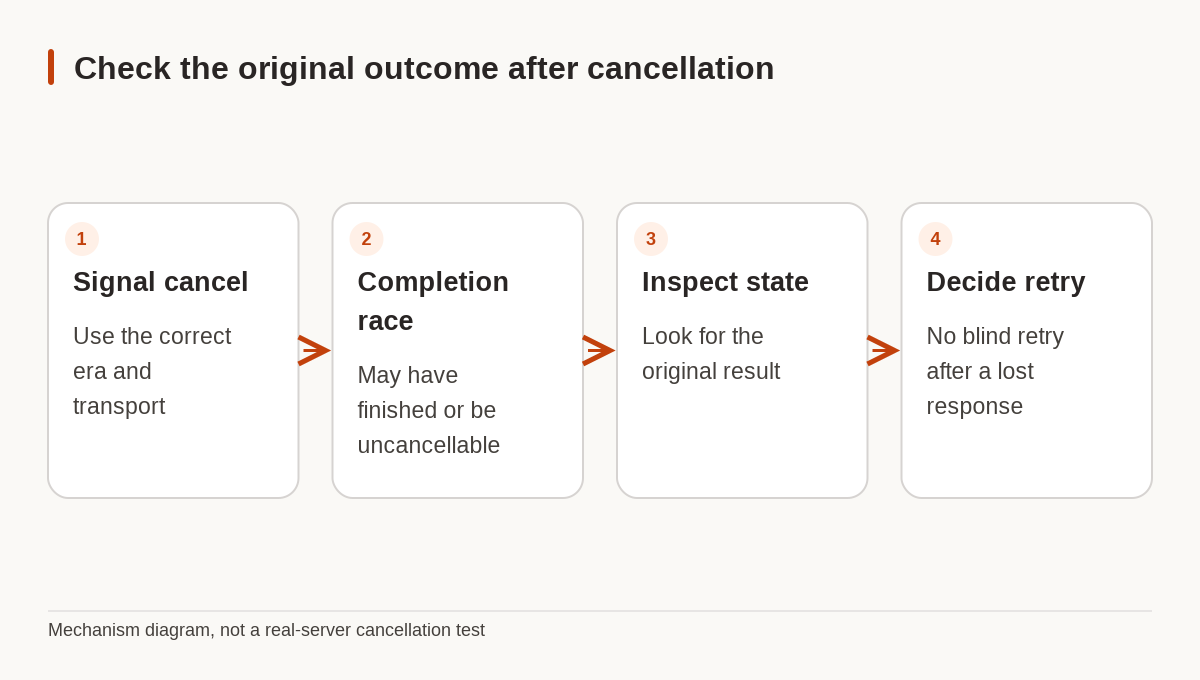
Cancellation races with completion and cannot roll back completed side effects.
For 2026-07-28 Streamable HTTP, closing the request's SSE response stream is the cancellation signal, which the server must treat as cancellation. With stdio there is no separate per-request stream to close, so the client sends notifications/cancelled referencing the request ID.
This notification is an illustrative current-protocol stdio message, not an extra message required for current HTTP cancellation:
{
  "jsonrpc": "2.0",
  "method": "notifications/cancelled",
  "params": {
    "requestId": "export-request-1",
    "reason": "User stopped the demo export"
  }
}
Older HTTP session and disconnect semantics differ. Check the protocol-era recovery guide rather than assuming all Streamable HTTP implementations behave identically. If an export or notification may already exist, inspect business state before repeating it.
What should a long-running client check?
Use a public operation without write side effects to check completion, missing totals, maximum timeouts and late results after cancellation.
Show progress and final completion separately. Avoid fabricated percentages. Preserve a clear reason when the total deadline is reached. Do not silently turn a late response into a new successful task after cancellation. For operations affecting external state, query that state before issuing another attempt.
Very long work may need an explicit task-handle design. The current change log moves experimental Tasks from the core protocol to an extension. Progress support does not imply task-extension support or durable execution after disconnection.
Keep protocol version, transport, stage, progress times and cancellation reason in a redacted diagnostic record. Nbility supplies the model API connection; host-to-MCP waiting behavior requires separate verification. Only message syntax was checked here, without real latency, proxy-timeout or cancellation measurements.