Turn a repeated review checklist into an MCP Prompt
Use prompts/list and prompts/get to retrieve a reusable review template, then verify the separate model execution and review outcome.

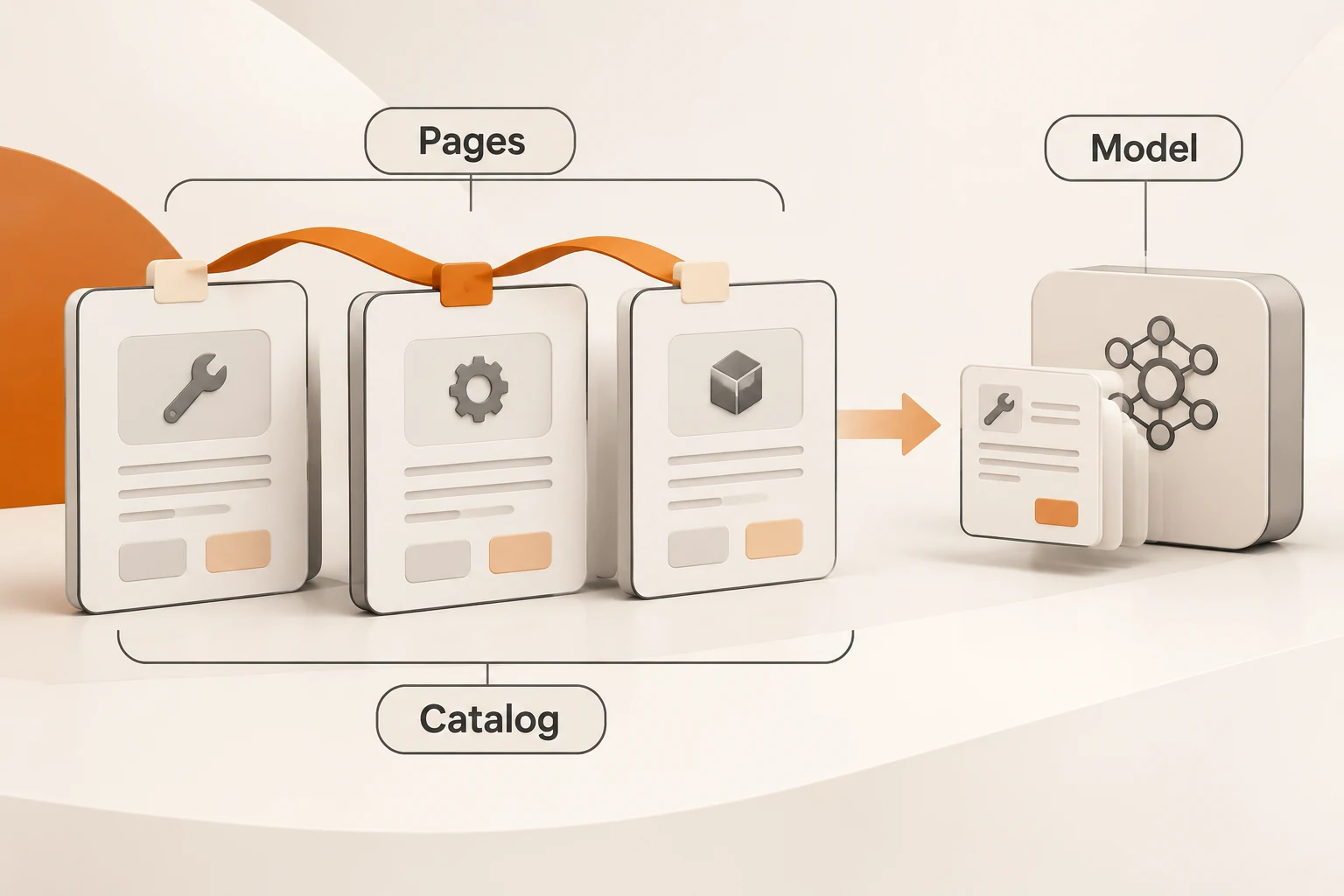
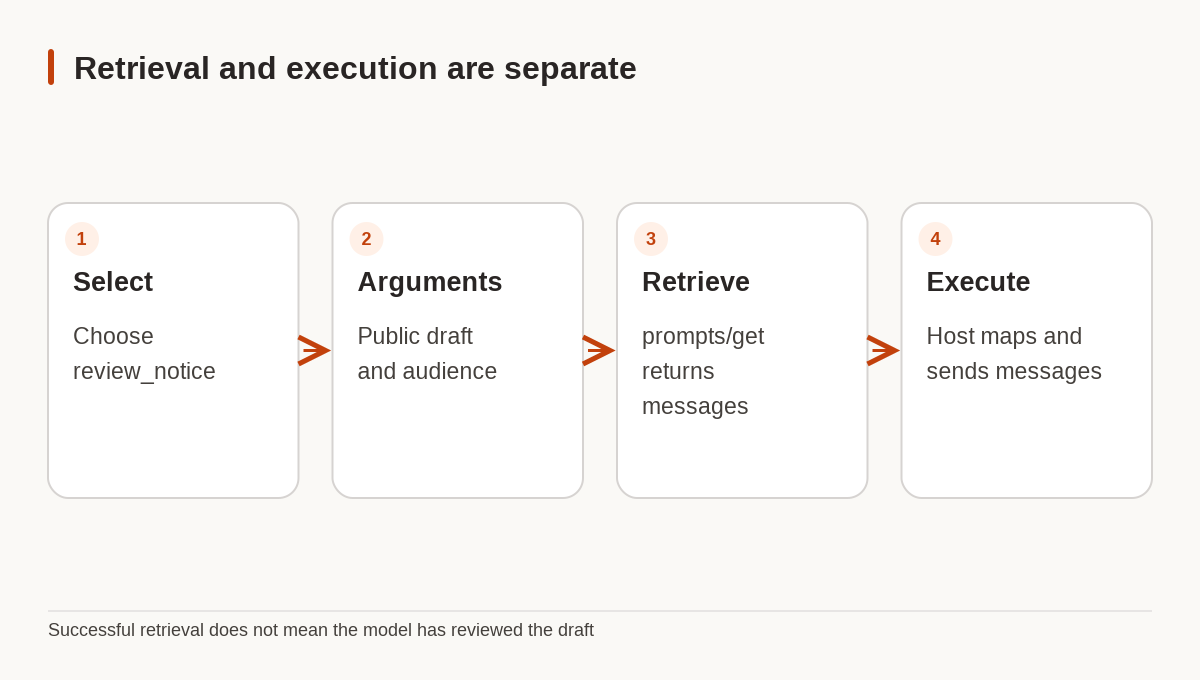
An MCP Prompt can make a repeated review checklist available as a selectable template. The user chooses it and supplies arguments; the server returns messages; the host decides how to send them to a model. Retrieving a template does not complete the review.
This article follows the 2026-07-28 Prompts specification, checked on November 25, 2026. The example reviews a public event notice. All exchanges are illustrative, with no connected business system.
When is a Prompt a useful template?
A Prompt fits a recurring checklist with recognizable inputs that a user explicitly chooses to run.
For an event notice, the checklist might require a concrete date, time, location and registration method, while rejecting unsupported promises. A review_notice template can apply these requirements to different drafts. Reuse helps consistency of instructions; it does not guarantee complete or correct model findings.
A chat prompt is input for the current interaction. An MCP Prompt is a discoverable server-provided message template. A Skill can also package scripts, resources and runtime dependencies. A Tool performs a query or action. For a portable procedure with scripts, see the Skill dependency checklist.
What does prompts/list return?
prompts/list describes available templates and their arguments, rather than returning completed reviews.
This is one catalog entry, not a complete JSON-RPC response:
{
  "name": "review_notice",
  "description": "Review a public event notice for missing details",
  "arguments": [
    {"name": "notice", "description": "Public draft text", "required": true},
    {"name": "audience", "description": "Intended readers", "required": true}
  ]
}
Prompt argument definitions use name, description and required. Do not copy a Tool's entire inputSchema into that position or assume SDK-specific extensions are interoperable protocol fields. In this example, prompts/get arguments are strings. Complex inputs need a documented serialization contract and server-side validation.
A host can support Tools without exposing Prompts. Check the host's supported features before treating a missing template selector as an installation failure. The MCP introduction places all three server primitives in context.
How is the draft supplied?
Call prompts/get with the template's exact name and its required arguments.
{
  "jsonrpc": "2.0",
  "id": "prompt-demo-1",
  "method": "prompts/get",
  "params": {
    "_meta": {
      "io.modelcontextprotocol/protocolVersion": "2026-07-28",
      "io.modelcontextprotocol/clientInfo": {
        "name": "article-reviewer",
        "version": "1.0.0"
      },
      "io.modelcontextprotocol/clientCapabilities": {}
    },
    "name": "review_notice",
    "arguments": {
      "notice": "Join our public demo this Saturday. Register now.",
      "audience": "First-time attendees"
    }
  }
}
An illustrative result member might contain the following. It supplies instructions, not a model's review:
{
  "resultType": "complete",
  "description": "Public notice review",
  "messages": [{
    "role": "user",
    "content": {
      "type": "text",
      "text": "Review this public notice for first-time attendees. Identify missing date, time, location and signup details. Do not invent them. Draft: Join our public demo this Saturday. Register now."
    }
  }]
}
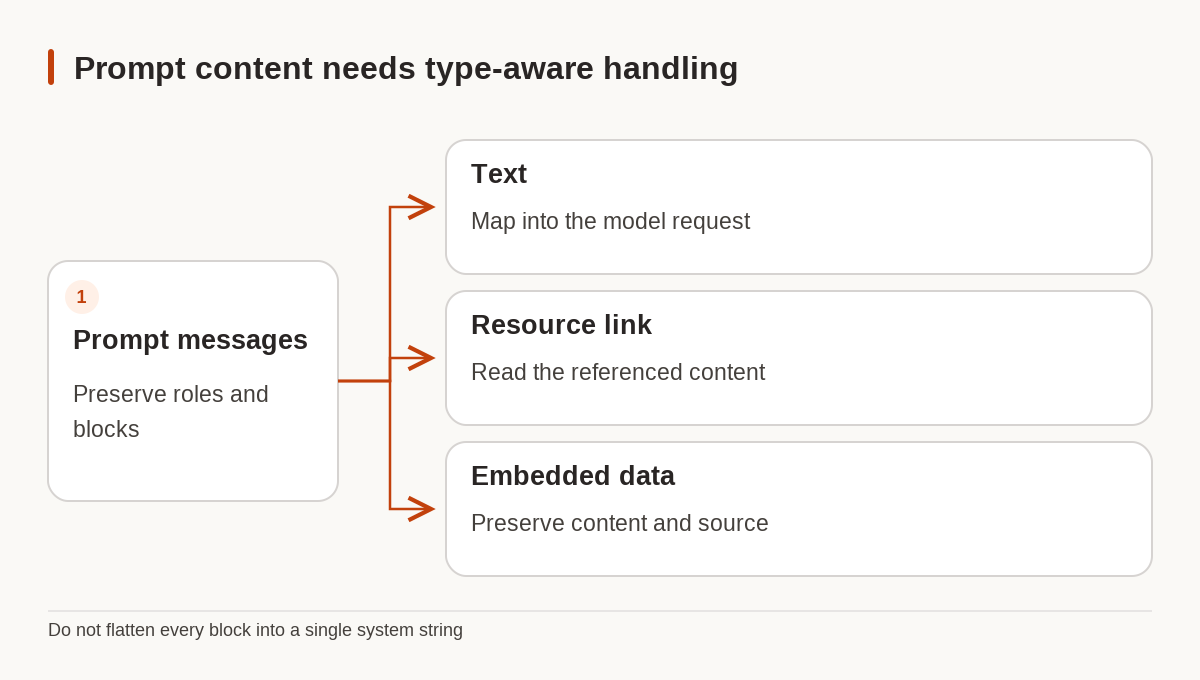
Prompt message roles are user or assistant. The host must map these messages and content blocks into the chosen model API. Flattening everything into a system string can change the roles and discard image, audio or resource content.
Does a resource link include its content?
An embedded resource contains data; a resource_link supplies a URI that the host may still need to read.
A template referring to event rules is useful only if the host can retrieve and include those rules. Preserve embedded text with its source rather than reinterpreting it as a local filename. The resource-to-context guide traces that path. Image and audio blocks also depend on host conversion and model support.
The current protocol also permits an input_required intermediate result from prompts/get. Handle additional input and continuation rather than displaying that response as a passed review. Use the connection flow for the actual protocol version.
Why does selecting the template not run it?
Prompts are designed for user-controlled selection, while each host chooses its interface and execution behavior.
A slash command is one possible UI, not a mandated command name. Inspect the server's declared prompts capability, the complete catalog, the retrieved messages and the eventual model request. Large catalogs also require cursor pagination.
Template content comes from the server. Choosing it does not grant new permission to send mail, edit files or run commands. Apply the host's authorization rules and the user's intent, including the tool-output permission boundary.
What should an acceptance check establish?
Use a deliberately incomplete public notice and verify retrieval, model execution and the substance of the feedback separately.
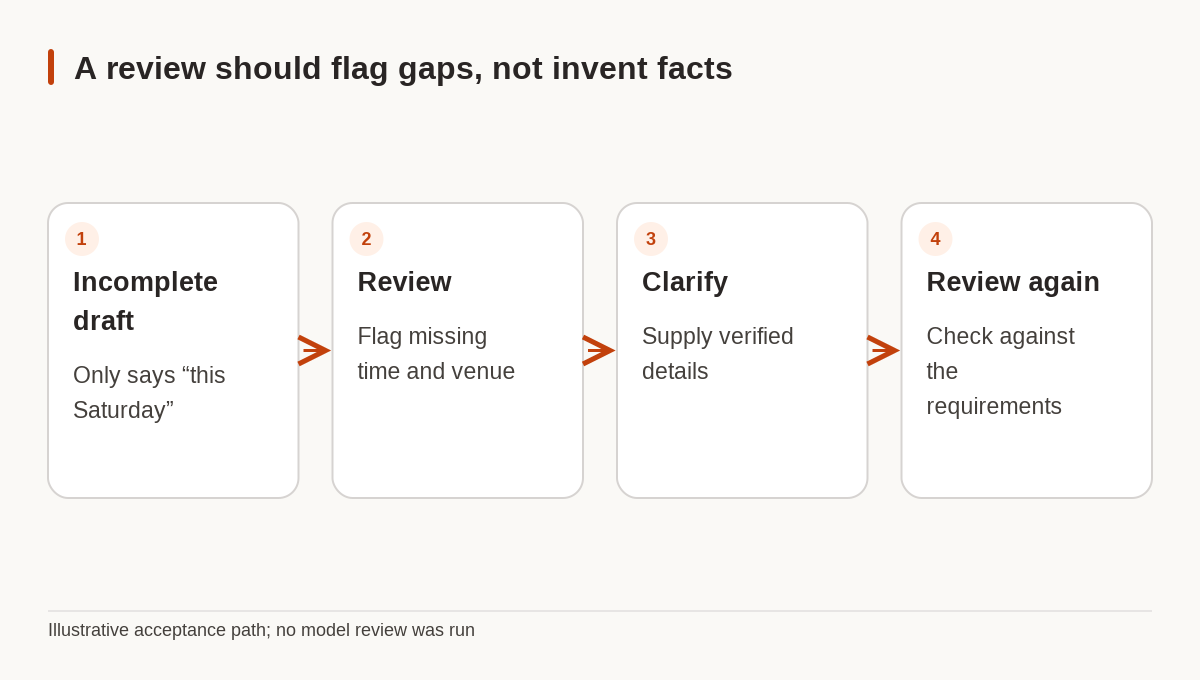
The review should identify missing details and request them without inventing a venue or a promise. Remove a required argument to check the server's error path; the specification recommends -32602 for missing required arguments. Track server or application-specific template versions when reviewing changes, and label any custom version field accordingly.
Nbility can supply the model connection described in the Chat Completions reference. Prompt discovery, retrieval, conversion and outcome validation remain the host's responsibility. The JSON was syntax-checked; this template, host UI and model review were not run.