Use Mistral OCR confidence to focus document review
Mistral OCR 4.1 can return structural blocks and confidence scores. Use them to locate review candidates while checking critical fields against the source.

A scan can be mostly legible while one amount, date, or negation is wrong. Mistral OCR's structural blocks and confidence scores can narrow the review area, but a score does not establish correctness or replace source checks for critical fields.
On November 22, 2026, the changelog and OCR guide documented mistral-ocr-4-1 with include_blocks and confidence_scores_granularity: "block". Block confidence dates to July; this is a practical document-processing guide rather than a new-release announcement. No document was uploaded and no recognition accuracy was measured.
Should you request page, block, or word confidence?
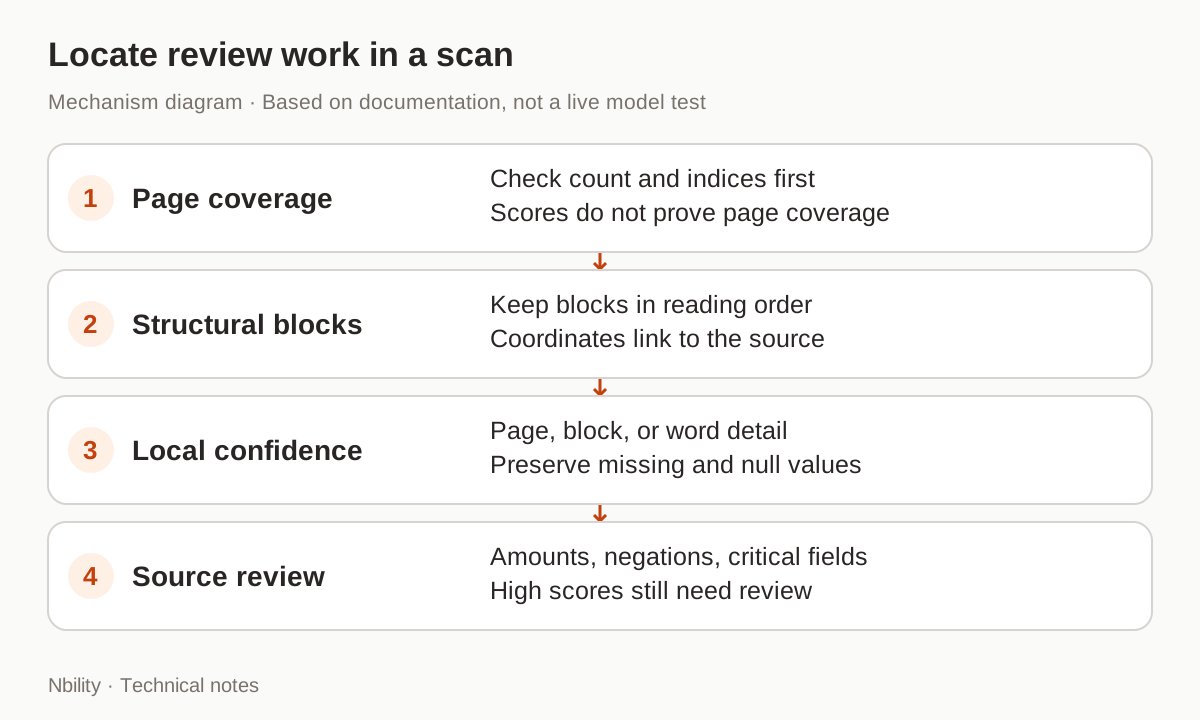
Block results are useful for assigning review work because they combine reading order, region coordinates, and local scores. Page confidence offers an overview; word confidence supports closer inspection.
| Setting | Main information | Useful for |
|---|---|---|
page | Page average and minimum content scores | Choosing pages to inspect |
block | Page scores plus block scores when block extraction is enabled | Locating a paragraph or table for review |
word | Page scores and per-word records, including table entries | Inspecting individual words |
The block setting does not replace include_blocks: true. Structural extraction requires OCR 4 or newer. Older models may accept the parameter but return an empty array, so empty blocks does not establish an empty page.
This differs from DeepSeek OCR completeness checks. Page coverage and the reliability of a returned character are separate questions, and the providers' fields are not interchangeable.
How do you request blocks and scores?
Enable block extraction and block confidence together. This example pins mistral-ocr-4-1 so a later change to a latest alias does not change the comparison.
curl --silent --show-error 'https://api.mistral.ai/v1/ocr' \
  -H "Authorization: Bearer $MISTRAL_API_KEY" \
  -H 'Content-Type: application/json' \
  -d '{
    "model": "mistral-ocr-4-1",
    "document": {
      "type": "document_url",
      "document_url": "https://arxiv.org/pdf/2201.04234"
    },
    "include_blocks": true,
    "confidence_scores_granularity": "block"
  }' -o ocr-response.json
The public paper URL comes from the official guide. The request needs a local official MISTRAL_API_KEY and was not sent here. For business documents, confirm permission to process the file and that the service can access it.
Blocks carry type, bounding coordinates, and content in reading order. Table blocks can reference tables through table_id; image blocks can reference images through image_id. Preserve those relationships so an extracted field can lead back to its source region. PDF citation chains explains why concatenating text alone loses useful evidence.
What do the three block scores mean?
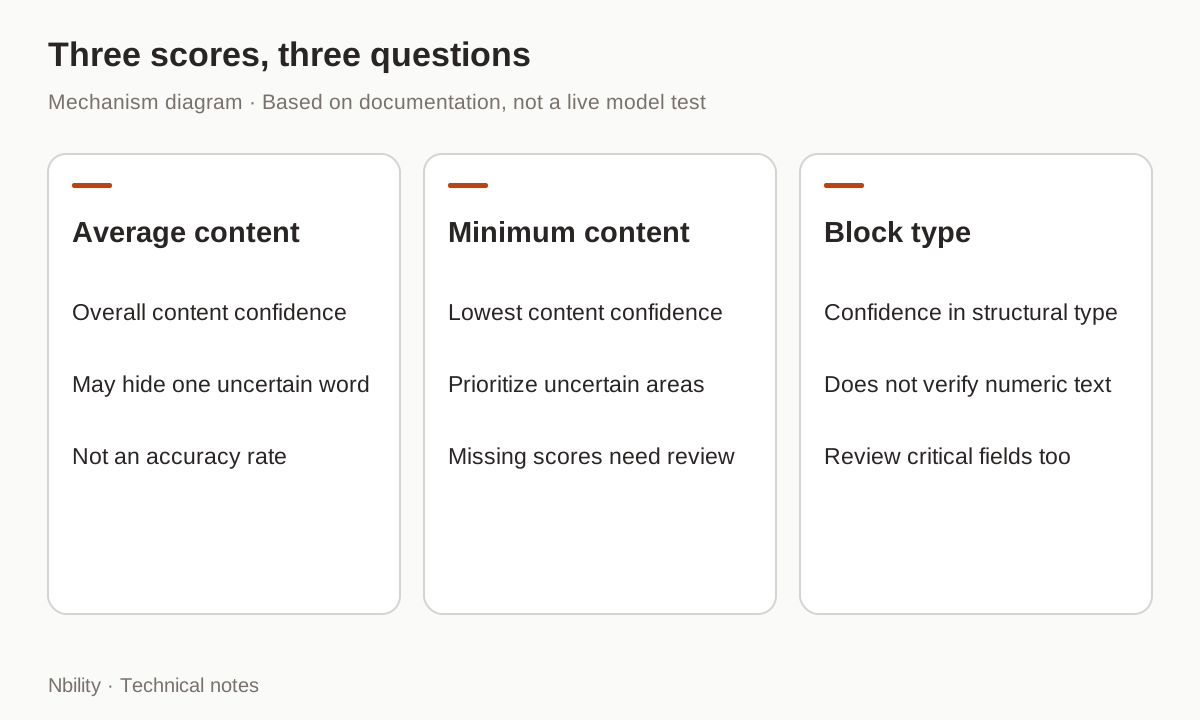
Average content confidence, minimum content confidence, and block-type confidence describe different judgments, not a single document accuracy rate.
average_content_confidence_scoreaverages confidence in the block's content.minimum_content_confidence_scorereports the lowest content confidence.block_type_confidence_scoreconcerns the detected structural type, such as a table or title.
A confidently detected table can contain a misread decimal point. A high average can hide one uncertain negation. Non-text blocks such as images can have null content scores; that is neither a zero score nor a reason to automatically approve the region.
Define business checks for amounts, account details, dates, negations, and exceptions, then use confidence to prioritize inspection. Critical fields still need source review at high confidence. Low, missing, or unfamiliar scores belong in a review path.
Can a script list review candidates?
A script can flag low or missing scores, but its output is a review queue rather than a list of verified text. This standalone example reads saved OCR JSON:
import json
import math
from pathlib import Path

result = json.loads(Path("ocr-response.json").read_text())
threshold = 0.90  # Demonstration policy, not a vendor recommendation
review = []
for page in result["pages"]:
    blocks = page.get("blocks")
    if not isinstance(blocks, list) or not blocks:
        review.append({"page": page["index"], "reason": "missing_blocks"})
        continue
    for index, block in enumerate(blocks):
        scores = block.get("confidence_scores") or {}
        score = scores.get("minimum_content_confidence_score")
        known = type(score) in (int, float) and math.isfinite(score) and 0 <= score <= 1
        if not known or score < threshold:
            review.append({
                "page": page["index"],
                "block": index,
                "reason": "low_or_missing_score",
            })
print(json.dumps(review, ensure_ascii=False, indent=2))
0.90 is an illustrative application threshold, not a vendor recommendation or a claim of 90% correctness. Calibrate a policy with documents that have human-reviewed answers, and retain mandatory checks for important fields. The script accepts scores in the 0–1 range and flags values outside it for review. Synthetic responses tested high, low, missing, empty, and invalid-score paths here; they do not test OCR quality.
Link candidates to the saved raw result and original document using the page index, block position, and coordinates. Preserve the mapping when converting indices to displayed page numbers or when the input is a cropped subset of the original.
How should corrected text reach the knowledge base?
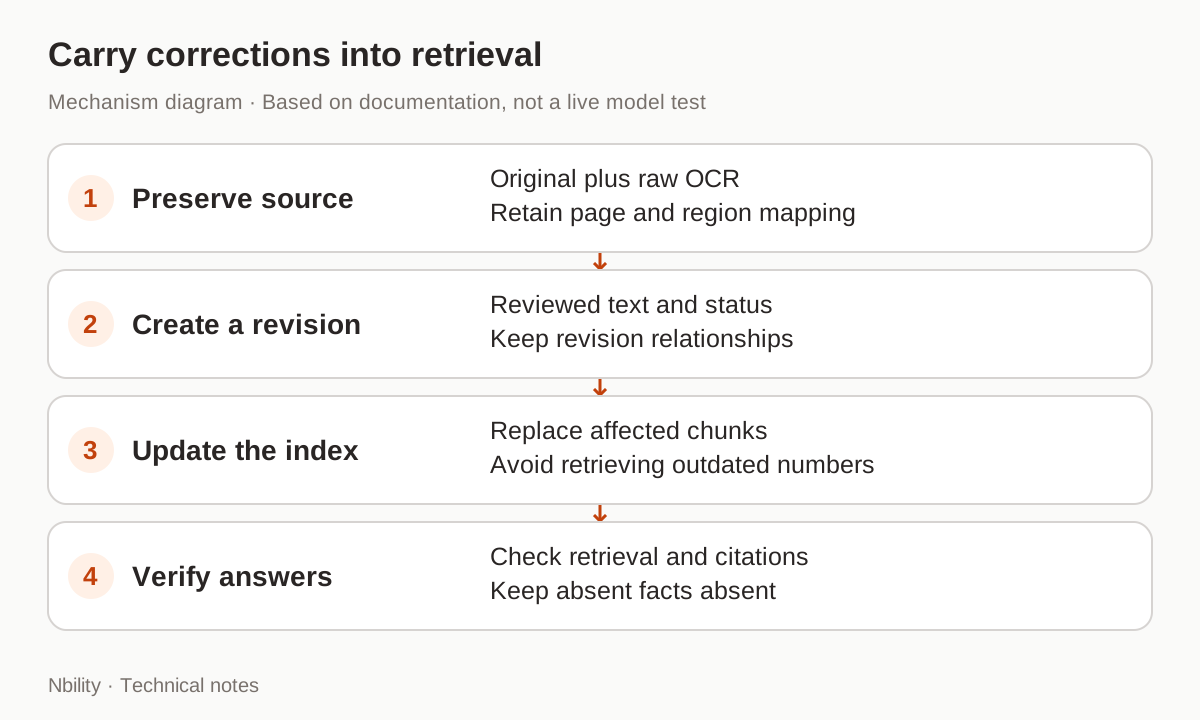
Keep the original, raw OCR, reviewed text, and review status linked, then index the approved revision.
Correcting a number in a text file does not update an old vector index. Identify the source and revision, rebuild affected chunks, and test retrieval and citations with explicit questions. Policy-version filtering covers version selection; unanswerable RAG questions help verify that absent facts remain absent.
This article uses Mistral's official OCR protocol. Nbility's model guidance and embedding API can inform the next stage, but do not establish support for the same OCR block endpoint. Validate extraction, location, and review on one public document before scaling up.