Before Retrying n8n: Check Whether the External Action Already Happened
Separate workflow failure from external action failure, preserve operation state, and test recovery in a copy before resending messages or repeating writes.

A digest workflow times out, you rerun it, and the group receives two copies. Workflow acknowledgement and external delivery are different facts. Not receiving a receipt does not establish that the action never happened.
Checked on November 10, 2026, this guide uses current n8n execution and error-handling documentation, the 2.46.7 stable release record, and a recent report. It provides a design and isolated verification plan; we did not run it against production n8n, messaging, or order systems.
Mark every external write
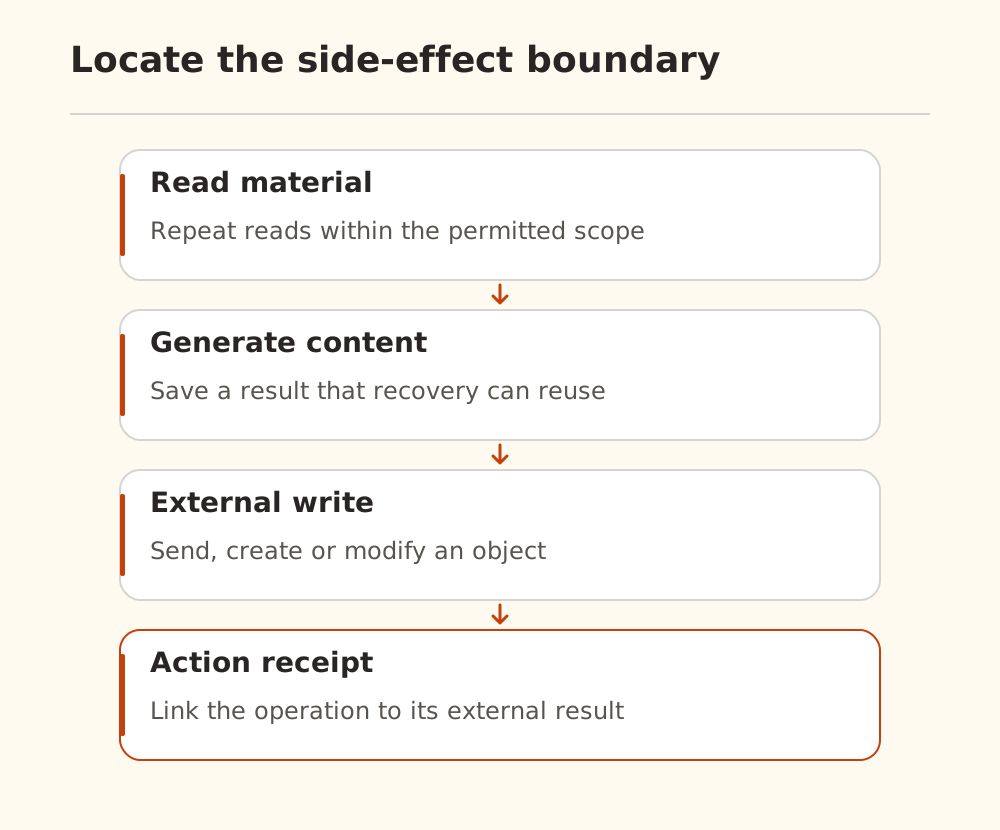
Separate reading source material, generating a summary, and sending it. Regeneration and message delivery have different recovery conditions. Sending, creating orders, changing inventory, and database writes require external outcome checks.
For each write, identify whether the destination supports result lookup or business idempotency, including key scope, lifetime, and payload rules. Adding an Idempotency-Key header to an HTTP Request node does not make an arbitrary service honor it.
The retry guide explains request amplification. Here the focus is an uncertain external outcome: the destination may have completed the action while the caller lost the response.
Identify the business operation across executions
This is a teaching record, not a built-in n8n object or a real execution:
{
  "operation_key": "demo-digest-2026-11-10-team-a",
  "action": "send_digest",
  "payload_version": "v1",
  "state": "pending_confirmation",
  "workflow_execution_ref": "DEMO_EXECUTION",
  "external_result_ref": null
}
The key identifies one business intention within the appropriate organization, task, and date scope. A new workflow execution ID should not turn the same digest into a new intended send. If content changes, define whether that means an update or a new version; do not casually reuse a key for different content.
Persist operation records and make claiming an operation atomic. An in-memory set disappears on restart, while a separate check-then-insert can race. Even an atomic local claim cannot close the gap between an external success and a local crash. Recovery still needs destination idempotency or a reliable lookup.
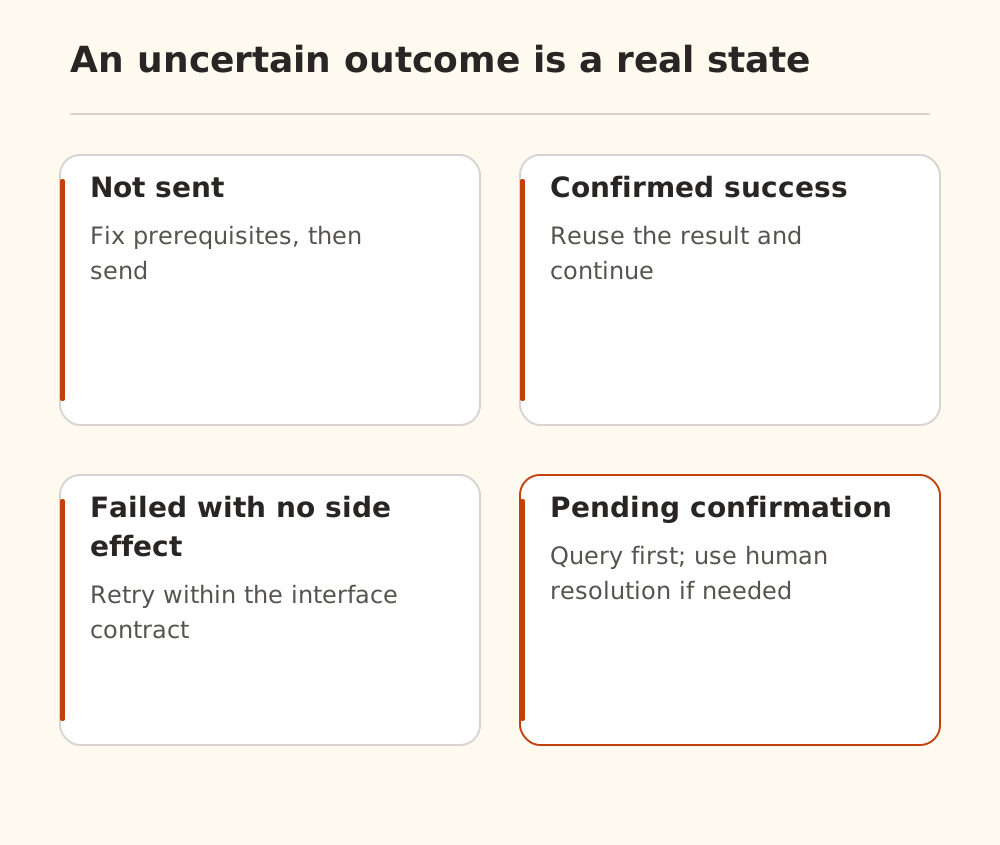
| Evidence | Recovery |
|---|---|
| Definitely not sent | Fix prerequisites and send |
| Destination confirms success | Reuse the result and continue |
| Definite failure with no side effect | Retry within the destination's rules |
| Sent but outcome unknown | Query first; pause for human resolution if needed |
pending_confirmation deliberately preserves uncertainty rather than disguising it as success or failure.
Debugging controls can still execute real nodes
The n8n debug guide describes loading old execution data and pinning it at the first node. That preserves an input; it does not automatically suppress later writes.
The execution-types documentation says Execute step can run the target and preceding nodes needed for its input. Production executions ignore pinned data. A pinned node is not a workflow-wide sandbox.
In a copy, replace production credentials and destinations with isolated substitutes, disable unnecessary writes, and determine what will run before executing. The n8n connection tutorial covers model access rather than this recovery contract.
Check caller and child outcomes independently
n8n #43136 reports a completed child workflow whose caller received the result later, under 2.46.6, queue mode, and native Agent workflow tools. The author added observations on November 10; the issue remained open. It includes production observations, focused event tests, and an undeployed patch. We did not reproduce it or adopt its timings as our measurements.
It is not a universal timeout explanation or proof of a fix in the newest release. It illustrates why waiting at the caller does not establish that a child did nothing. Empty Agent tool results describe another distinct handoff problem.
Verify recovery in a copy
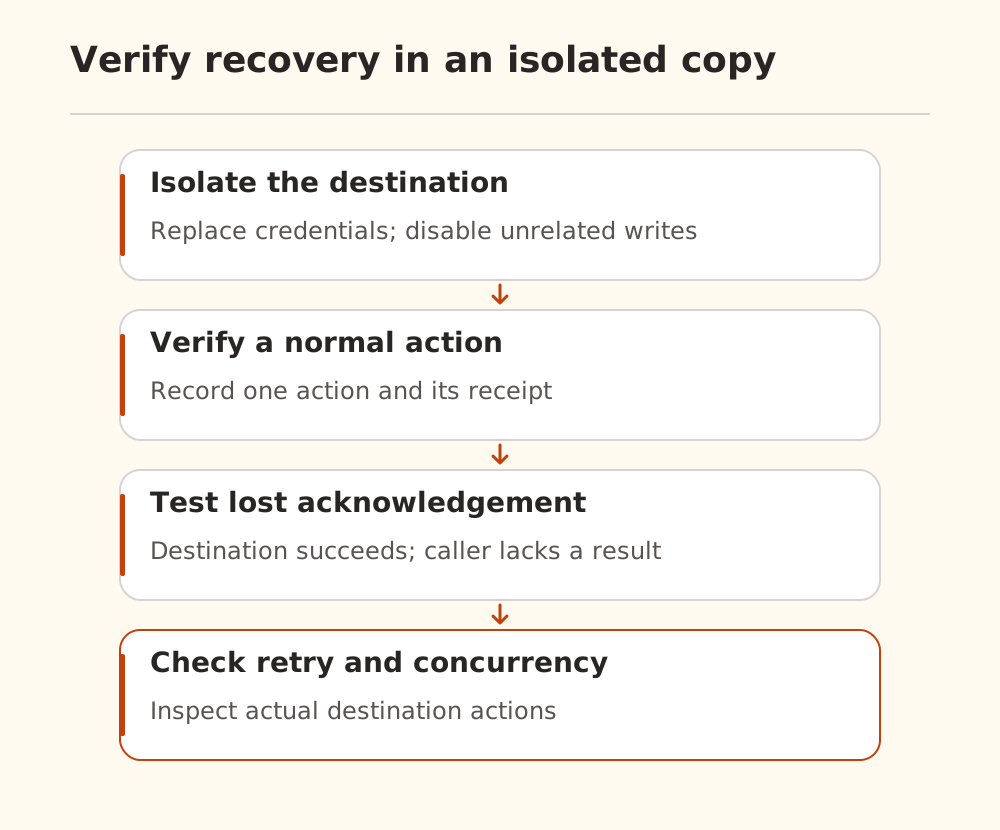
Check normal completion, definite non-delivery, destination success with a lost response, and concurrent recovery of the same operation. Inspect actual action counts and records at the destination. If there is no supported idempotency or reliable query, retain a human confirmation step.
An error workflow can alert and link an execution; it does not undo sent messages. Keep alerts bounded and preserve a redacted support record. Record Nbility model calls separately from business sends so recovery targets the right stage.