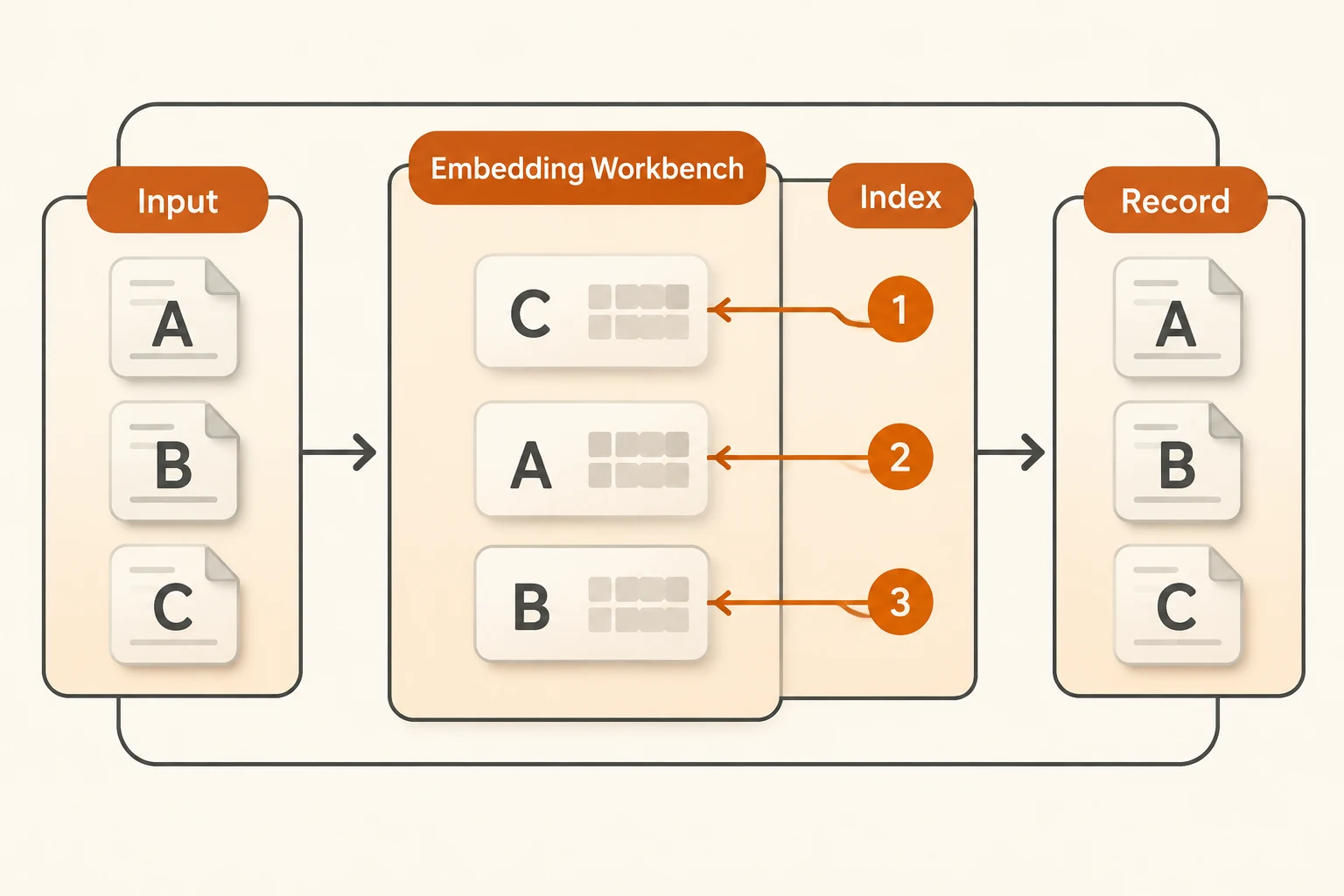
A vector similarity of 0.8 is not 80 percent confidence
Vector search thresholds depend on the metric, model, and corpus. A reproducible unit-vector example separates cosine, Euclidean distance, and answer correctness.
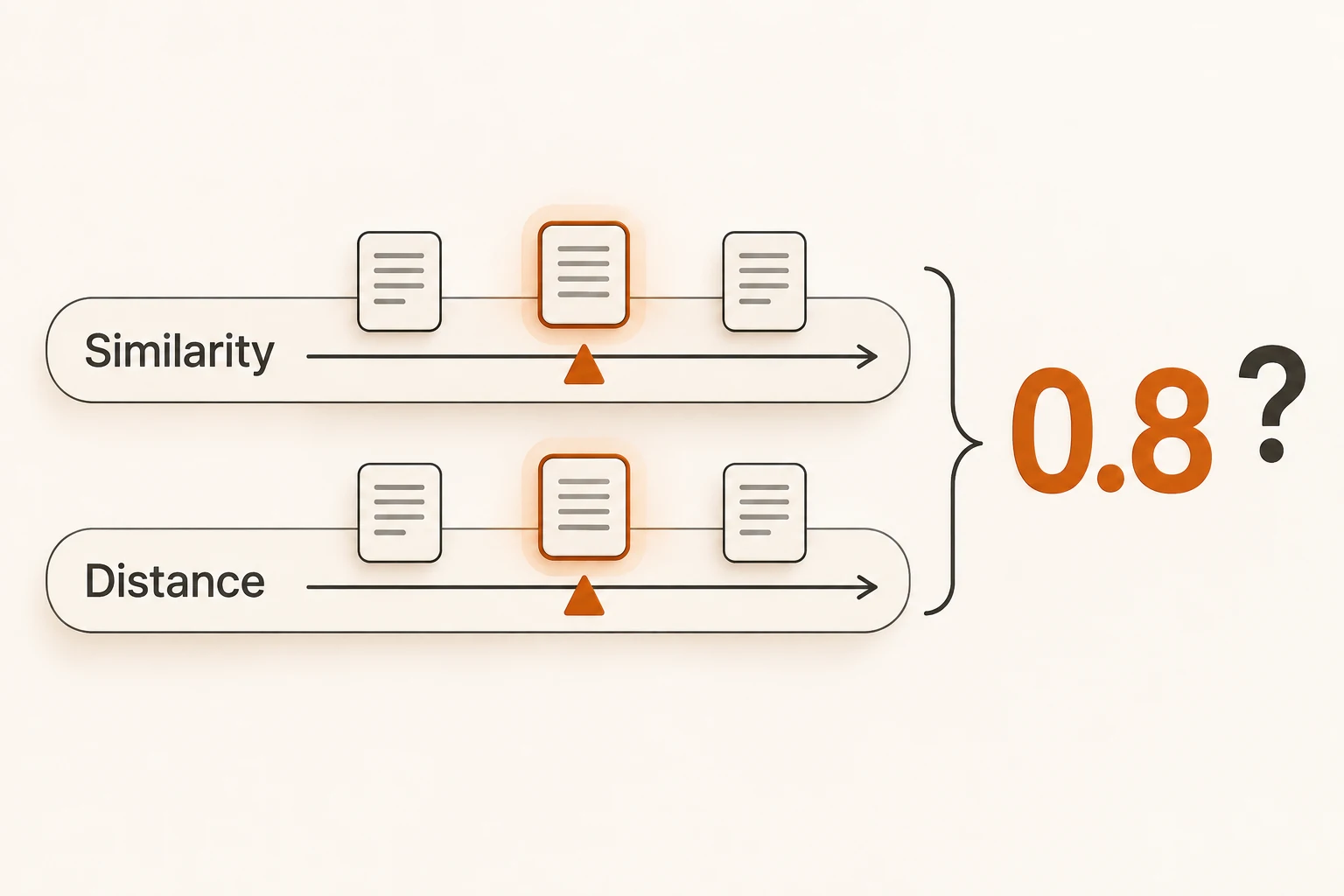
A vector-search score of 0.8 does not mean an answer has an 80 percent chance of being correct. First establish whether it is cosine similarity, a distance, a model score, or a framework transformation. A threshold also needs rechecking after changes to the model, chunking, or retrieval backend.
This article checks Qdrant's search and score-filtering documentation, OpenAI's embedding guide, and the multilingual-e5-large model card on November 26, 2026. All numerical examples below use explicitly defined teaching vectors, not embeddings of real text.
Is a higher score always better?
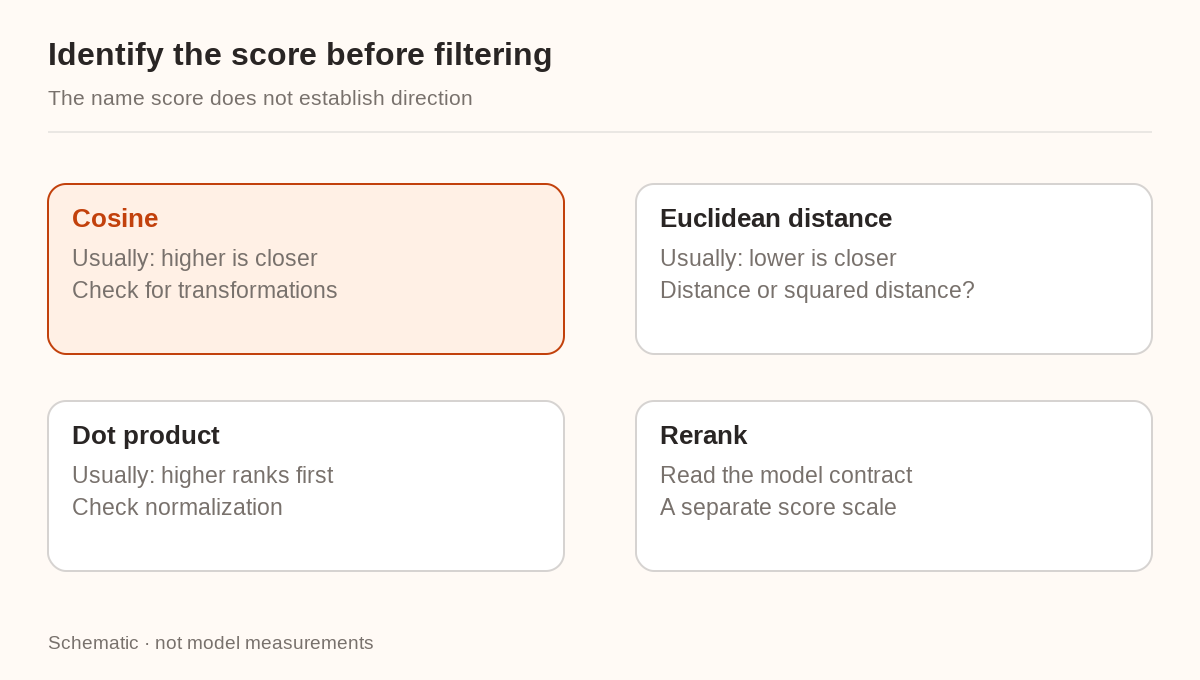
No. Cosine similarity generally increases with closeness, while Euclidean distance decreases. A framework may transform distances into another relevance scale, so a field called score does not establish its direction.
| Value | Usual preference | Check before applying a threshold |
|---|---|---|
| Cosine similarity | Higher | Is the value raw cosine? |
| Euclidean distance | Lower | Distance, squared distance, or a transformed value? |
| Dot product | Higher | Are vectors normalized, or does magnitude affect ranking? |
| Reranker score | Model-specific | Do not interpret it as vector similarity or correctness probability |
Qdrant explicitly documents that score_threshold removes worse scores according to the metric. For Euclidean metrics, larger, more distant values are excluded. Do not copy a generic score >= threshold condition from a different wrapper without checking its meaning.
Can the difference be calculated directly?
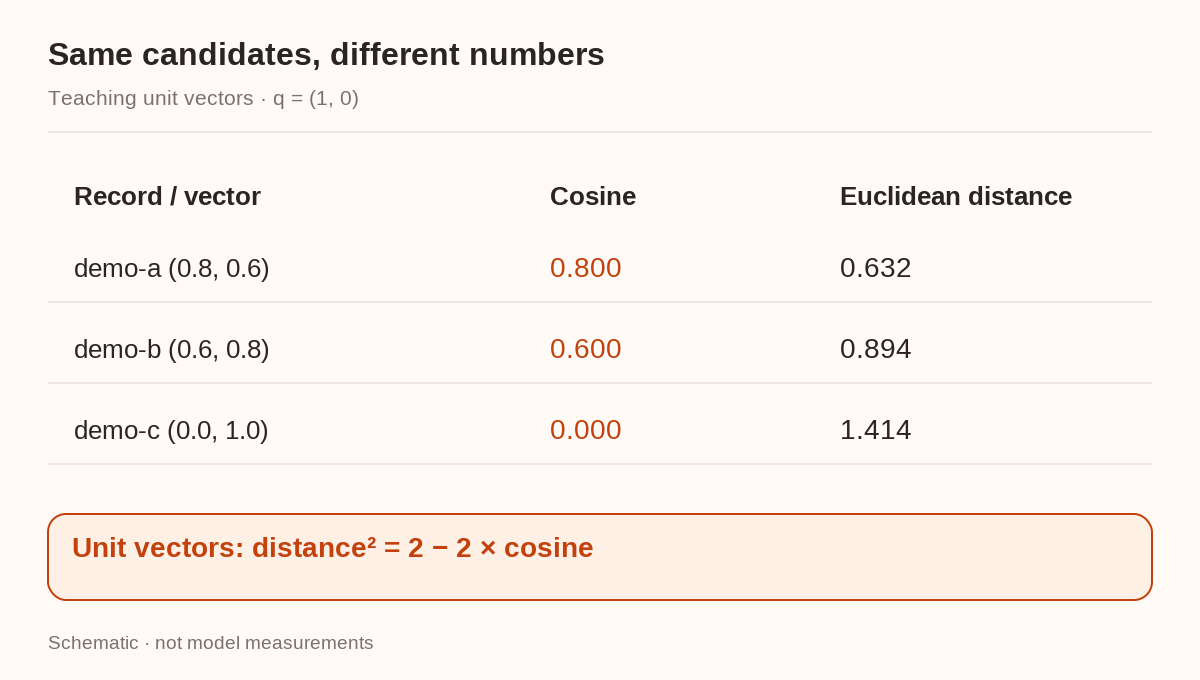
Yes. A query q=(1,0) and three unit vectors give a small reproducible example. This complete Python program uses only the standard library:
import math

q = (1.0, 0.0)
vectors = {
    "demo-a": (0.8, 0.6),
    "demo-b": (0.6, 0.8),
    "demo-c": (0.0, 1.0),
}
for record_id, vector in vectors.items():
    dot = sum(a * b for a, b in zip(q, vector))
    cosine = dot / (math.hypot(*q) * math.hypot(*vector))
    distance = math.dist(q, vector)
    print(record_id, f"cosine={cosine:.3f}",
          f"euclidean={distance:.3f}")
Its calculated values are:
| Record | Cosine | Approximate Euclidean distance |
|---|---|---|
| demo-a | 0.800 | 0.632 |
| demo-b | 0.600 | 0.894 |
| demo-c | 0.000 | 1.414 |
The same record has two numerical values. Equal ranking does not make thresholds interchangeable. For unit vectors, distance² = 2 - 2 × cosine, so a cosine minimum of 0.8 corresponds to a Euclidean maximum of approximately 0.632. This relationship applies to unit vectors and these raw formulas, not arbitrary database score fields.
OpenAI documents that its embeddings are normalized to length 1 and therefore give identical cosine and Euclidean rankings. That statement does not cover every provider, manually shortened vectors, or unchecked postprocessing.
Why can a new model produce higher scores overall?
Training affects the score distribution. Higher absolute values do not automatically mean better retrieval. The E5 model card specifically explains that cosine values around 0.7 to 1.0 are expected for that model and emphasizes relative ordering. That is not a target range for every embedding model.
During migration, hold the corpus and questions fixed. Check whether correct evidence is retrieved and unrelated material enters the answer before selecting a threshold. Investigate space, dimension, and cache compatibility first when an index may be inconsistent.
How do you choose a threshold beyond demonstration questions?
Label questions and their required evidence before examining candidate thresholds. Include direct questions, paraphrases, exceptions, similar product IDs, and questions with no answer. Reserve some cases for checking the selected setting afterward.
Record the metric, normalization, chunk revision, filters, and candidate count. A stricter threshold may remove distracting context but also exclude an important exception. Keep critical business cases visible instead of relying entirely on an aggregate result.
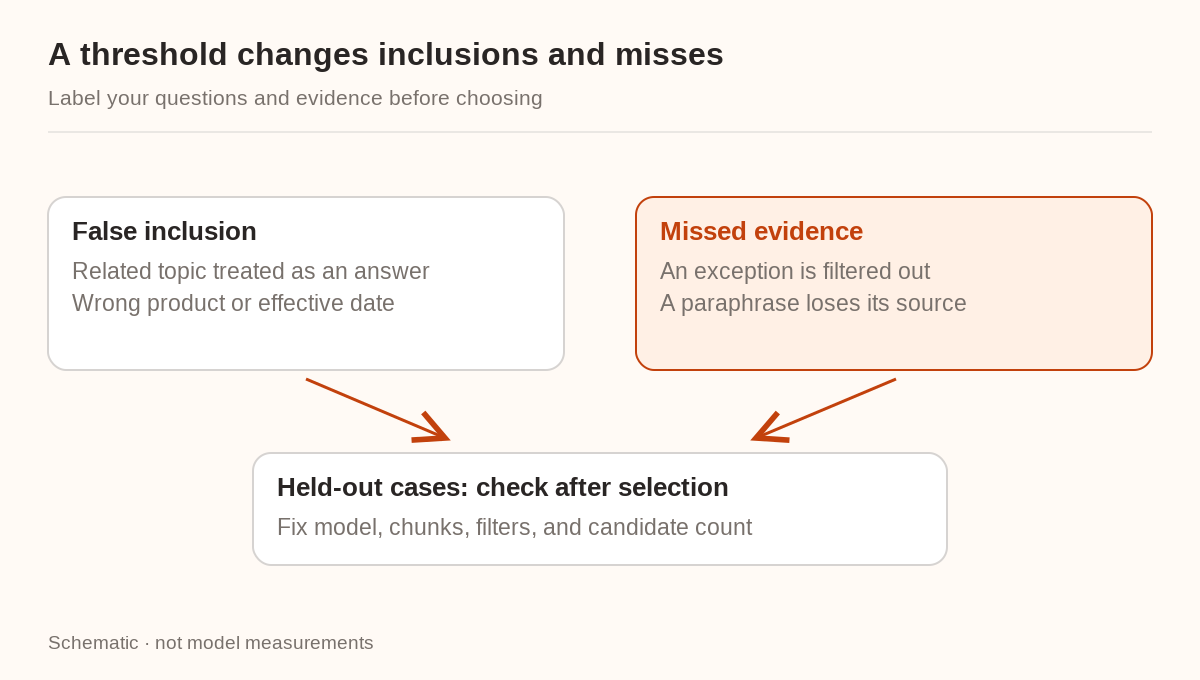
No candidate passing a threshold is different from the corpus containing no answer. The former may be a retrieval failure. Use unanswerable-question checks to separate the two and detect a setting that rejects questions the system should answer.
Can vector search and reranking share a threshold?
Decimal output alone is no reason to reuse a threshold. Vector retrieval and reranking are separate stages with separate scoring semantics. Track candidate coverage, retained evidence after reranking, and support for the final answer.
The candidate-coverage guide explains why reranking cannot recover a document it never receives. Use Nbility's Rerank API and Embeddings API documentation for their respective contracts.
We ran the two-dimensional calculation locally and checked the unit-vector relationship. We did not call embedding or reranking models, query a live vector database, or determine a universal threshold. The operational choice still depends on your corpus and tolerance for errors.