Give Claude an advisor without handing over execution
Claude’s advisor tool adds strategic guidance inside an executor turn. Understand model pairing, opaque results, separate usage, and paused-turn recovery.

A development task mixes strategic choices with routine execution. Claude's advisor tool lets an executor consult another model at a difficult point, then continue the task itself. The advisor does not take over the terminal or run tools.
This is a way to evaluate a lighter executor with occasional stronger guidance. Whether it pays off depends on completed tasks and combined usage. This article checked the advisor guide and November 9 model changes on November 22, 2026. No live advisor request or performance comparison was run.
What can the advisor see and do?
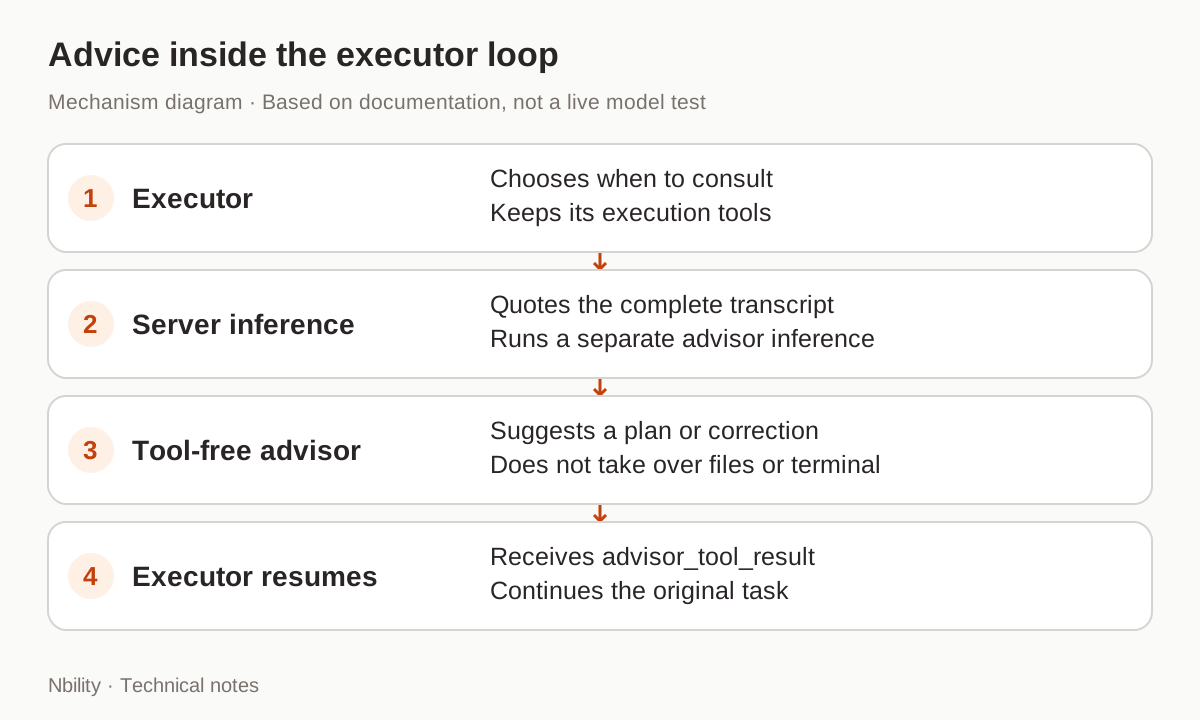
The advisor receives the executor's full transcript as quoted context: system instructions, tool definitions, earlier results, and text already generated during this turn. The advisor has no tools and no context management of its own.
The executor chooses when to call advisor. The server runs a separate inference, returns an advisor_tool_result, and lets the executor continue. This normally happens inside one /v1/messages request, with paused turns requiring special handling.
That differs from agents working in separate worktrees, which raises questions about file ownership, commits, and merging. An advisor adds guidance inside the executor's loop; it does not provide an independent checkout or parallel test runner.
Because the complete transcript reaches the advisor inference, review its model and platform against the same data-handling requirements as the executor.
What does a minimal request look like?
The Messages API uses advisor_20260301 and the advisor-tool-2026-03-01 beta header. This example follows the documented Sonnet 5 executor and Opus 5.5 advisor pairing, with explicit call and output caps:
import anthropic

client = anthropic.Anthropic()
response = client.beta.messages.create(
    model="claude-sonnet-5",
    max_tokens=4096,
    betas=["advisor-tool-2026-03-01"],
    tools=[{
        "type": "advisor_20260301",
        "name": "advisor",
        "model": "claude-opus-5-5",
        "max_uses": 2,
        "max_tokens": 2048,
    }],
    messages=[{
        "role": "user",
        "content": "Review a proposed CSV import design. Explain validation order, duplicate handling, and how to test failure recovery. Do not access external systems.",
    }],
)
print(response.model_dump_json(indent=2))
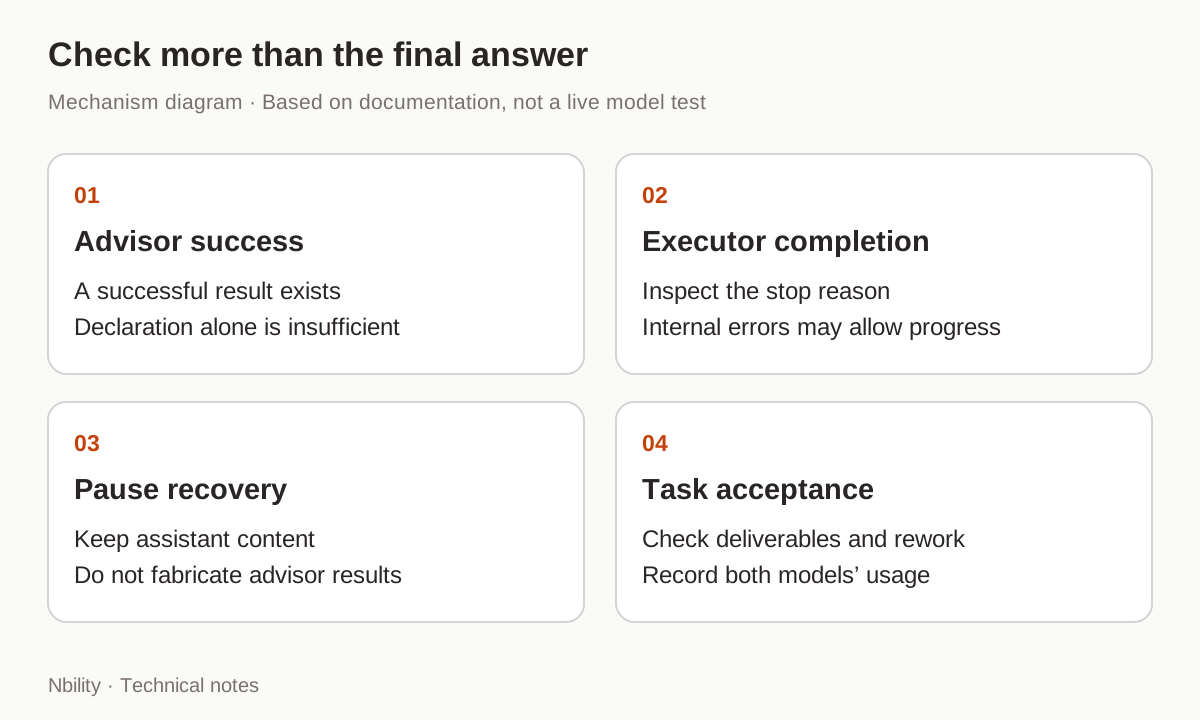
The example requires an official ANTHROPIC_API_KEY. Only Python syntax was checked. It exposes no file tools and cannot inspect a real repository. Declaring an advisor also does not guarantee a call: verify response blocks rather than guessing from the final answer.
max_uses applies to the whole turn, which may span several requests after pause_turn or client tool results. Top-level max_tokens limits executor output. The tool's max_tokens limits each advisor call's thinking and text, with a current minimum of 1024. Neither cap substitutes for the other.
Can the same advisor be kept when moving to Fable 5.2?
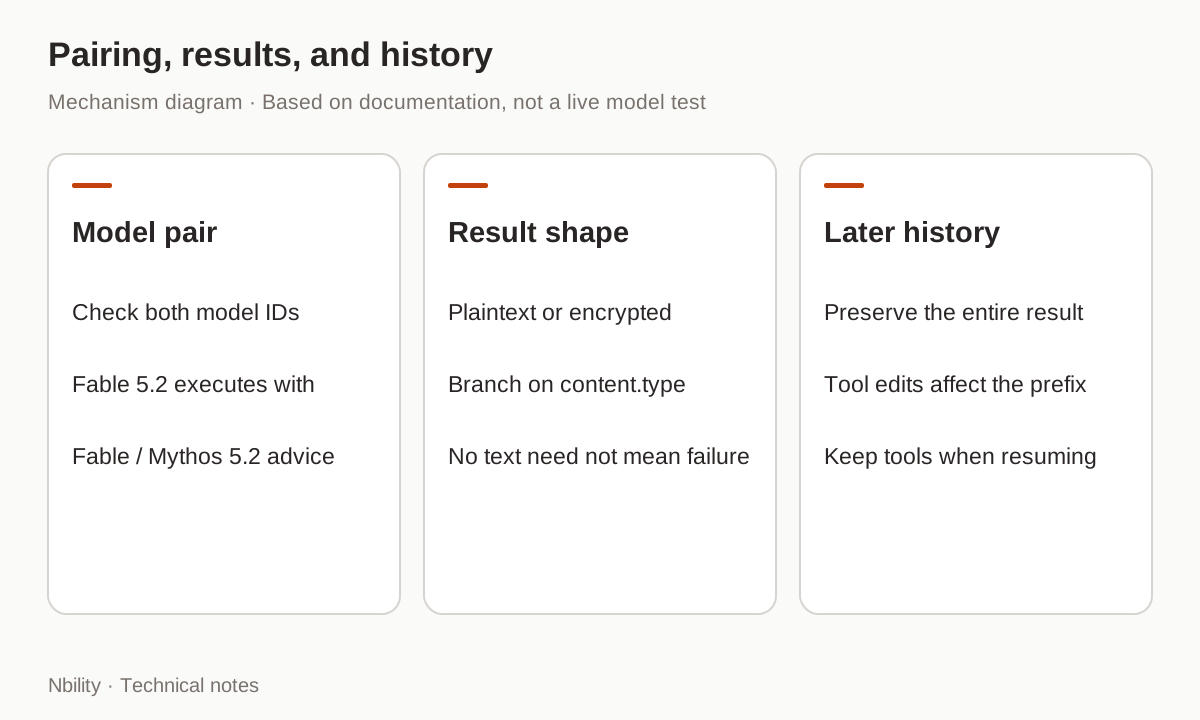
A Fable 5.2 executor currently accepts only Fable 5.2 or Mythos 5.2 as its advisor. Replacing only the executor while retaining an Opus advisor returns a 400.
Check both model fields against the compatibility table. Model names and numbers alone are insufficient. The Fable model-choice article discusses positioning; organization and platform eligibility remain separate checks.
Successful results are not always readable advice. Opus 5.5 and several other advisors return advisor_redacted_result with encrypted_content; some earlier advisors return plaintext advisor_result. Missing text is therefore not automatically an error. Preserve the entire result block unchanged rather than decoding or replacing the opaque content.
Why do top-level usage totals omit the advisor?
Top-level usage fields total executor tokens only. Advisor usage appears in usage.iterations[] entries with type: "advisor_message", billed at the advisor model's rates.
Separate message executor iterations from advisor iterations. Do not sum executor iterations and then add top-level executor totals again. Preserve ordinary input and cache categories as reported. A short visible suggestion does not establish a low-cost call.
There is no live invoice behind this article, so there is no savings percentage. Compare the same task and completion criteria, recording success, rework, calls, time, and complete usage. Investigating model quality and agent call chains provide useful context. Advice creates value only if the extra inference helps the overall task.
What happens when the advisor fails or pauses?
An advisor error need not fail the HTTP request. advisor_tool_result_error can indicate a call cap, rate limit, capacity issue, or excessive context; the executor receives it and continues.
If a workflow requires successful consultation, check for a successful advisor result rather than accepting HTTP 200 or fluent final text as evidence.
A response ending with stop_reason: "pause_turn" can contain a pending server_tool_use without an advisor result. Append that assistant content unchanged and resume with the same advisor tool and beta header. Do not fabricate a client tool result for a server-side advisor. If a client tool is also pending, follow the tool_use path and return its results normally.
Changing advisor settings mid-conversation also edits the tools prefix when thinking blocks are present. Thinking-prefix validation explains the risk. Establish the configuration in a disposable conversation before relying on it for a long task.
Nbility's Claude compatibility documentation does not promise every server-side beta tool. Verify beta headers, advisor result preservation, and usage reporting through the chosen gateway; official availability is not evidence of a tested gateway integration.