Claude's text watermark is live: which models carry it, and who can check
Since November 16, 2026, supported Claude models watermark their text output. Here is what the watermark actually encodes, which models and platforms carry it, when sampling parameters weaken it, and why only a few organizations can detect it today.
Claude's text output now carries a watermark. The November 16, 2026 release notes state that Claude Opus 4.6, Opus 4.5, Sonnet 4.5, and Haiku 4.5 carry Anthropic's text watermark on supported platforms, and the help center's model table also lists the newer Fable 5.2, Opus 5.5, Sonnet 5.5, and Haiku 5.5. The watermark does not change meaning, adds no tokens, and cannot be traced back to a person or organization. Checking whether a passage came from Claude, however, requires Anthropic's detection API, which is open to a small set of organizations for now.
This article was checked on November 17, 2026 against three official sources: the text watermark page in the platform docs, the help center article on how Claude marks AI-generated content, and Anthropic's technical explainer (published August 14, 2026, updated September 1 with detection API details). I did not send a live request to observe the watermark and have no access to the detection API, so the sections below separate official statements from what can be checked locally.
What the watermark is: a pattern in the choices that do not matter
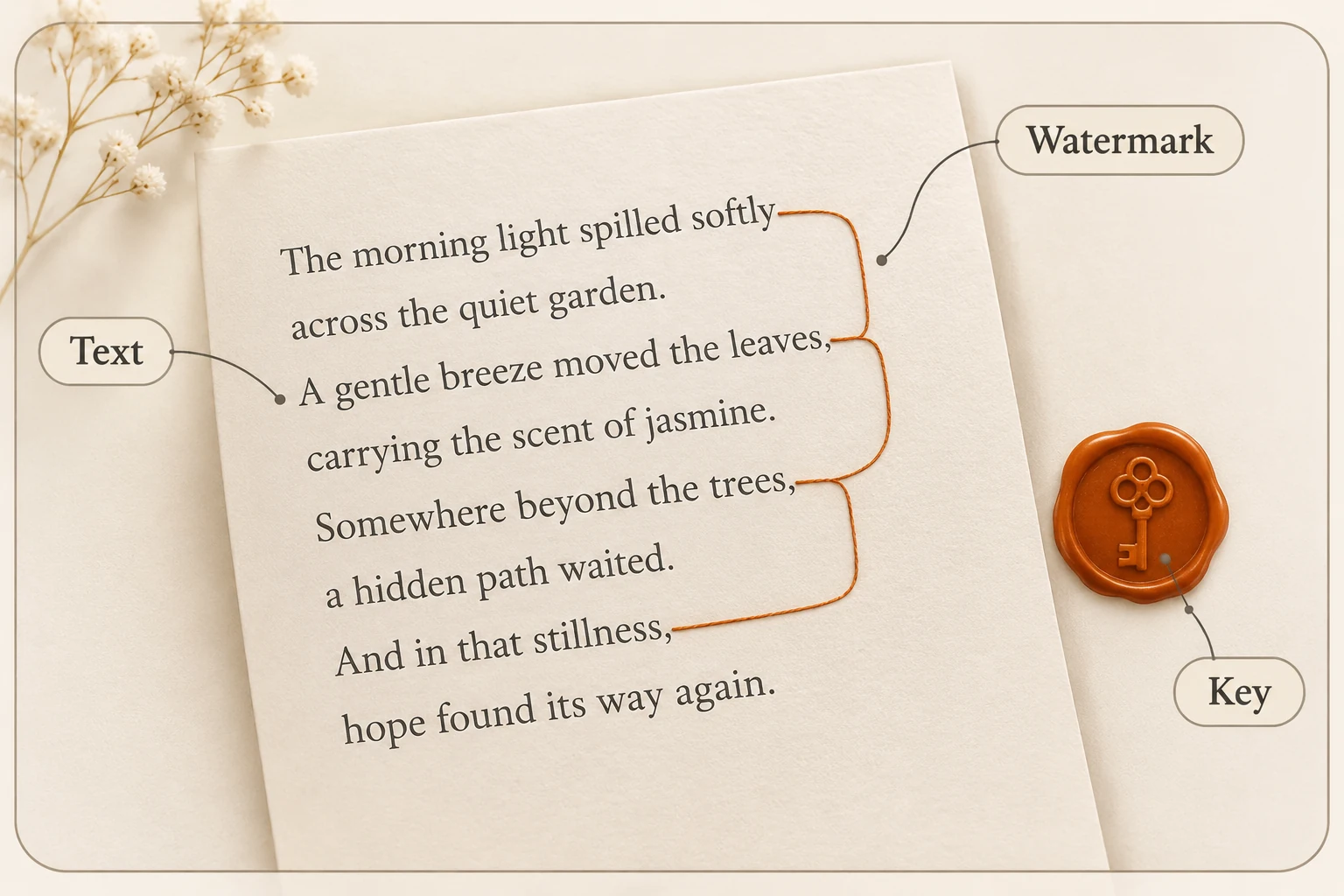
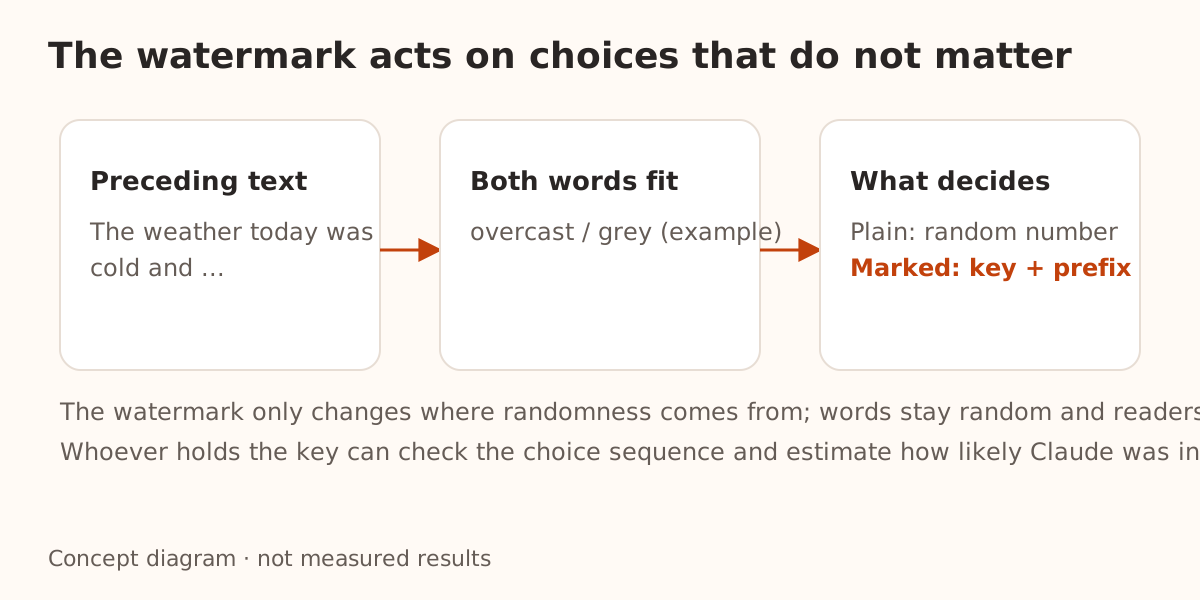
A model writes text one token at a time. At many positions, two candidate words are equally good and the meaning of the sentence barely changes either way, so the final pick is made by a random number. The watermark changes where that randomness comes from: instead of an arbitrary generator, a key plus the few preceding words decides which candidate wins.
The words stay random, but the pattern becomes checkable. Someone holding the key can compare a passage's sequence of choices with the choices Claude would make under that key and produce a probability that Claude was partly involved in writing it.
Unlike the visible watermark on a banknote, this one is invisible to readers. Anthropic lists the practical consequences:
- No extra tokens, no change in price, and negligible effect on speed;
- No information about the user, organization, or conversation, and nothing in the key that could recover it;
- No discernible difference to a reader; in the side-by-side evaluations Anthropic cites, human raters saw no quality difference.
Where the watermark has little or nothing to attach to
The watermark only acts where a choice is genuinely free. Where an exact output is required — an arithmetic answer, a keyword in code, a proper noun — there is no choice, so nothing is marked.
Several text types therefore carry weaker watermarks, and Anthropic names them:
| Text type | Watermark status |
|---|---|
| Translation | Every word is chosen by Claude, so it is watermarked |
| Proofreading that only fixes grammar and punctuation | Nearly all words remain the author's, so there is little to attach to |
| Dense factual passages, formulas, code | Few free choices, so the watermark is sparse |
| Very short passages | Not enough signal for reliable detection |
The same logic explains a limit worth knowing: paraphrasing, heavy rewriting, or replacing the text with different wording makes the watermark hard to detect. Anthropic says directly that light editing will probably not remove it while a full rewrite will. That is background for understanding the boundary, not a technique: failing to detect a watermark does not prove a passage was written by a human.
Which models and platforms carry it
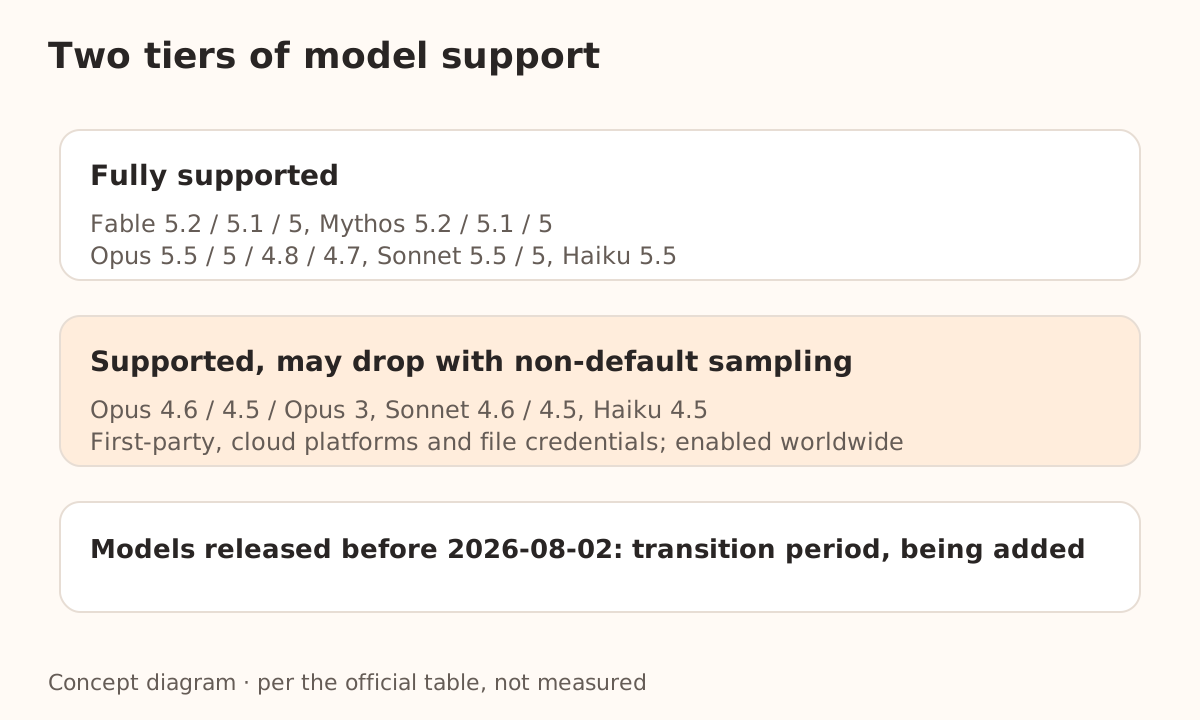
The help center table is the most complete list available. It splits support into two groups:
- Fully supported: Fable 5.2, Fable 5.1, Fable 5, Mythos 5.2, Mythos 5.1, Mythos 5, Opus 5.5, Opus 5, Opus 4.8, Opus 4.7, Sonnet 5.5, Sonnet 5, and Haiku 5.5, marked as supported across first-party surfaces, cloud platforms, and file credentials.
- Supported, but not reliably: Opus 4.6, Opus 4.5, Opus 3, Sonnet 4.6, Sonnet 4.5, and Haiku 4.5. For these, output may lack the watermark when sampling parameters are set to non-default values.
Coverage spans the Claude API, the Claude apps, Claude Code, Claude Cowork, and Claude Tag, plus Claude on AWS, Google Cloud, and Microsoft Foundry. Anthropic says marking is enabled worldwide because it does not yet have a durable way to scope it by region. Models released before August 2, 2026 are in a transition period and are being added over the coming months.
Sampling settings are the one thing developers need to check
The platform docs give sampling its own section, and it contains the only action item for anyone writing code:
If a request sets
temperature,top_p, ortop_kto a non-default value, the output might not carry the watermark.
The watermark is therefore not unconditional. The docs also warn that a framework or client library may be setting these parameters on your behalf, so if the watermark matters to you, inspect the request body that actually goes out.
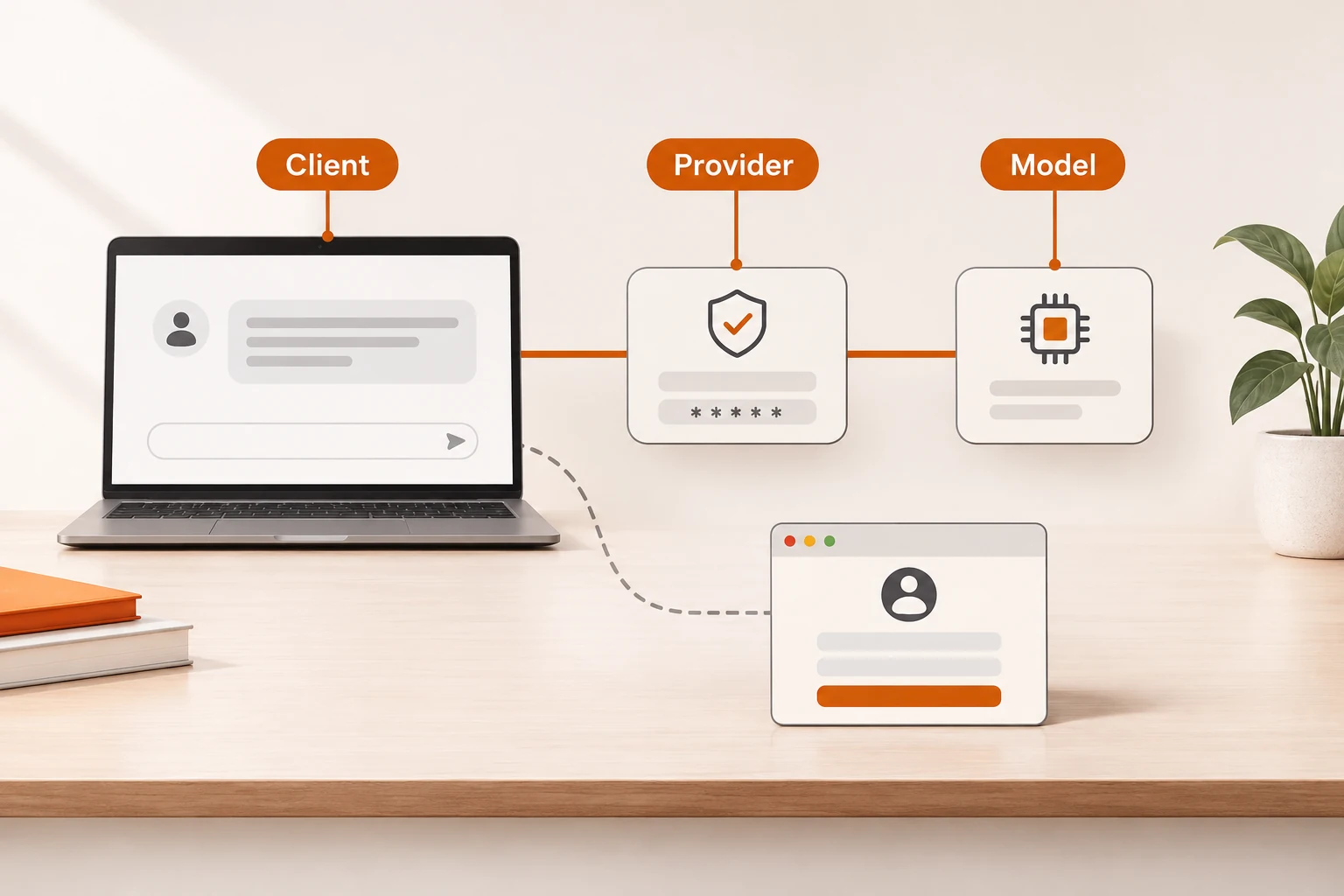
When Nbility relays a Claude request, these fields pass through as the client sent them. ClaudeRequest in relaykit/dto/claude.go declares temperature, top_p, and top_k as nullable fields with omitempty, and the OpenAI-to-Claude conversion only copies a value the client provided. The gateway does not inject a default temperature. Whether the output carries a watermark therefore depends on what the client or SDK puts in the request, not on the relay in between.
Who can actually check for a watermark
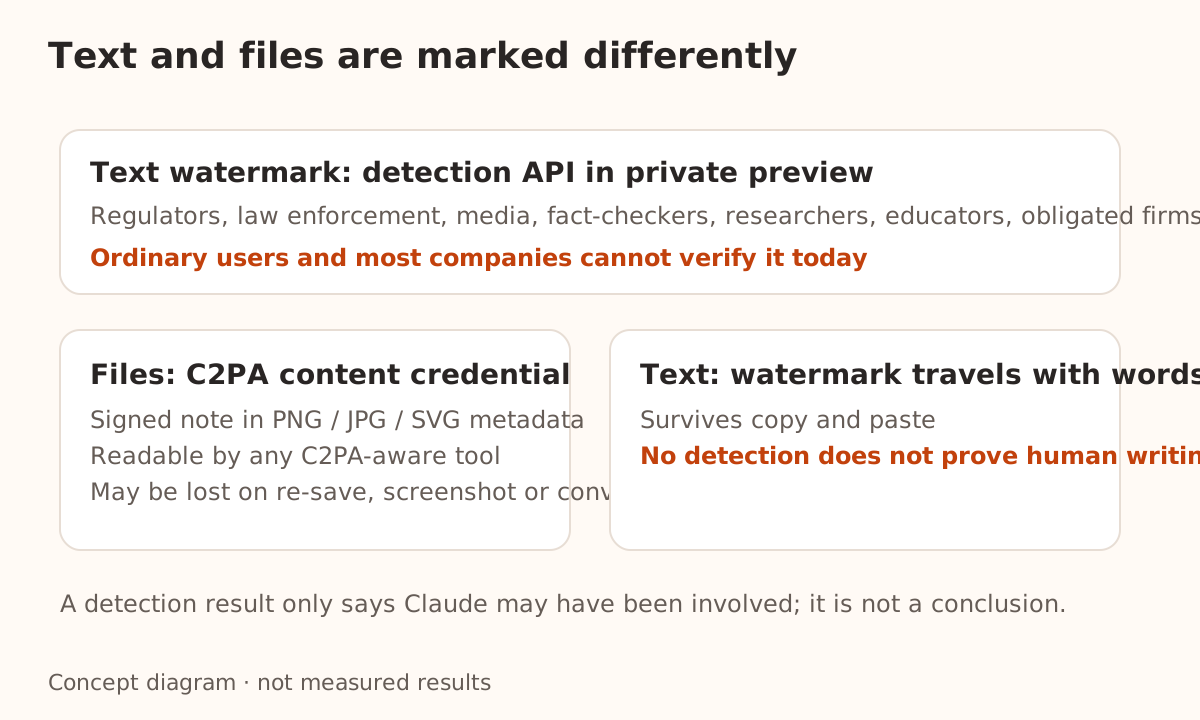
Text watermark detection is in private preview. Access is open to organizations the EU rules cover — regulators, law enforcement, media, fact-checkers, independent researchers, educational organizations, and EU civil society groups — plus enterprises with an equivalent obligation to verify marking for their own compliance. Anthropic plans to widen access over time. For now, ordinary users and most companies cannot verify a passage themselves.
Files work differently. When Claude produces a supported file type such as PNG, JPG, or SVG, it attaches a C2PA Content Credential: a signed note in the file's metadata recording that Claude made or processed the file. Any C2PA-aware tool can read it, and Anthropic offers a Claude Content Checker for files. The difference from the text watermark is durability: a content credential is ordinary metadata and can disappear when a file is re-saved, screenshotted, or converted, while a text watermark travels with copy-pasted words.
What a watermark proves, and what it does not
Anthropic's own description is deliberately narrow:
- It answers only "how likely is it that Claude was partly involved," and cannot prove a passage was human-written;
- It cannot tell "Claude wrote this" apart from "Claude heavily edited this";
- It cannot identify another AI model; a different provider uses a different key and method;
- A positive result is not a conclusion: Claude may only have proofread or translated.
This is also why so-called AI detectors are a different tool. They have no access to Anthropic's key and rely on surface patterns in the phrasing, so their errors run in a different direction.
Why now
The trigger is the EU AI Act. Since August 2, 2026, AI providers serving the EU market must mark AI-generated content. Anthropic signed the corresponding Code of Practice on Transparency of AI-Generated Content alongside other major model providers, so models released on or after that date support marking from launch.
This explains the point readers most often get wrong: the watermark is not applied to certain users or certain requests. It is a model-level compliance behavior, unaffected by account region, plan, or whether the call goes through a third-party gateway. As long as the request reaches a supported Claude model, the output comes from the same watermarked model.
FAQ
Does using a third-party client or an API gateway remove the watermark?
No, not for that reason. The watermark is applied when the model generates, and a gateway only forwards the request and response. Two things do matter: the model may not be on the supported list (older models are still being added), or the request may set non-default sampling parameters.
I translate Claude's English into Chinese. Is the translation still watermarked?
Yes. Every word in a translation is chosen by Claude, which is exactly the case where the watermark works well. Asking Claude to fix typos only, by contrast, gives it almost no choices to make.
Can I check a passage myself?
Not today. Text detection is limited to the private preview. For files, the Claude Content Checker reads the content credential.
Does the watermark affect my rights to the output?
Anthropic says no. The watermark only helps establish whether Claude was involved; it says nothing about ownership and does not change a user's rights under the terms.
The practical takeaway
For most people this changes nothing that matters day to day: no extra cost, no quality change, no code change required. Two groups should look closer. Teams that rely on the watermark for compliance should check whether a framework is quietly adding a non-default sampling parameter to their request body. Anyone producing official content on an older model should compare it against the supported list before promising that marking will be present.
For related limits at the message layer, see the thinking-signature prefix check in Fable 5.2; for how long a Claude-side conversation record survives, message thread expiry covers the same boundary from another angle. For configuration, the Claude Code third-party API guide and the Claude compatibility documentation cover the client and API layers respectively.