Claude Linked billing: customer payment, application policies
Claude Linked billing lets eligible customers fund app usage, while the app organization retains model access, rate limits, and data policies.
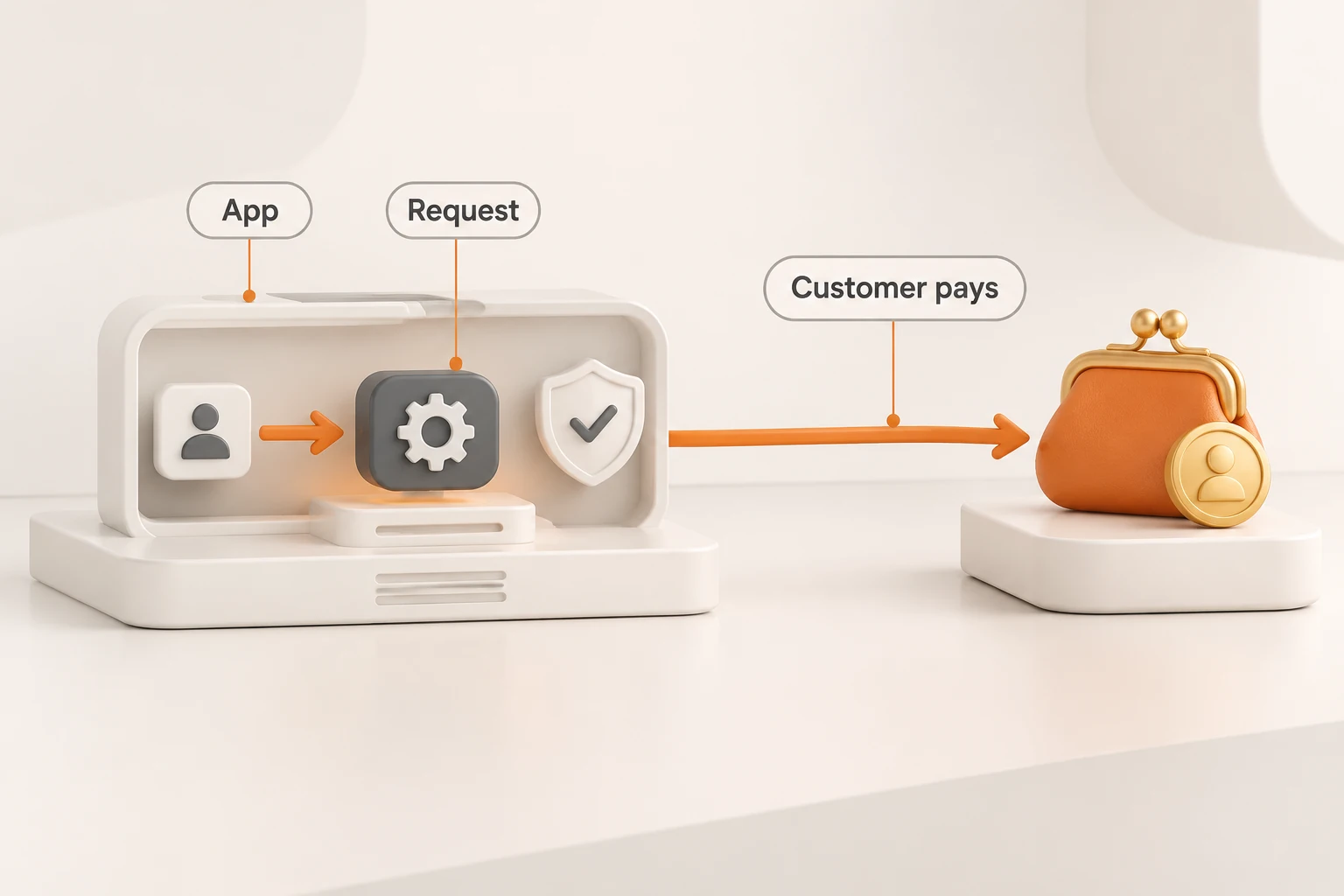
Claude Linked billing lets a customer pay for Claude usage in your application through their own API organization. The request still runs in your application's organization, with your model access, rate limits, and data policies. Moving the bill does not move the customer's zero data retention or encryption arrangements onto that request.
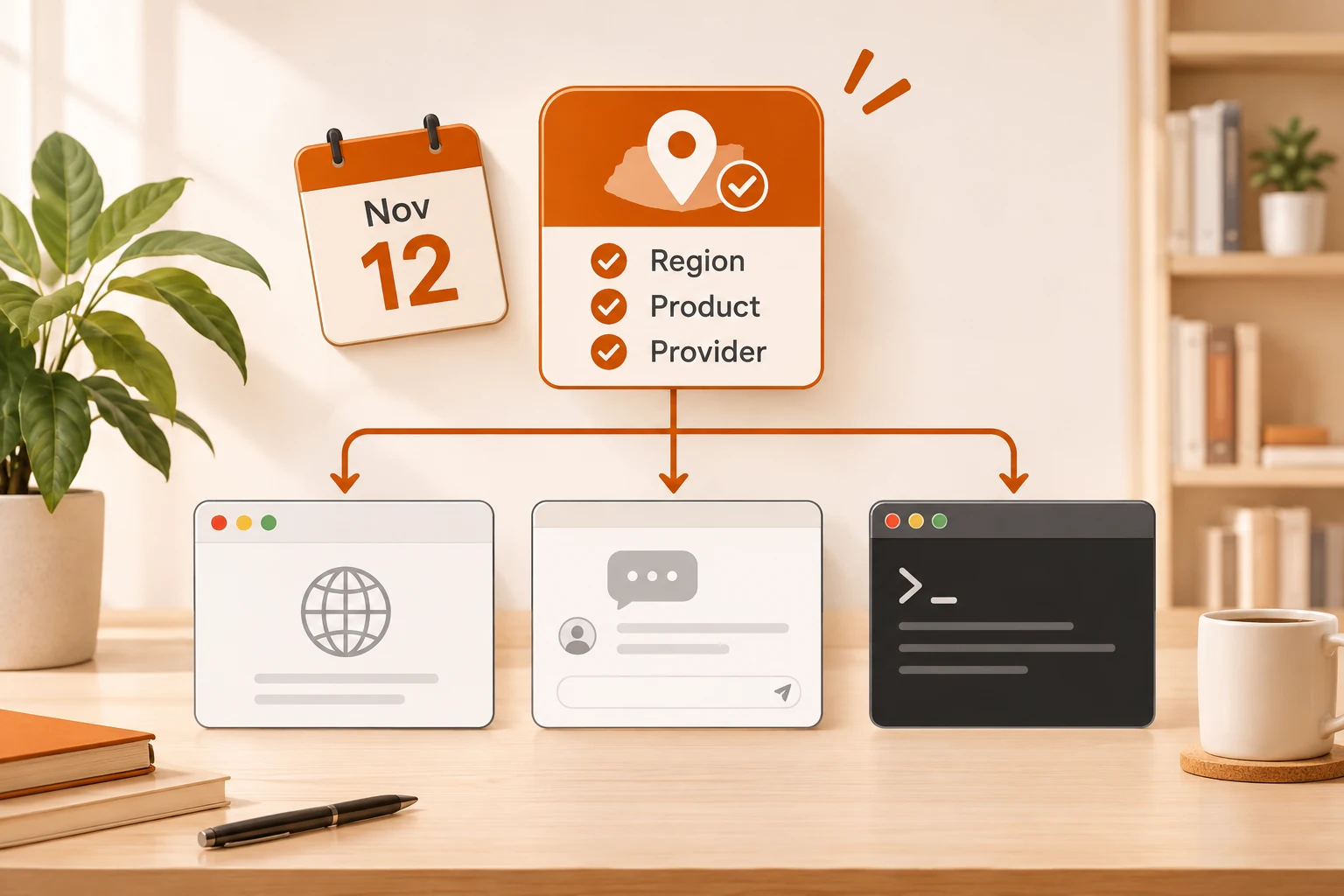
Anthropic announced the beta on November 17, 2026. We rechecked the release notes and Linked billing guide on November 18. This is a product and acceptance guide, not a complete OAuth implementation. No organizations were linked and no billable calls were made for this article.
Which customers can pay this way?
The customer's Claude Platform organization must pay Anthropic directly for API usage, through purchased credits or invoiced billing. Organizations billed through AWS, Google Cloud, or Azure marketplaces are ineligible, as are organizations with only a Claude subscription.
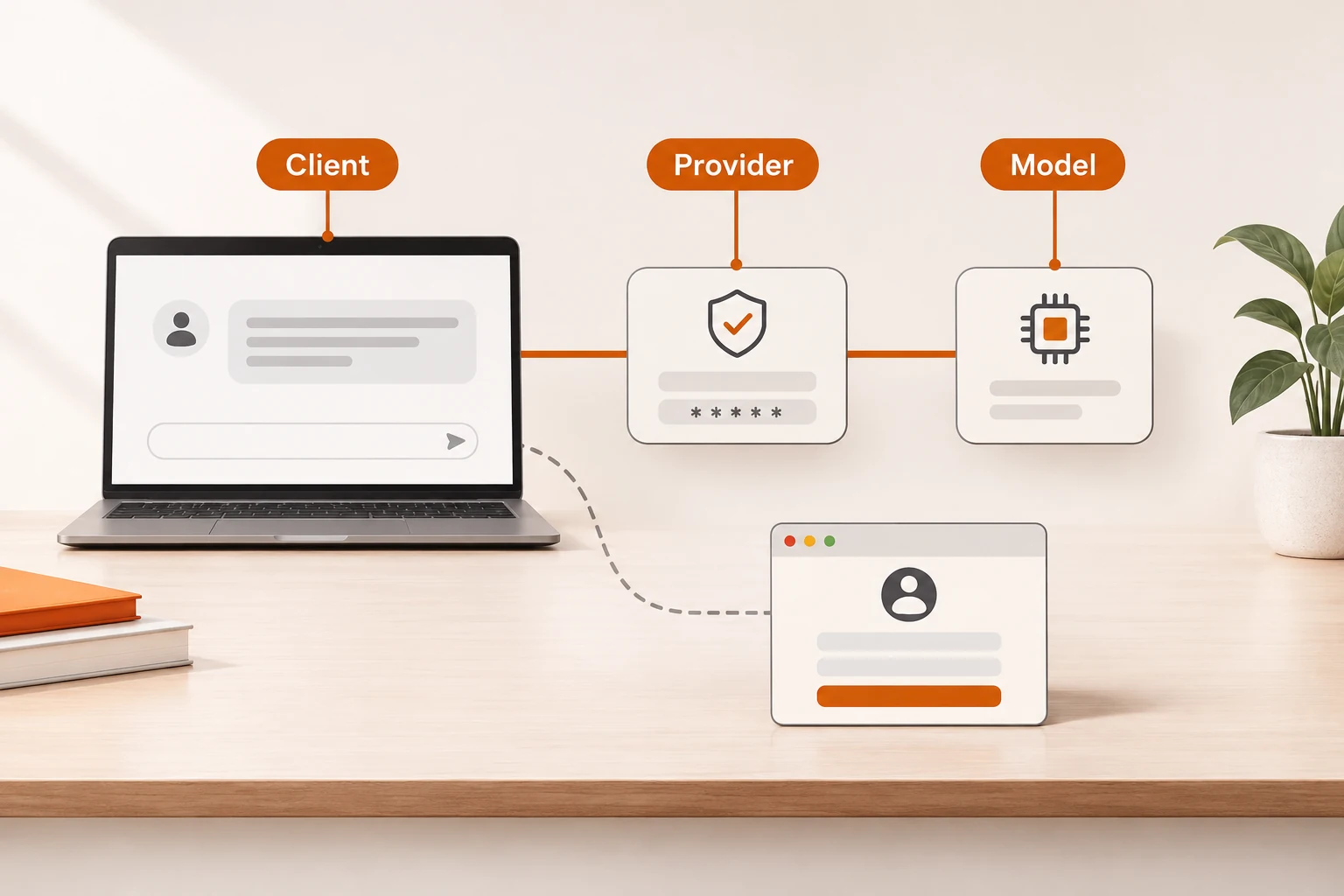
An eligible customer approves an organization connection instead of handing your app a long-lived API key. The person approving needs the Admin or Billing role. Your app subsequently chooses the payer on individual requests.
| Customer arrangement | Eligibility under the documented rule |
|---|---|
| API credits purchased directly from Anthropic | Eligible payment method; linking and request checks still apply |
| Direct Anthropic API invoice | Same |
| Cloud marketplace billing | Ineligible |
| Claude subscription only | Ineligible |
Not every credit balance can fund linked usage. The guide excludes some promotional credits, including monthly API credits from Claude Max, Ultra, and Team plans, and partner, VC, and startup program credits. A visible balance alone does not establish that the request can be paid.
Whose data policies apply?
The application's policies apply. Requests use your organization's rate limits, model access, service tier, data retention, and encryption keys. The customer's ZDR, BAA, and CMEK arrangements do not extend to this usage.
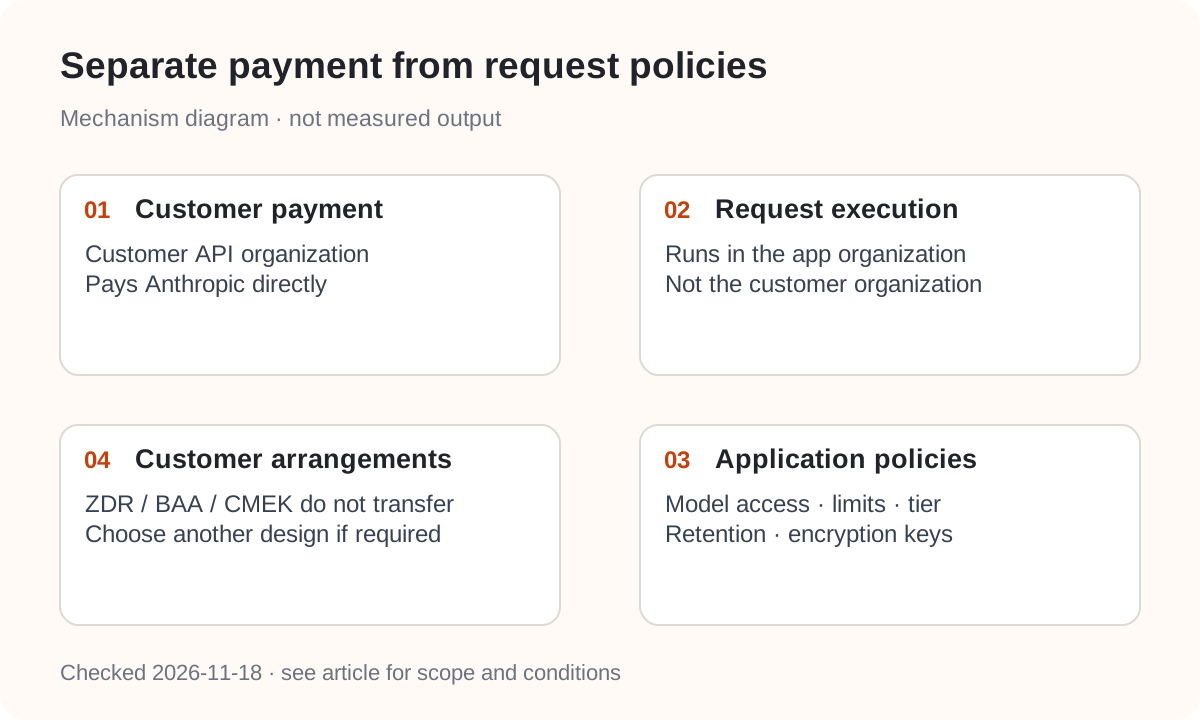
If a customer's contract requires inference covered by their own CMEK, a “customer pays” setting cannot establish that requirement. Anthropic explicitly says not to link customers requiring HIPAA, FERPA, or CMEK coverage for this usage.
This is a different decision from self-hosting Managed Agents: one changes where a service runs; the other changes who pays for model calls. Map the data path, request organization, and payer separately. Our gateway architecture explanation helps place the routing layer in that map.
How does an application choose the payer?
With the guide's default operator service account authentication, a request can name the customer as payer using this body fragment. It is not a complete request: authentication, profile headers, and inference parameters are omitted.
{
  "billing_policy": {
    "type": "billing_policy",
    "bill_to": "user_profile"
  }
}
That call also needs the user-profiles-billing-2026-10-01 beta header and the correct customer's anthropic-user-profile-id. With the same operator authentication, omitting billing_policy charges the app; explicitly setting bill_to: "self" does too. Linking a customer does not automatically change the payer on all later calls.
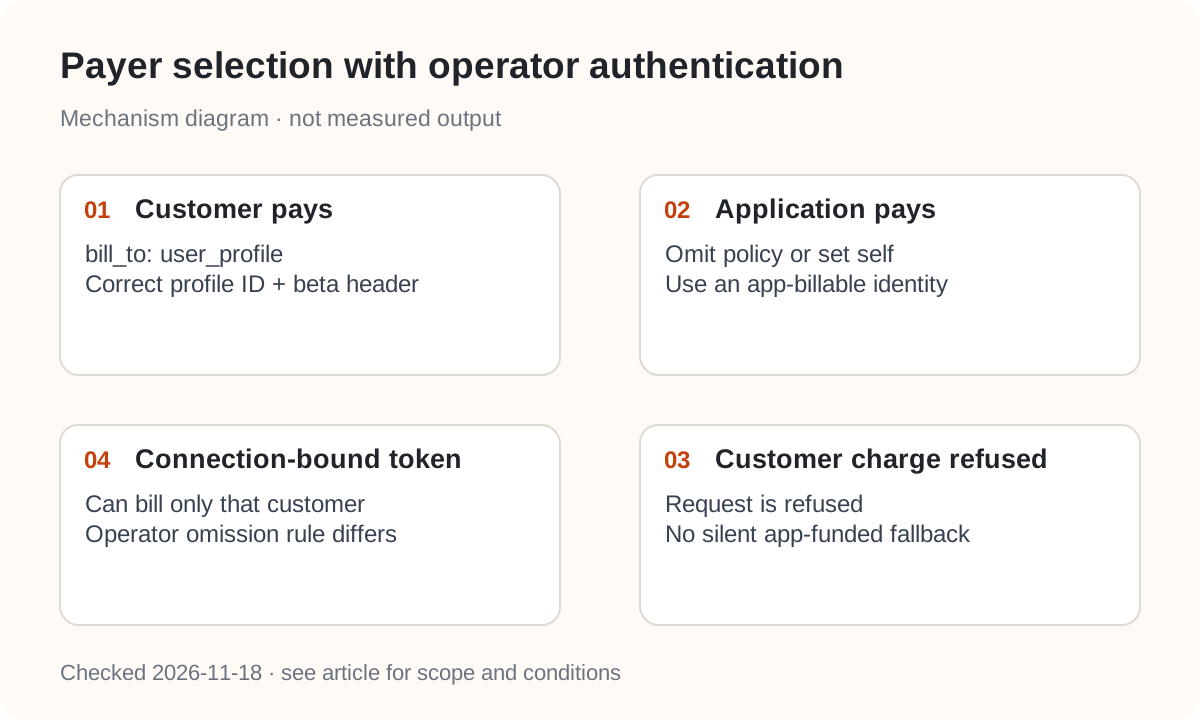
There is a separate connection-bound access token path. Those tokens can bill only their connection's customer; on the supported inference endpoints they bill that customer even without billing_policy. Do not apply the operator omission rule to them. Follow the full official identity and connection procedure for the chosen path, and use appropriate credential storage practices.
If a call assigned to the customer cannot be billed to them, the API refuses it instead of silently charging the app. Any application-funded fallback is a separate product and budget decision. For unattended work, use a budget that can stop execution rather than unconditional retries.
Which calls need a different design?
The supported inference endpoints are /v1/messages and /v1/chat/completions. /v1/messages/count_tokens accepts and ignores billing_policy, so successful token counting does not prove the customer can pay.
Two limitations affect workflow design:
- A customer-billed request cannot use billable code execution features; the guide specifies a 400 response.
- Message Batches cannot currently bill customers. An individual batch request specifying
bill_to: "user_profile"fails withinvalid_request_error; neither party pays for that item, and other items continue normally.
A global “customer pays” toggle across all SDK methods would hide these differences. Classify the endpoint and features before choosing a payer.
What should acceptance testing establish?
Use a test app and a second eligible organization. An app cannot link the organization that owns it. Record outcomes without storing tokens or request bodies:
| Case | Expected observation |
|---|---|
| Successful organization connection | Show “linked,” without promising “billing active” |
| Ordinary customer-funded inference | Usage attributed to the correct customer profile and bill |
| Customer credit or spending limit prevents payment | Request fails without automatic application funding |
| Customer unlinks the app | Later customer-funded requests no longer succeed |
| An application-funded call | Use an identity that permits app billing and verify the app pays |
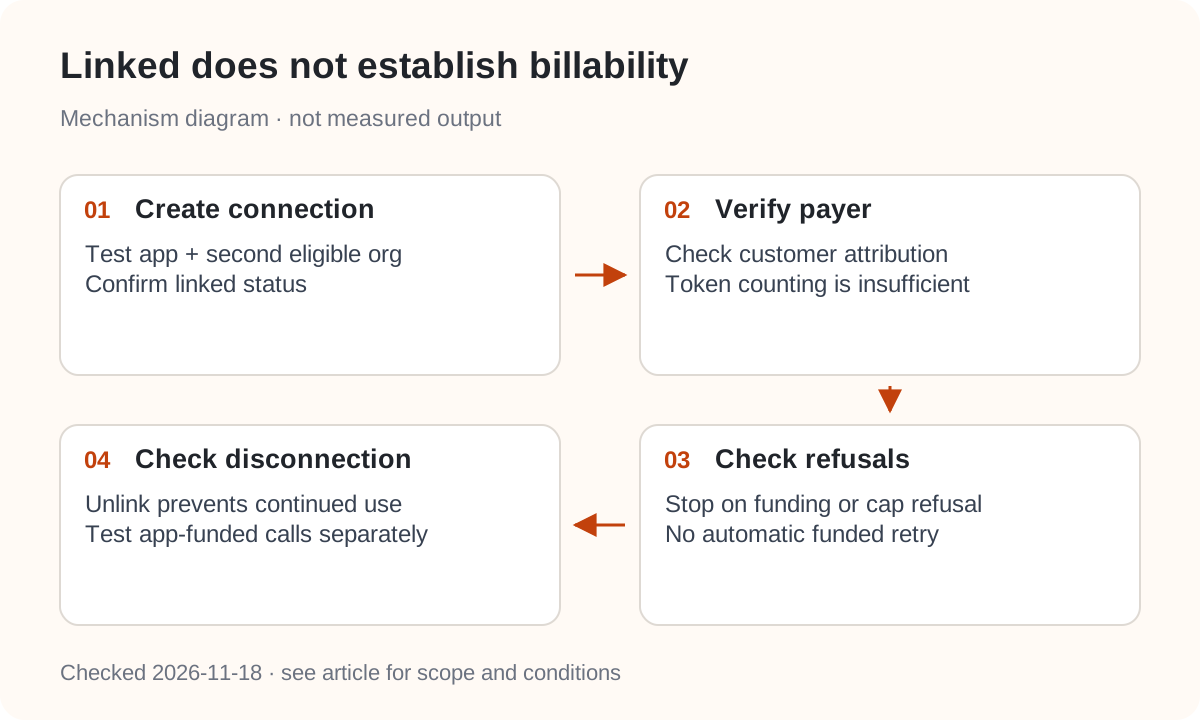
A 402 response does not distinguish insufficient credit from a spending limit. Investigate eligibility and connection state for 403 user_profile_not_billable. Customers can cap app spending or unlink it in Claude Console, so the product must explain what happens when a request is refused.
We have not established that Nbility offers this official organization-linking feature. For an enterprise application, first clarify whether the customer wants to fund the model usage or requires requests to belong to its own organization. Those requirements lead to different architectures.