Give Scheduled Agents a Budget They Can Actually Stop At
Separate alerts, rate limits, task admission, and API key quotas; use reservations to account for concurrent work and uncertain requests.
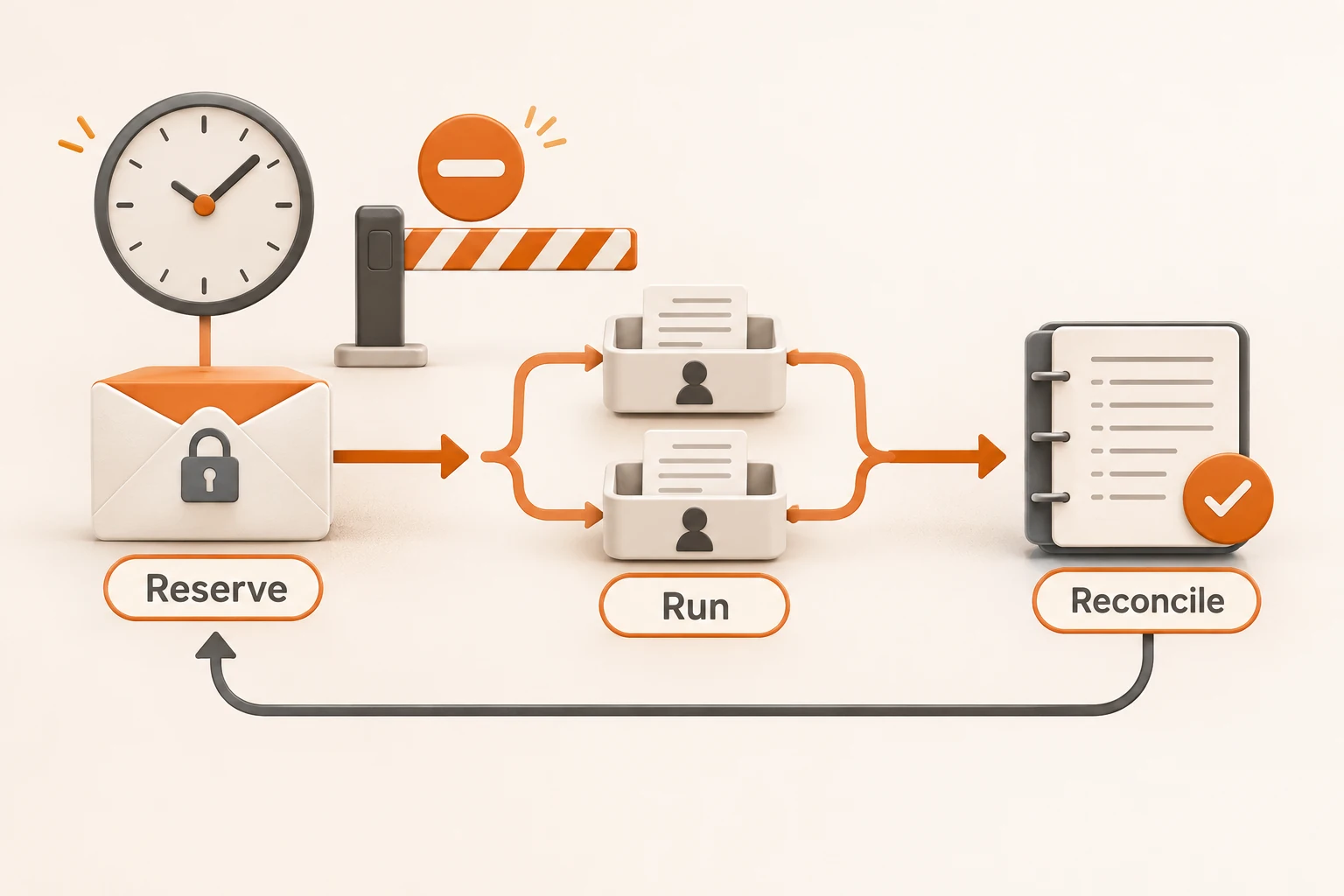
A research assistant that runs manually during the day may perform far more work when scheduled overnight: pagination, summarization, retries, and delegated steps. A morning cost alert arrives after those calls. Stopping new work requires a decision at dispatch time.
This design was checked on November 13, 2026 against Anthropic's current limit documentation and the Nbility enterprise workspace guide. It is not a deployed scheduler or a test of a provider's exact concurrent spending boundary. The budget units are illustrative, not model prices or a newly implemented Nbility feature.
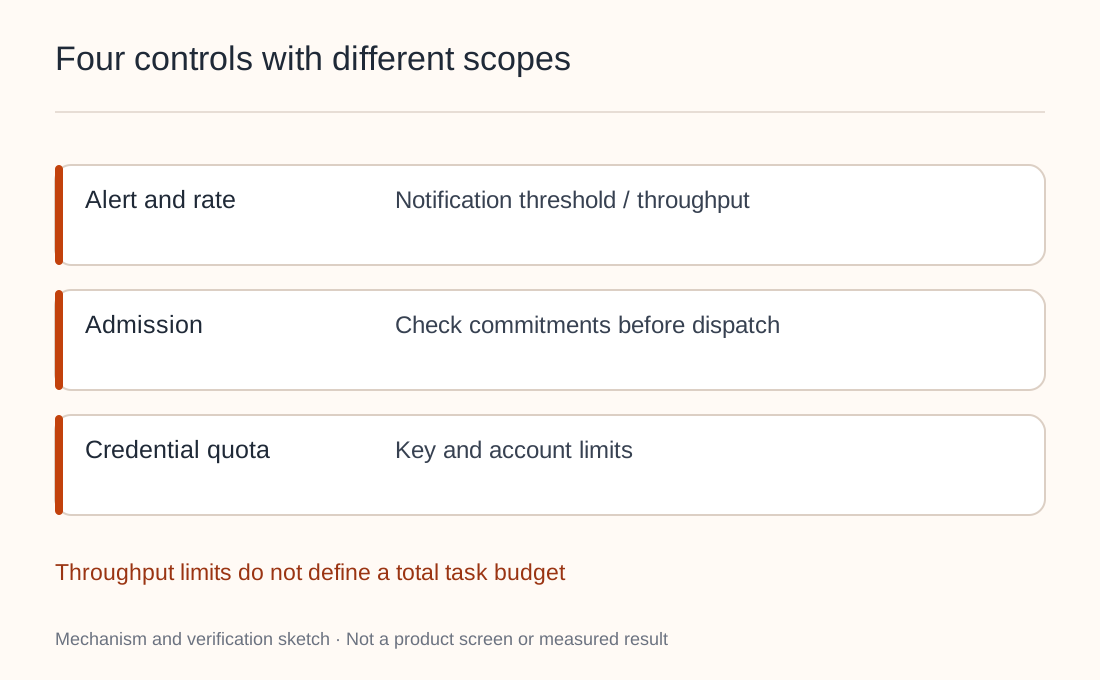
Distinguish four controls
| Control | What it governs | What it does not establish |
|---|---|---|
| Cost alert | When someone is notified | That calls stop before notification |
| Request or token rate limit | How quickly work may be sent | Total overnight expenditure |
| Application task budget | Whether a task may dispatch another step | Complete accounting for every external cost |
| Key or account quota | Available scope for that credential or account | A separate budget for every workflow |
Anthropic's documentation distinguishes spend limits from rate limits and describes organization and workspace scopes. Its status codes and console settings are specific to that service.
Nbility's enterprise documentation describes a separate key quota and Owner wallet balance. Enterprise calls charge the Owner's wallet. Separate keys help bound and inspect different uses; they do not create department or cost-center features that the current product does not offer.
Reserve before concurrent work starts
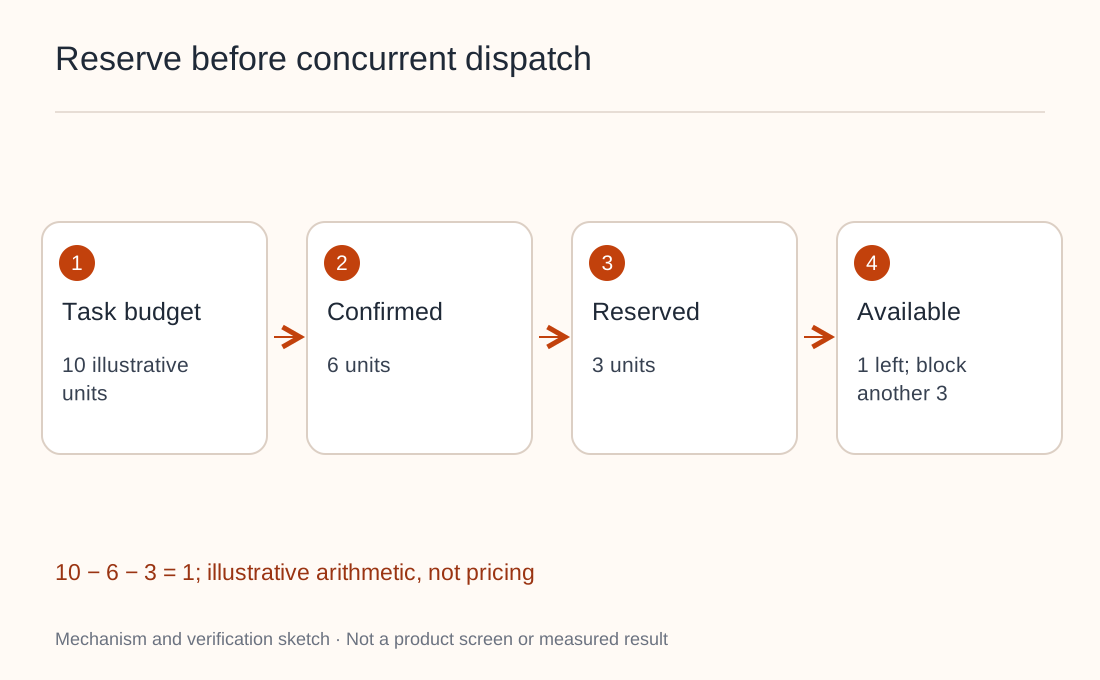
Counting costs only after completion ignores in-flight commitments. Consider a teaching budget of 10 units, with 6 confirmed and two prospective steps requiring 3 units each. If both workers independently see 4 available units, both may start, committing 12 in total.
Include outstanding reservations:
Available = Task budget - Confirmed spend - Outstanding reservations
10 - 6 - 3 = 1
After the first reservation, the second three-unit step must wait or shrink. This is an admission calculation, not a new pricing scheme.
Checking and reserving must be atomic across workers. A local variable cannot coordinate multiple processes. Use integer minor units or suitable decimal arithmetic.
A reservation must reflect bounded inputs, outputs, tool calls, and current pricing. Where a cost cannot be bounded reliably, an estimate is not a hard guarantee. Reduce the step, disable uncontrolled paths, or require manual handling. A model instruction to “spend at most ten” is not server enforcement.
Keep uncertain requests pending
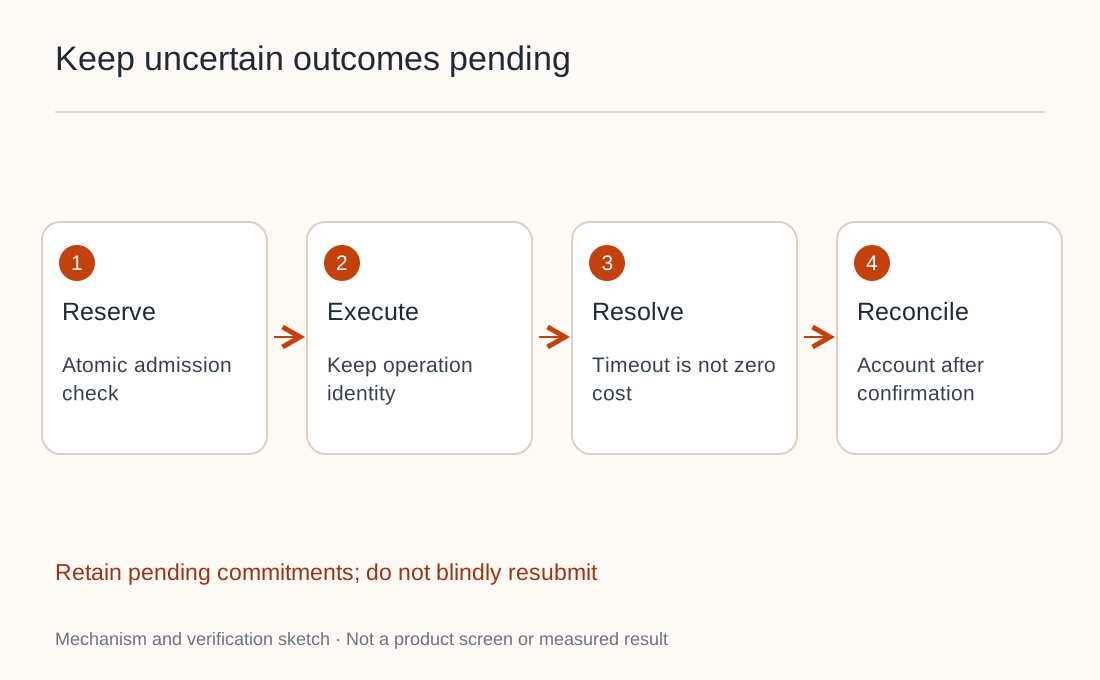
When a result is confirmed, replace its reservation with the actual charge and release the unused amount. A client timeout does not establish zero expenditure. Do not immediately release everything and submit again.
Retain a stable operation ID, timestamps, state, and any supported lookup reference. Query an existing task only when the provider offers that operation; synchronous chat requests do not necessarily have queryable jobs.
Retries also consume budget. External writes and notifications may execute twice. See n8n side-effect recovery and asynchronous video job handling for related recovery decisions.
Start with a narrow scheduled report
Bound the sources, item count, content size, models, tools, retries, concurrency, and elapsed runtime. When a limit is reached, save completed work and a pending list, then stop dispatching. Stopping local waiting does not guarantee cancellation of remote work already submitted.
Use separate keys for interactive and unattended workloads, applying supported quotas, expiry, and model restrictions. Follow the key security guide. Purpose separation still does not produce exact per-task accounting automatically.
Before promising a hard budget, verify concurrent admission, delayed receipts, unknown outcomes, and restart recovery with simulated events. Check that new work is blocked, existing work is not duplicated, and outstanding reservations survive restart. Those scheduler scenarios were not executed for this article.
Finally, account for model, search, tool, and storage costs separately using available records. The agent cost guide explains why client totals and service bills may cover different activity. A clear dispatch boundary and a separate reconciliation process make stopping and resuming understandable.