Gemini 4 Hydrogen Is Out. Your 3.8 Flash App Can Wait a Few Weeks
Gemini 4 Hydrogen became generally available on November 12. Compare 3.8 Flash's pricing timeline, default thinking level, output caps, explicit caching and sampling parameters before planning a reversible migration.
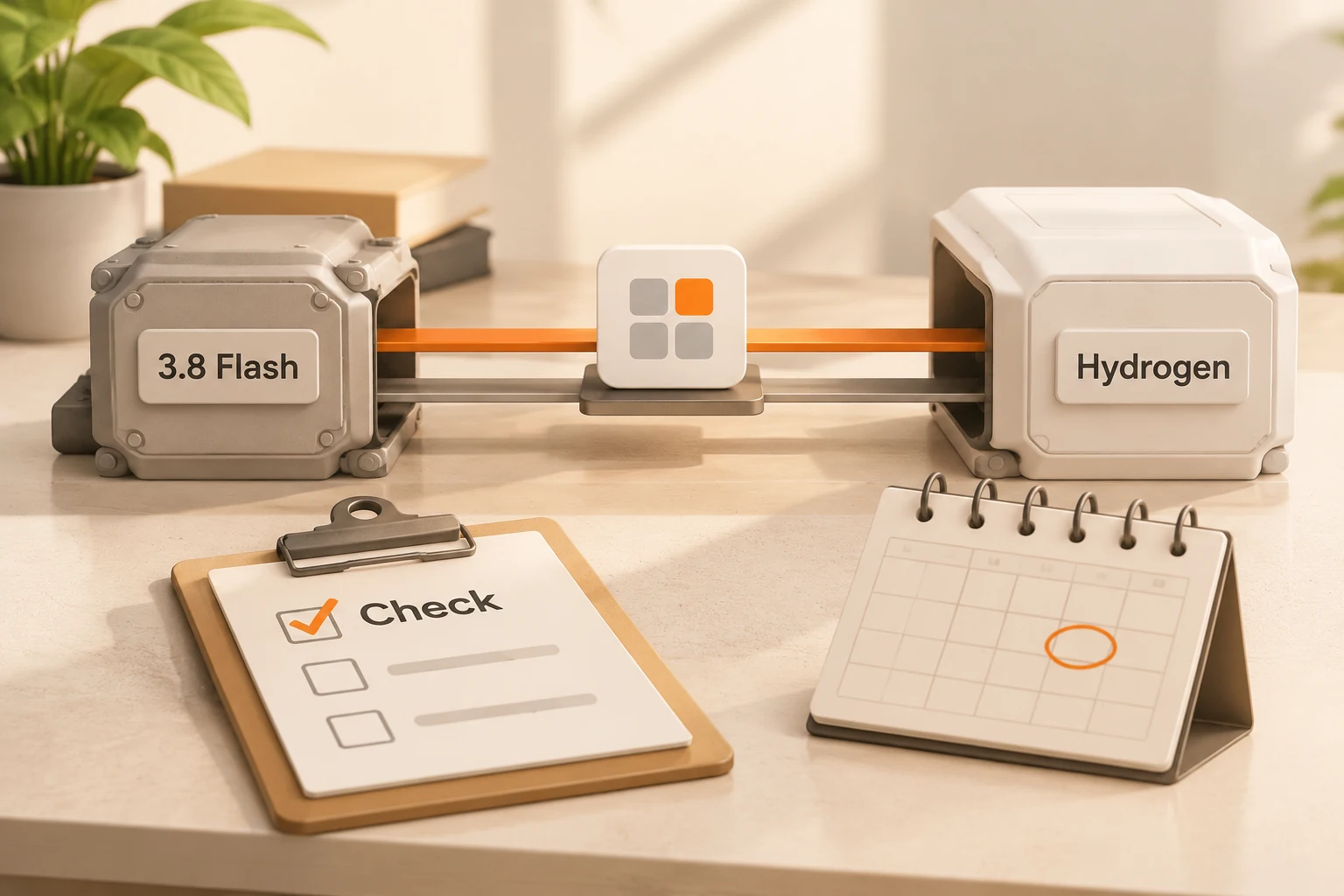
On November 12, 2026, Google made gemini-4-hydrogen generally available and named it the recommended upgrade from 3.8 Flash and earlier Gemini 3 and 2.5 models. If you already run gemini-3.8-flash in production, the first question is practical: what happens to your bill and your requests if you switch now?
This article checks Google's What's new in Hydrogen, the 3.8 Flash notes, the pricing page and the deprecations page as of November 15, 2026. We did not run authenticated model requests or compare output quality. Claims such as "more than 5x fewer fabricated claims" are Google's own.
Read the pricing dates, not just the rates
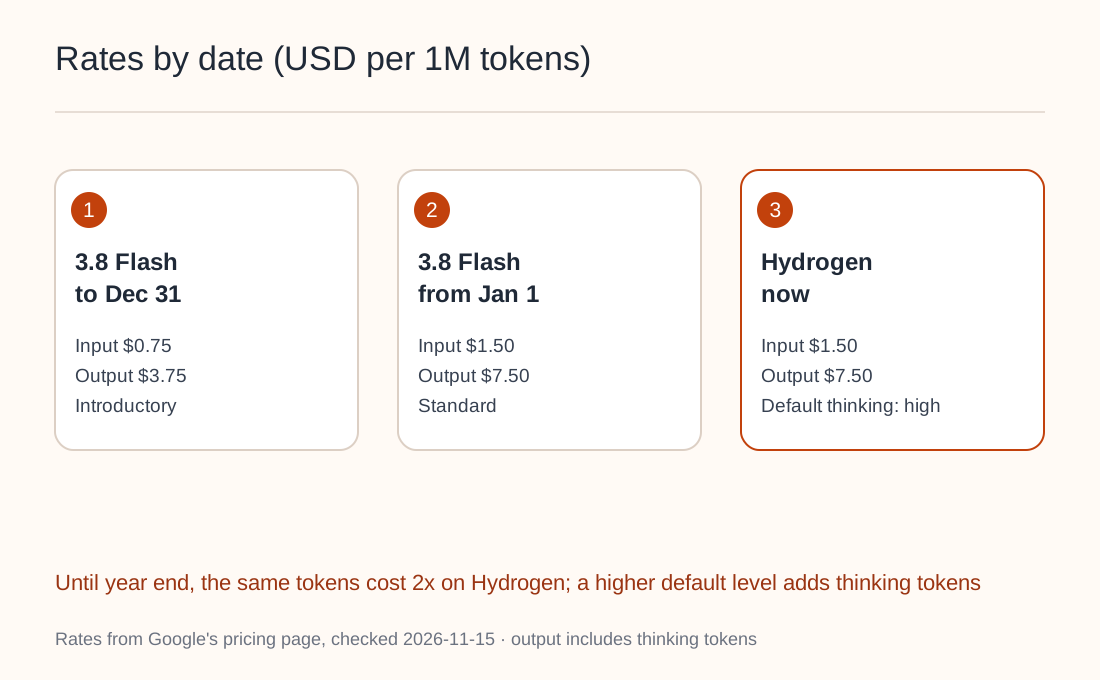
Paid-tier rates per million tokens (USD):
| Model | Input / output now | Later |
|---|---|---|
gemini-3.8-flash | Introductory $0.75 / $3.75 through 2026-12-31 | $1.50 / $7.50 from 2027-01-01 |
gemini-4-hydrogen | $1.50 / $7.50 | No change announced |
Until December 31, the same number of tokens costs twice as much on Hydrogen as on 3.8 Flash. From January 1 the rates match. Hydrogen also has a rate-limited free tier. For both models, output pricing includes thinking tokens.
The rate is only half the story. Hydrogen defaults to the high thinking level, while 3.8 Flash defaults to medium. Swapping only the model ID can therefore increase thinking tokens per request as well. The deprecations page currently lists no shutdown date for either model, so nothing forces a switch this week.
If you still call gemini-2.5-pro or gemini-2.5-flash, your situation differs: those IDs change routing in December. See Gemini model migrations to finish before December.
Six changes to make before switching the model ID
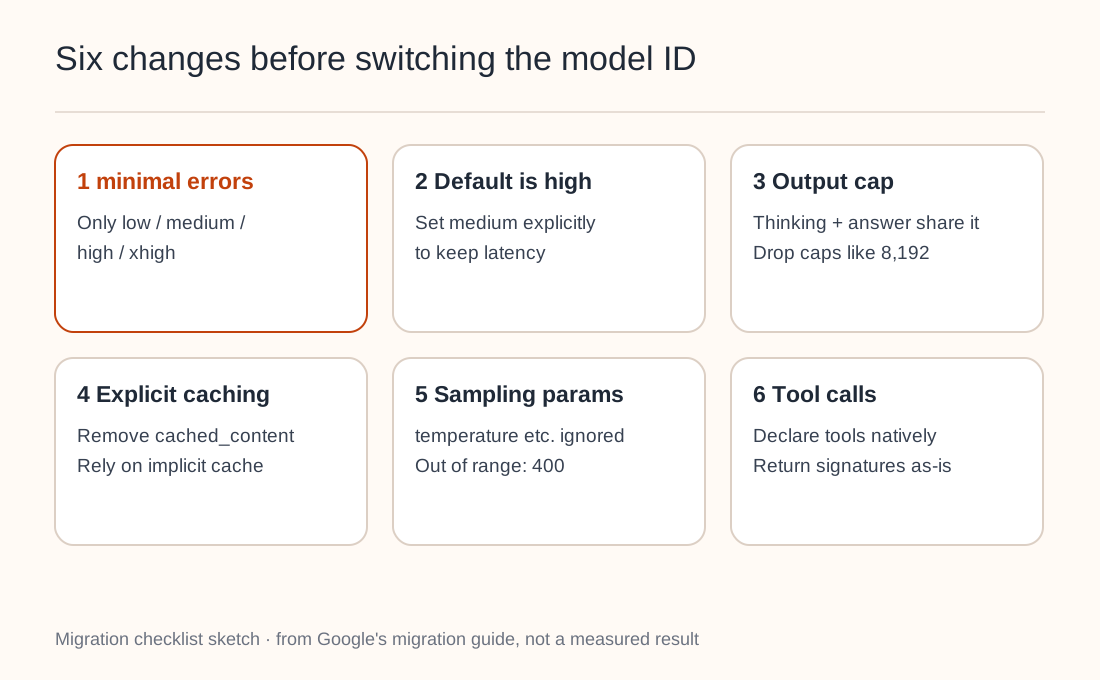
From the migration guide, ordered by how likely they are to break a request:
minimalreturns an error. Hydrogen acceptslow,medium,high(default) and the newxhigh. 3.8 Flash also rejectsminimal, but configs carried over from older models may still contain it.- The default moves from
mediumtohigh. Setmediumexplicitly to keep similar latency and token use. Keepxhighfor multi-step problems thathighcannot solve; Google warns it can overthink simple prompts. - Low output caps truncate answers.
max_output_tokenscovers thinking and the visible answer together. The guide recommends removing hard-coded caps such as 8,192 or raising them to 65,536. Lower the thinking level to save tokens instead of squeezing the cap. - Explicit caching is gone. Hydrogen does not support
cachedContentsorcaches.create; removecached_contentfrom requests. Implicit caching is on by default for prefixes of at least 4,096 tokens and bills cache hits at 5% of the input rate. - Sampling parameters are ignored. In-range
temperature,top_pandtop_kvalues are ignored by the server; out-of-range values return400. Prompts that relied on them for style need a fresh review. - Declare tools natively. Prompting the model to emit custom JSON as a tool call with no declared tools can return
MALFORMED_FUNCTION_CALL. Use function calling or structured outputs. If your client manages history, send thought signatures back unchanged.
Two more points affect request structure. Like Carbon and Argon, Hydrogen uses one 1,048,576-token window shared by input, thinking and output. A synchronous answer stops at 65,536 tokens; longer output needs background execution or client-side continuation, covered in the Gemini Argon long-output guide.
A conservative request
Through Nbility's Gemini-native compatible API, a generateContent call can look like this. Confirm the model ID for your group in the model list first; this article does not verify that the model is listed on Nbility.
curl "https://api.nbility.ai/v1beta/models/gemini-4-hydrogen:generateContent" \
  -H "x-goog-api-key: $NBILITY_API_KEY" \
  -H "Content-Type: application/json" \
  -d '{
    "contents": [{
      "role": "user",
      "parts": [{"text": "Check this retry queue for race conditions"}]
    }],
    "generationConfig": {
      "maxOutputTokens": 65536,
      "thinkingConfig": {"thinkingLevel": "medium"}
    }
  }'
Setting medium explicitly means your first comparison changes only the model, not the thinking depth as well. Field names follow Google's current generateContent docs; the Interactions API uses generation_config.thinking_level instead, so don't mix the two.
Let a fixed sample decide when to switch
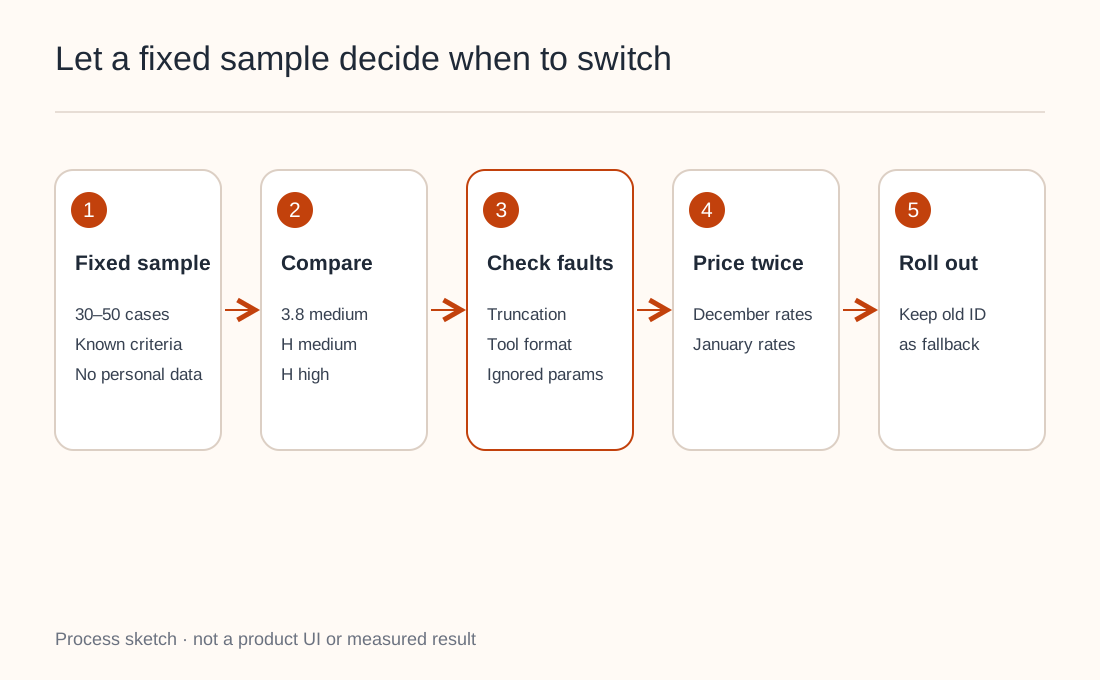
Vendor claims do not replace your own results. One way to run it:
- Pick 30–50 production requests with known answers or acceptance criteria, and strip personal data.
- Run the same set on 3.8 Flash
medium, Hydrogenmediumand Hydrogenhigh. Record completion,finishReason, input/output/thinking tokens and latency. - Check first for truncation, malformed tool calls and output that changed because a parameter is now ignored. Then compare quality.
- Multiply the recorded tokens by the rates for each period and price December and January separately.
- Keep the old model ID as a fallback and shift traffic gradually.
For turning "it feels better or worse" into records, see how to diagnose a suspected model regression.
When switching early makes sense
- New projects, or services you planned to re-evaluate after the January price change anyway.
- Multi-step tool tasks where 3.8 Flash keeps failing and your sample shows Hydrogen finishing them. The higher rate may cost less than repeated retries.
- Workflows that plan with Carbon and execute on a cheaper model. Google documents switching between Carbon and Hydrogen within one Interactions session.
- Hosted agents on the Gemini API such as the Antigravity Agent, which moved to Hydrogen as its default model on November 12. See how that default and its billing work if you want to pin the model or cap spend.
If 3.8 Flash already meets your bar on the sample and most of your spend comes from many short requests, finishing the comparison before the end of December is the safer plan.