Carbon Doubles in Price on December 1. Split Hard Problems From Routine Work
Introductory pricing for Gemini 4 Carbon and Argon ends on November 30; input and output rates double from December 1. A reproducible example shows how to keep planning on Carbon and move execution to Hydrogen.
Gemini 4 Carbon (gemini-4-carbon) became generally available on November 10, and Google calls it its strongest reasoning model. Its introductory price lasts only until November 30, 2026. From December 1, input goes from $2 to $4 per million tokens and output (including thinking) from $10 to $20. The pricing page lists the same dates and numbers for Gemini 4 Argon.
If you recently moved an entire agent pipeline to Carbon, December's bill will roughly double at the same usage. Rather than reverting to an older model, it's worth asking which steps actually need it.
This article checks Google's What's new in Carbon, What's new in Hydrogen and the pricing page as of November 15, 2026. The cost example uses assumed token counts; no real task was run. You need your own records for how many tokens each model actually uses on your work.
How the three models are priced now
| Model | Through Nov 30 | From Dec 1 | Default thinking | Free tier |
|---|---|---|---|---|
gemini-4-carbon | $2 / $10 | $4 / $20 | medium | No |
gemini-4-argon | $2 / $10 | $4 / $20 | medium | No |
gemini-4-hydrogen | $1.50 / $7.50 | No change announced | high | Yes, rate-limited |
Rates are USD per million input / output tokens, and output includes thinking tokens. All three support implicit caching only, with cache hits billed at 5% of the input rate, so Carbon's cached-input rate also moves from $0.10 to $0.20. Grounding with Google Search is billed per query on top.
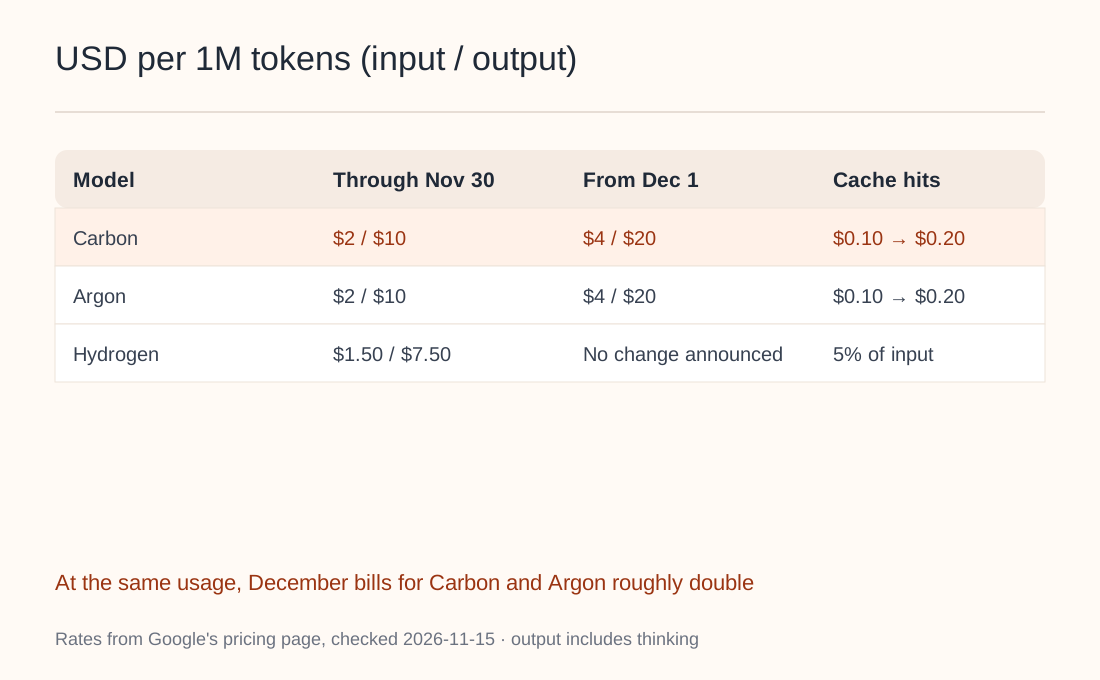
One difference is easy to miss: Google says Carbon spends more thinking tokens than Argon on hard problems to test hypotheses and check edge cases. Even at the same rate, the same step can consume more tokens on Carbon.
Which steps deserve Carbon
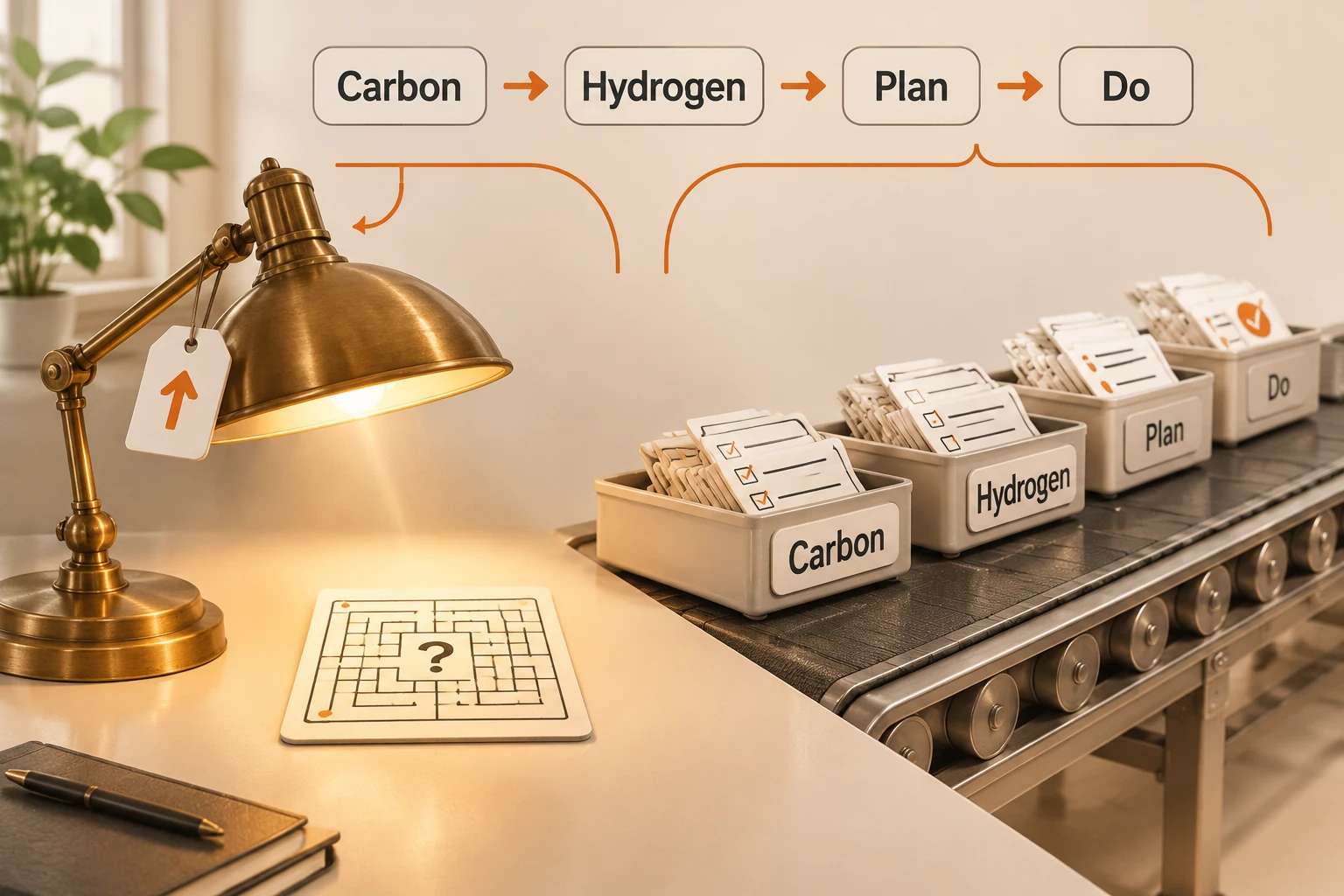
Google's suggested split is to have Carbon plan system interfaces and resolve hard roadblocks, then hand code edits, parallel subagent tasks and test runs to Hydrogen. For a coding task, that looks like:
- Plan and locate: read the requirements and relevant code, then produce a change plan, the files involved and acceptance criteria. A good fit for Carbon.
- Execute: edit files, add tests and run checks according to the plan. This repeats the most, so it suits Hydrogen.
- Escalate when stuck: when the executor fails repeatedly, or tests show the plan itself is wrong, send the failure record back to Carbon.
- Accept: confirm the result with tests and human review, not the model's self-assessment.
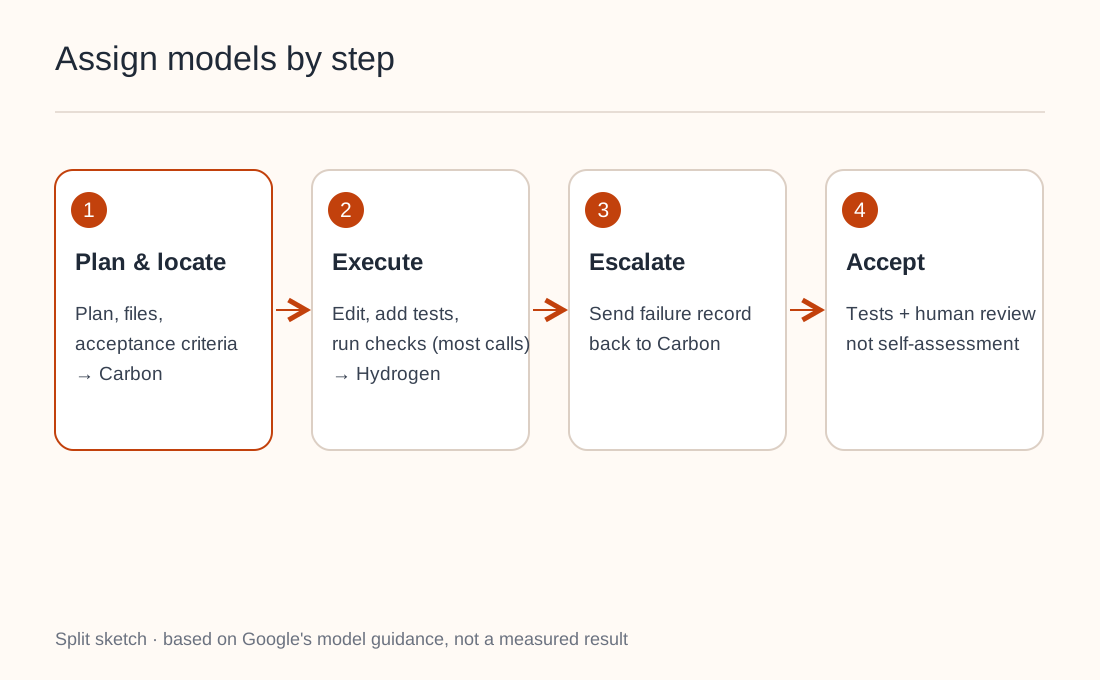
For the handoff, putting the plan into the executor's input as text is easier to inspect than relying on internal thinking shared across models. Google documents switching between Carbon and Hydrogen within one Interactions session. When you manage history yourself through a compatible API, whether one model's thought signatures carry over depends on that interface; a text handoff avoids the question. For routing trade-offs, see multi-model routing.
A reproducible example
Assume a task with 12 calls, each with 50,000 input tokens (no cache hits) and 8,000 output tokens. To compare rates alone, assume both models use the same tokens per call:
Hydrogen, one call: 0.05 × 1.5 + 0.008 × 7.5 = $0.135
Carbon, one call (introductory): 0.05 × 2 + 0.008 × 10 = $0.18
Carbon, one call (from Dec 1): 0.05 × 4 + 0.008 × 20 = $0.36

All 12 on Carbon: $2.16 introductory, $4.32 from Dec 1
2 on Carbon + 10 on Hydrogen: $1.71 introductory, $2.07 from Dec 1
From December, the split costs about half as much as running everything on Carbon. Because Carbon often spends more thinking tokens in practice, the all-Carbon line is an underestimate. These figures illustrate the method; they are not a measured bill for any task. Implicit cache hits would lower the input portion further.
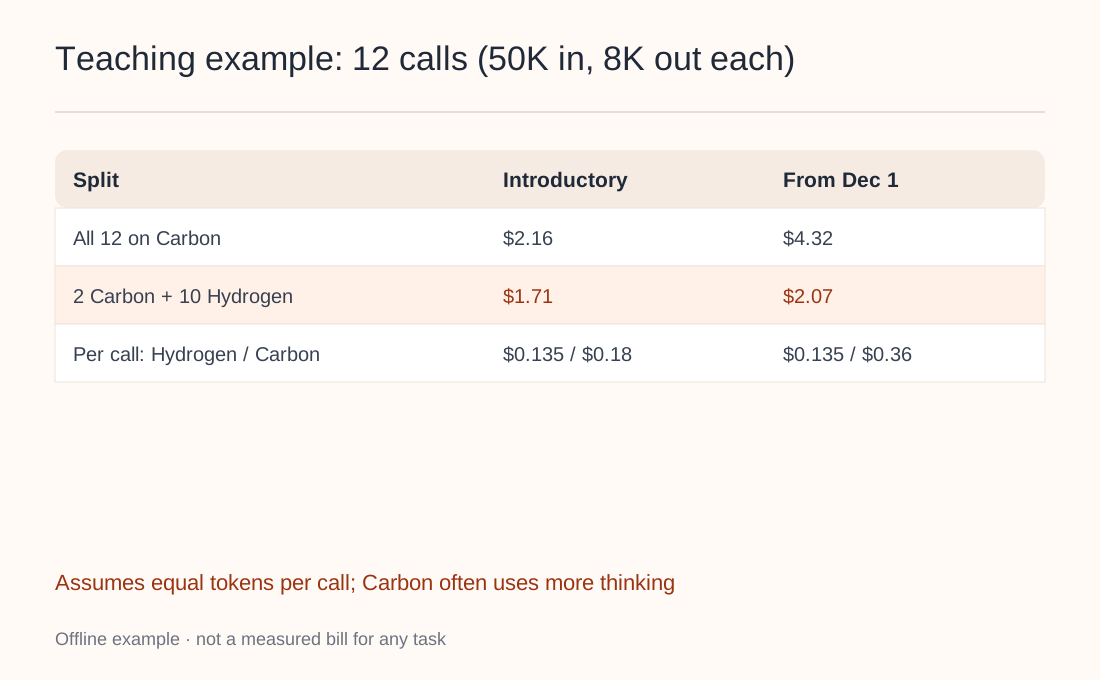
For your own tasks, record actual input, cached, output and thinking tokens per call, then multiply by the rates for the period. As with usage displays versus the real bill, client estimates and final settlement can differ.
Three things to do before December
- Tag model calls by purpose: log whether each call is planning, execution or review, so you can see where the Carbon spend goes at month end.
- Check timeouts and output caps: Google recommends
max_output_tokensof at least 32,768 for Carbon. Hard requests can take minutes, so set HTTP timeouts to at least 15 minutes or use background execution. Moving to a cheaper model won't fix truncated answers. - Budget automated runs: for nightly pipelines, check the remaining budget before each new call, as described in budget reservations for scheduled agents.
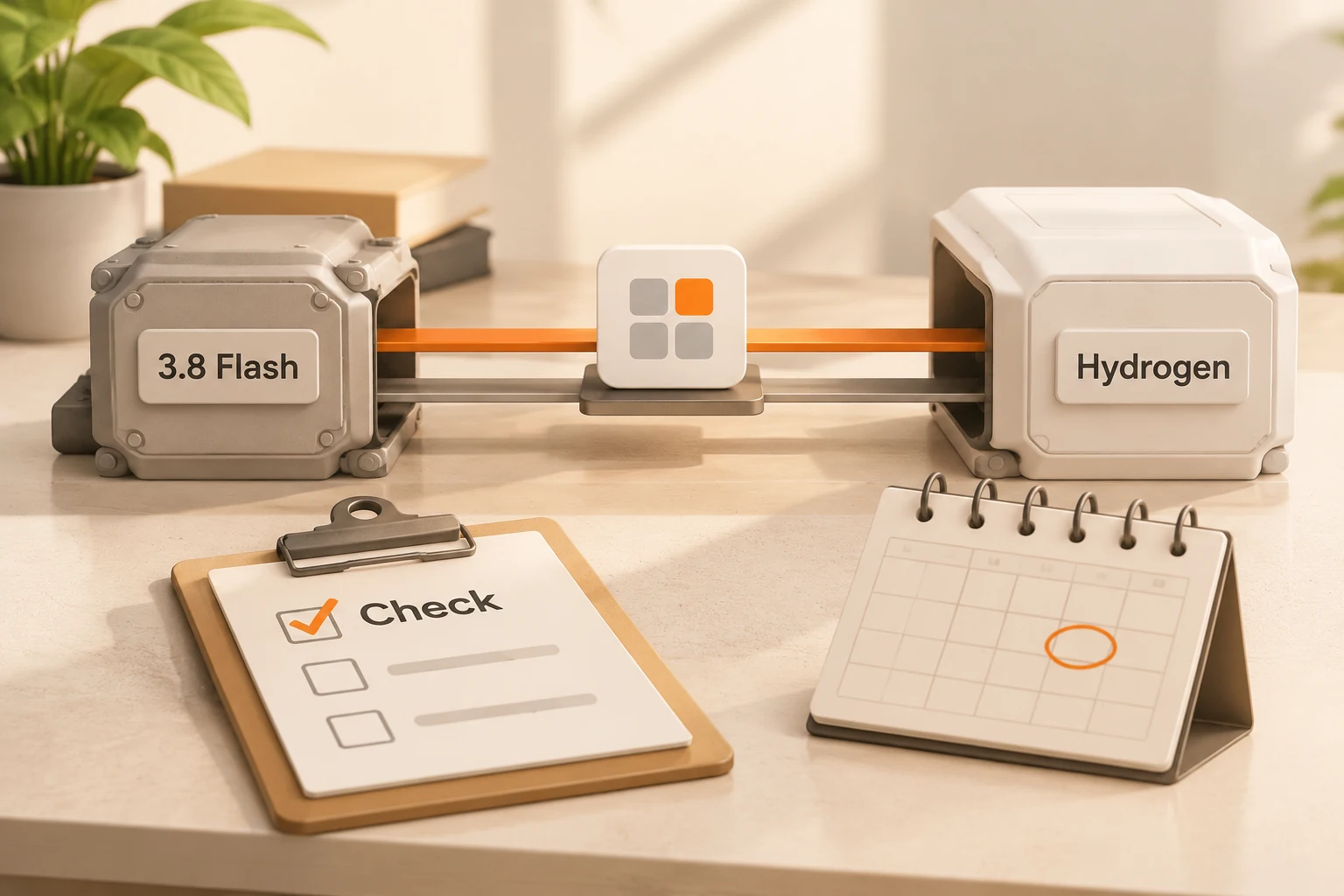
If a step already completes reliably on Hydrogen at high or xhigh, there's no reason to pay Carbon rates for it. Migration details are in what to change before moving from 3.8 Flash to Hydrogen. Before calling through Nbility, confirm the model ID is available to your group in the model list, and see billing for how charges work.