Gemini 4 Neon gives frequent complex tasks a middle option
Gemini 4 Neon launched on November 18 between Hydrogen and Carbon. Compare complete tasks, then check thinking defaults, shared context, caching, and long output before switching.
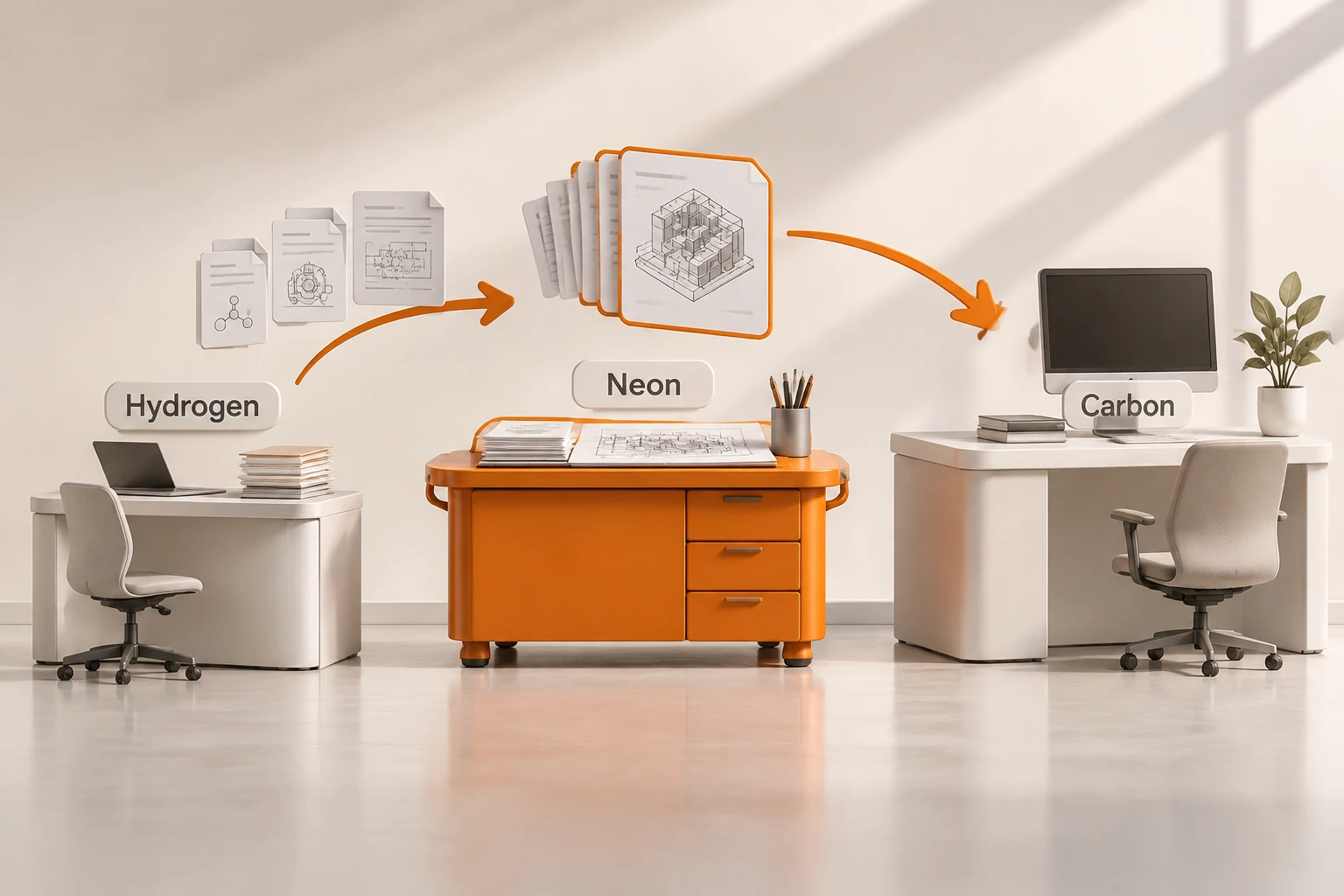
Gemini 4 Neon became generally available on November 18, 2026. Google positions it between Hydrogen and Carbon for frequent, complex software engineering, knowledge work, and scientific tasks. If Hydrogen already handles your everyday work, start by comparing the jobs that repeatedly need corrections or changes across several files.
This article checks the release notes, Neon migration guide, and model specifications on November 19. We have not called the model or independently measured Google's claims about speed and task completion.
Which jobs are worth trying on Neon?
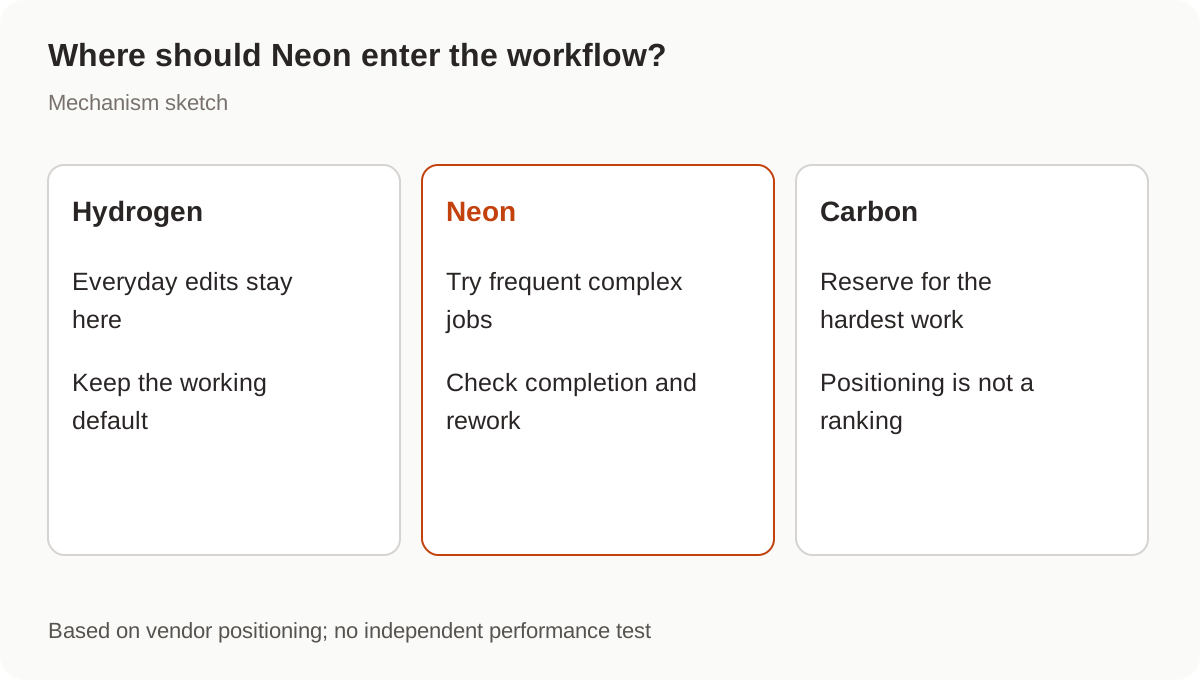
Start with work that looks manageable per request but takes several rounds to finish: repository changes, analysis across multiple attachments, or deliverables that depend on a chain of tool results. Google emphasizes end-to-end completion and fewer redundant actions. Those are vendor claims to test against your own work.
| Work | First model to consider | Reason |
|---|---|---|
| Everyday coding and small edits | Hydrogen | Preserve a working default |
| Frequent multi-file changes and document analysis | Neon | Matches its stated position |
| The hardest architecture, science, and security problems | Carbon | Remains Google's recommendation for the most difficult work |
These are starting points, not measured rankings. Existing applications can review Hydrogen migration changes and the separate Carbon pricing and task allocation discussion.
Pick a real task without confidential material. Before running it, define the files to change, required checks, and final deliverable. Count tool calls, retries, waiting, and manual corrections. A polished final paragraph is weak evidence if the rest of the job remains unfinished. The fixed-task comparison method provides a useful starting point.
What does the official API price tell you?
As checked on November 19, Google's price is $3 per million input tokens and $15 per million output tokens, including thinking tokens. Neon is available on the paid API tier. Access through Google AI Studio plans and API billing are separate arrangements.
Unit prices do not establish the price of a finished job. A cheaper request can become expensive when it requires repeated correction. Whether Neon reduces those rounds remains untested here. Compare the total spend across all calls required to meet the same acceptance conditions.
These are Google's prices, not Nbility prices or confirmation that gemini-4-neon is available through Nbility.
What changes when you replace the model ID?
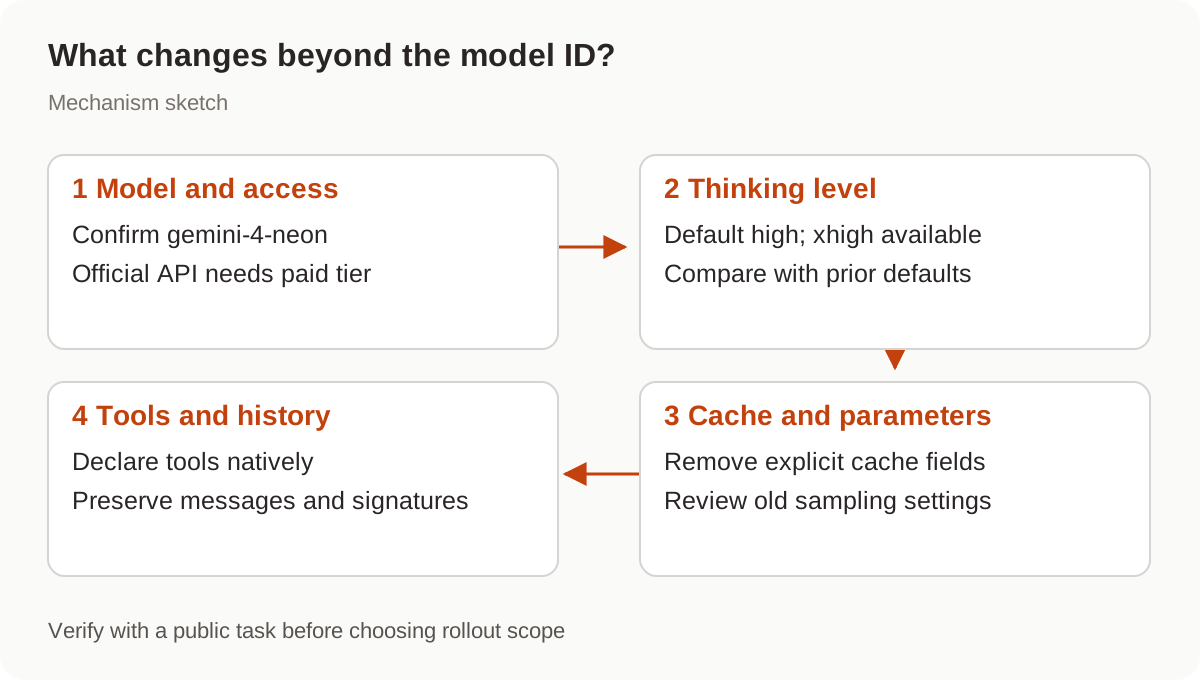
Google says other Gemini 4 applications can retain their request schema, but defaults differ. Neon supports low, medium, high, and xhigh, with high as the default. Carbon and Argon default to medium and top out at high. An application that omits thinking_level changes behavior when it changes the model ID.
For migration from Gemini 3 or earlier, also review:
- Explicit caching: Neon does not support
cachedContentsorcaches.create. Removecached_content. Implicit caching is supported, but support does not guarantee a hit on each request. - Sampling fields: Remove
temperature,top_p, andtop_k. In-range custom values are ignored; out-of-range values return 400. - Tools and history: Declare tools natively. Do not ask for invented raw-text tool JSON. When managing
generateContenthistory yourself, preserve model messages and thought signatures unchanged; do not copy signatures between calls.
This follows the official Interactions API shape and selects high explicitly. It has not been executed here. Set GEMINI_API_KEY locally rather than writing a credential into a file you will share.
curl "https://generativelanguage.googleapis.com/v1beta/interactions" \
  -H "x-goog-api-key: $GEMINI_API_KEY" \
  -H 'Content-Type: application/json' \
  -d '{
    "model": "gemini-4-neon",
    "input": "Plan a multi-file refactor for a public demo project and give acceptance conditions for each step.",
    "generation_config": {"thinking_level": "high"}
  }'
A successful text response verifies this request path. Tool execution, multi-turn continuation, and attachments still need their own checks.
Does a million-token window mean a million-token synchronous answer?
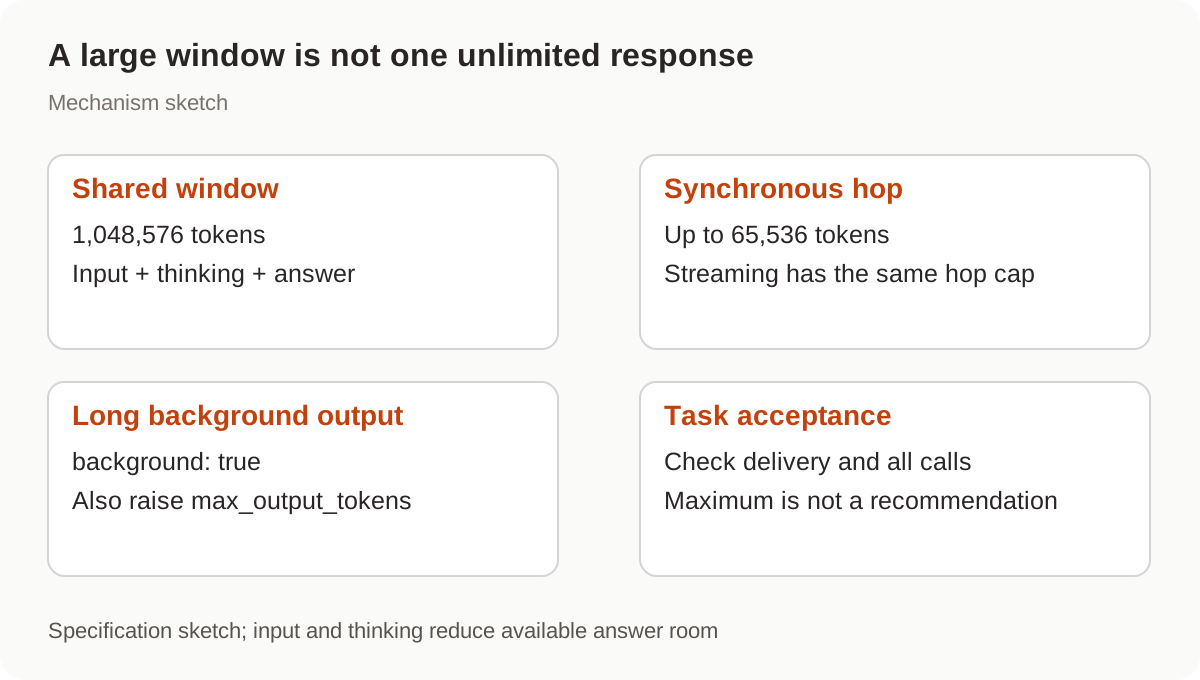
The 1,048,576-token window is shared by input, thinking, and output. Default synchronous output is capped at 65,536 tokens, including for streaming calls. Longer output uses background execution or client continuation; raising a number alone does not create an unlimited synchronous response.
Google's guide requires both background: true and a larger max_output_tokens for background output beyond 64K. Enabling background without changing that limit still stops at 65,536. The output budget also includes thinking. The same shared-window principle is explained in the Argon context discussion.
A short refactoring plan does not need a million-token allowance. Define the work, inspect completeness, and increase limits only when the task requires it.
What should decide a rollout?
Run the current model and Neon with explicit thinking settings and equivalent tool permissions. Compare complete deliverables, redundant reads, manual repair, and total elapsed time and cost. If improvement appears only for one class of work, route that class to Neon. See multi-model routing for the broader approach.
For Nbility, check the Gemini native compatibility documentation and your accessible model list. Documented generateContent support does not establish support for Google Interactions, background continuation, or official cache resources. Those paths have not been tested through Nbility for this article.