Migrating Mistral Large 4 reasoning effort
Mistral Large 4 accepts low, medium, and high effort, defaulting to high. Replacing none also requires checking thinking chunks, streaming, and message replay.
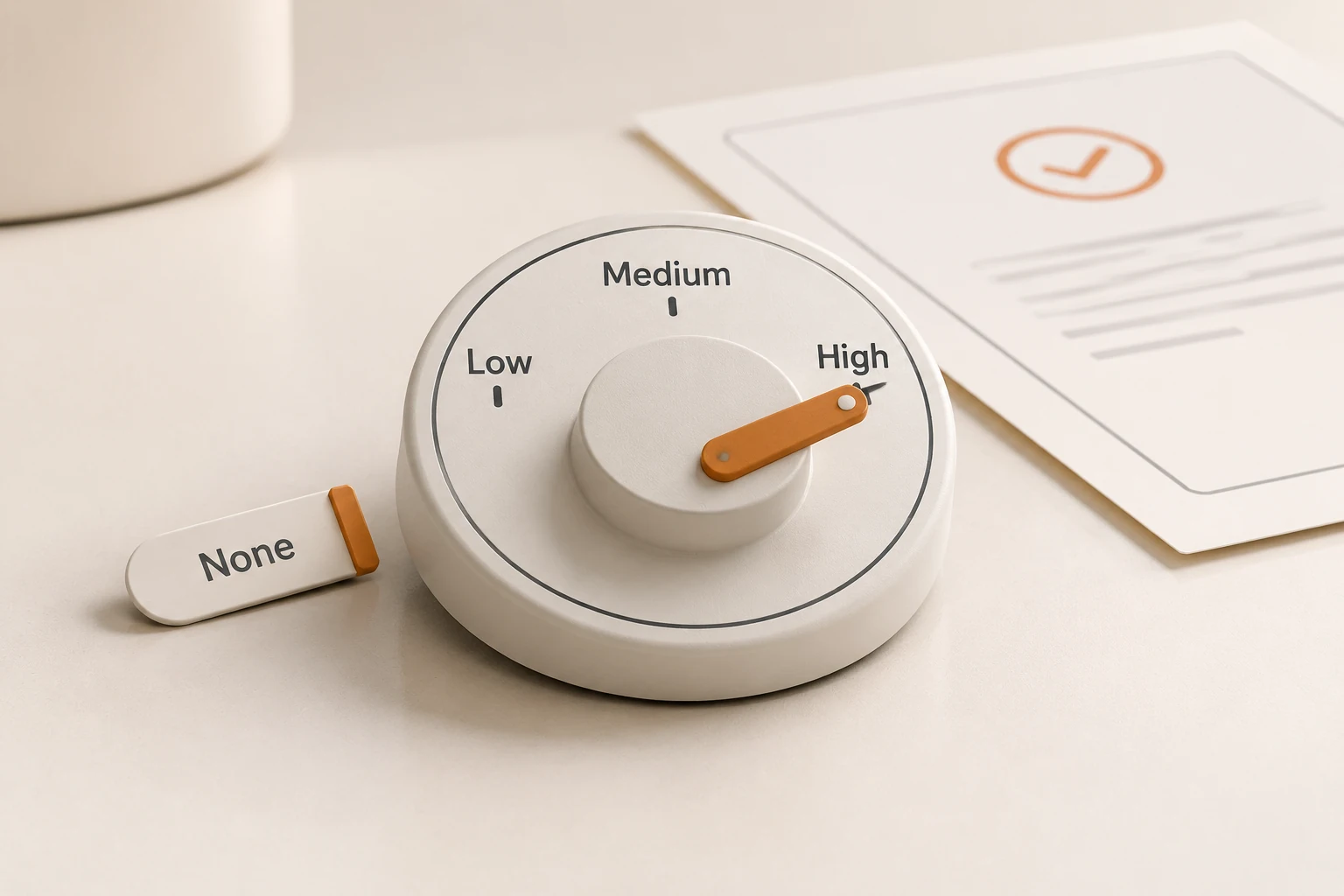
Mistral Large 4 accepts low, medium, and high for reasoning_effort; the former none value returns 400. Omitting the field defaults to high. Use low for the least reasoning, but expect thinking content and reasoning tokens to remain. Another model's effort settings are not a safe drop-in configuration.
We rechecked the Mistral changelog and reasoning guide on November 18, 2026. The changelog dates this parameter change to October 29; it is not a new announcement today. No Mistral API calls were made and no latency or quality comparisons were measured.
Why can an SDK enum contain a value the model rejects?
SDK enums cover several models. Their combined set of values is not a per-model capability table. Current Mistral documentation distinguishes these groups:
| Model on the documented platform | Effort values | Common mistake |
|---|---|---|
mistral-large-4 / mistral-large-4-0 | low, medium, high | none, minimal, xhigh, and max are unsupported |
mistral-small-2603, mistral-medium-3-5 | The guide documents none and high | Extending that pair to Large 4 |
Mistral-hosted zai-glm-5-3, zai-glm-5-3-flash | low, high, max | Treating max as a Large 4 alias |
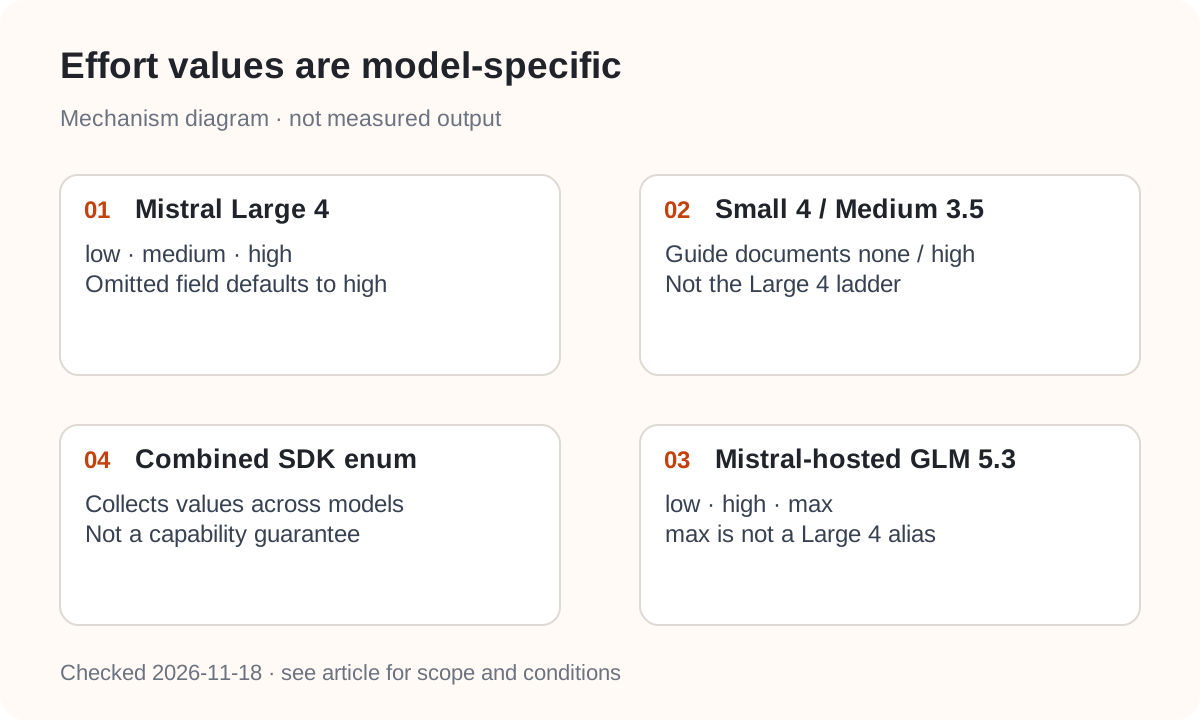
These are Mistral platform semantics. A self-hosted engine, another host, or a gateway may map parameters differently. A matching model name does not establish identical behavior; see model listings versus capabilities.
What replaces Preview's none setting?
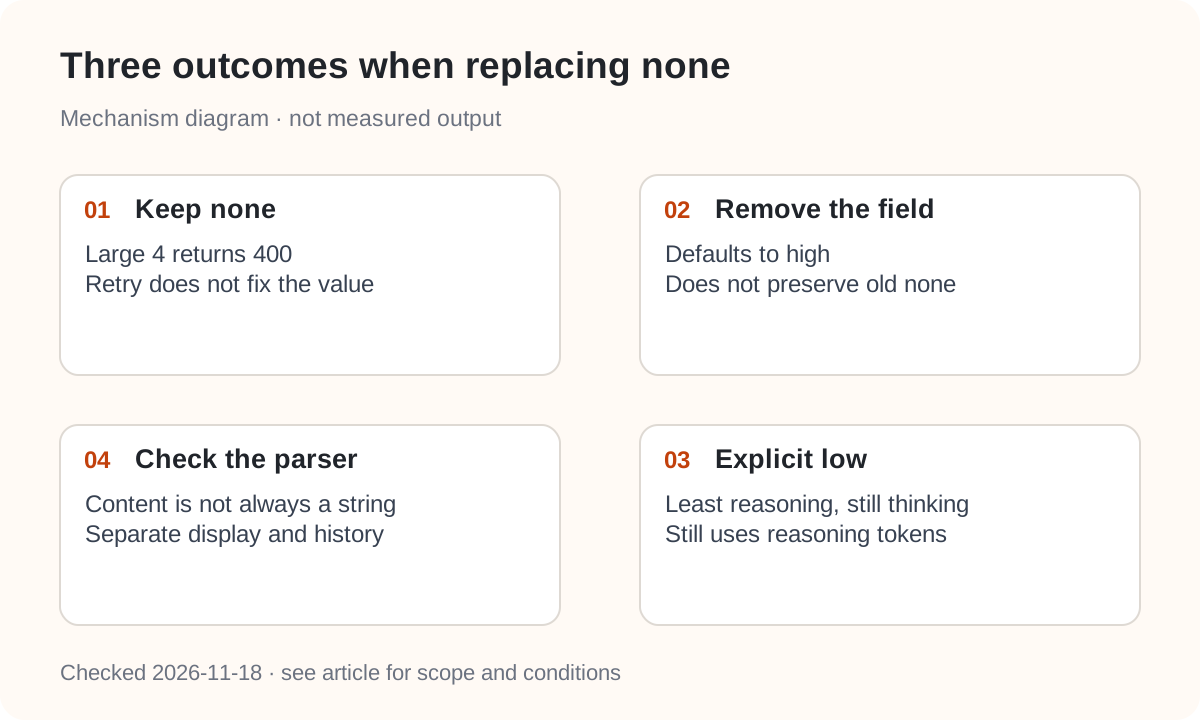
First identify the intent behind "reasoning_effort": "none". Use low to minimize reasoning. Use explicit high if following the documented starting point for complex work. Removing the field selects default high, rather than retaining the previous none behavior.
- "reasoning_effort": "none"
+ "reasoning_effort": "low"
low still uses reasoning tokens and returns a thinking chunk. The guide warns to expect more output tokens and latency than the old none mode, without establishing a universal increase. A UI should not label this setting “reasoning off.”
This minimal request targets Mistral's official Chat Completions endpoint and was not executed for the article:
curl --fail-with-body https://api.mistral.ai/v1/chat/completions \
  -H "Authorization: Bearer $MISTRAL_API_KEY" \
  -H "Content-Type: application/json" \
  -d '{
    "model": "mistral-large-4-0",
    "messages": [{"role": "user", "content": "Calculate 17 * 23."}],
    "reasoning_effort": "low"
  }'
If a client only offers an on/off switch, inspect the outgoing value before changing the model configuration. Relabeling a switch does not stop it from sending none. OpenCode users can consult version-specific effort and Variant configuration.
Can content still be treated as a string?
Not universally. The reasoning guide describes thinking-enabled content as chunks: final-answer text appears in type: "text", while reasoning appears in type: "thinking". Rendering an answer and retaining conversation state are different jobs.
This Python fragment extracts display text from an already-decoded, non-streaming official response dictionary. It is not a cross-provider parser and omits errors, tool calls, and empty-choice handling:
message = response_body["choices"][0]["message"]
content = message.get("content")

if isinstance(content, str):
    answer = content
else:
    answer = "".join(
        block.get("text", "")
        for block in (content or [])
        if block.get("type") == "text"
    )

print(answer)
# Save the full message for later turns, not only answer.
The fragment was checked locally with synthetic string and mixed thinking/text dictionaries, not the official SDK. The guide instructs applications to replay the complete assistant message, including thinking, in multi-turn conversations. Extract text for display without replacing the stored message with that text. Cross-model moves need separate compatibility checks.
Streaming adds another variation: the documented delta.content is a chunk list during thinking, may contain both thinking and text at the transition, and may become a string during the answer phase. A single early type check cannot determine the shape of the entire stream. Our empty-content guide covers related rendering failures.
What should migration checks establish?
Start with a short, harmless task whose result is independently checkable, then test representative work. A single arithmetic answer is not a quality ranking.
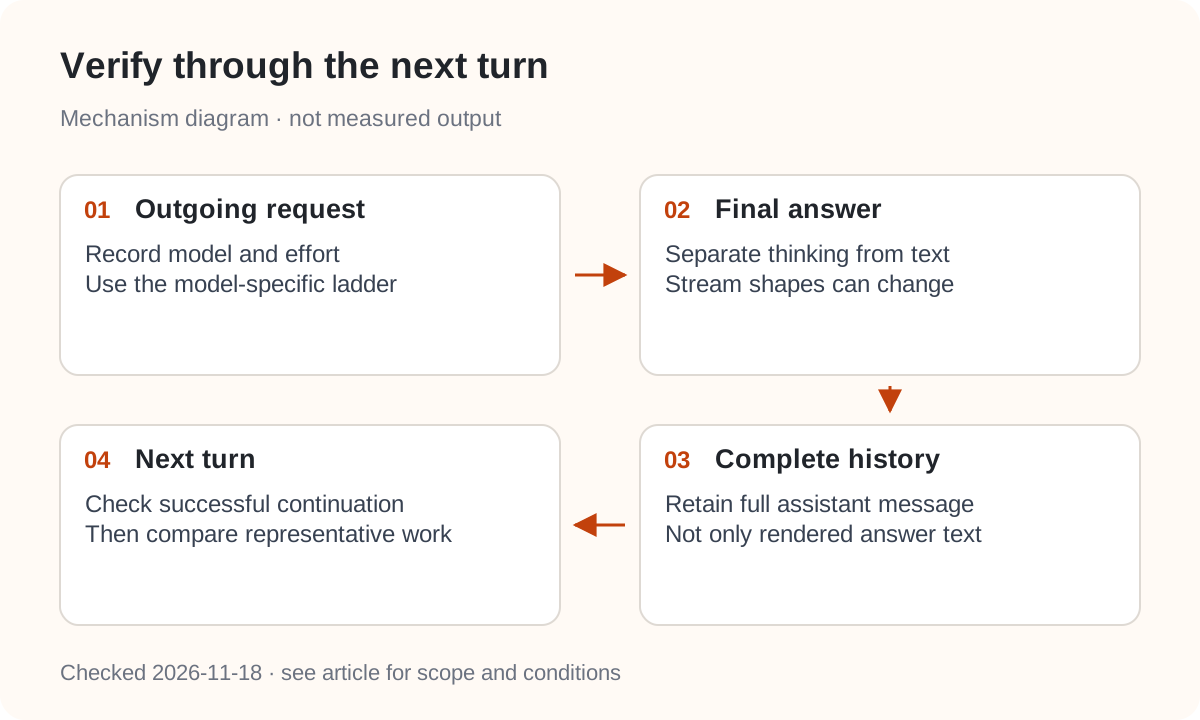
Record the actual outgoing model and effort, non-streaming final text, complete streamed answer, and successful continuation with full messages preserved. Only then compare low, medium, and high on the same materials, recording completion, waiting time, and usage. Without those observations, report neither savings nor a universally best setting. See controlled task comparison.
For Nbility, confirm how the selected channel maps requests and responses; equivalence with direct Mistral calls was not tested. Our Le Chonk deployment guide explains why weights, serving engines, and hosted interfaces need separate checks. Fix the invalid parameter first, then verify parsing and history instead of retrying a deterministic 400.